








Although Tanzanian coffee is not as renowned as its neighbor Kenya, it has earned the reputation of "coffee gentleman" with its mellow body and soft acidity, and the Kilimanjaro region is a representative of specialty African beans. This article systematically reviews the historical origins and grading system of Tanzanian coffee, explains in detail the specific size classification standards of AA, AB, PB, and C grades, and, using cupping and pour-over experience as an entry point, presents the complete quality control process of Front Street Kilimanjaro AA washed beans from baking curve confirmation to flavor realization, helping you understand the causes of citrus berry notes and honey tea-like sweet aftertaste, and evaluate the price positioning and purchasing logic of different grades.

Have you ever tasted Tanzanian coffee? If you haven't tried it yet, Front Street Kilimanjaro is worth picking up. This bean carries the representative flavor of specialty African coffee: after extraction by pour-over, the fruit acidity is clearly discernible, yet it is not as sharp and intense as Kenya's; overall it is closer to citrus and berry notes, with intertwined sweetness and acidity and full layers, making it an African coffee whose regional character you can taste.
Whenever a new bean arrives, Front Street Coffee goes through this fixed process. The roasting stage not only tests the roaster's grasp of regional characteristics, but also requires cupping and pour-over and other tasting methods to verify whether the set roasting curve is truly suitable. For this reason, Front Street Coffee often has the same bean undergo multiple rounds of evaluation. Although time-consuming, it is a necessary step recognized by Front Street Coffee—coffee beans that have not been repeatedly tested and confirmed will not be hastily put on the shelves by Front Street Coffee.
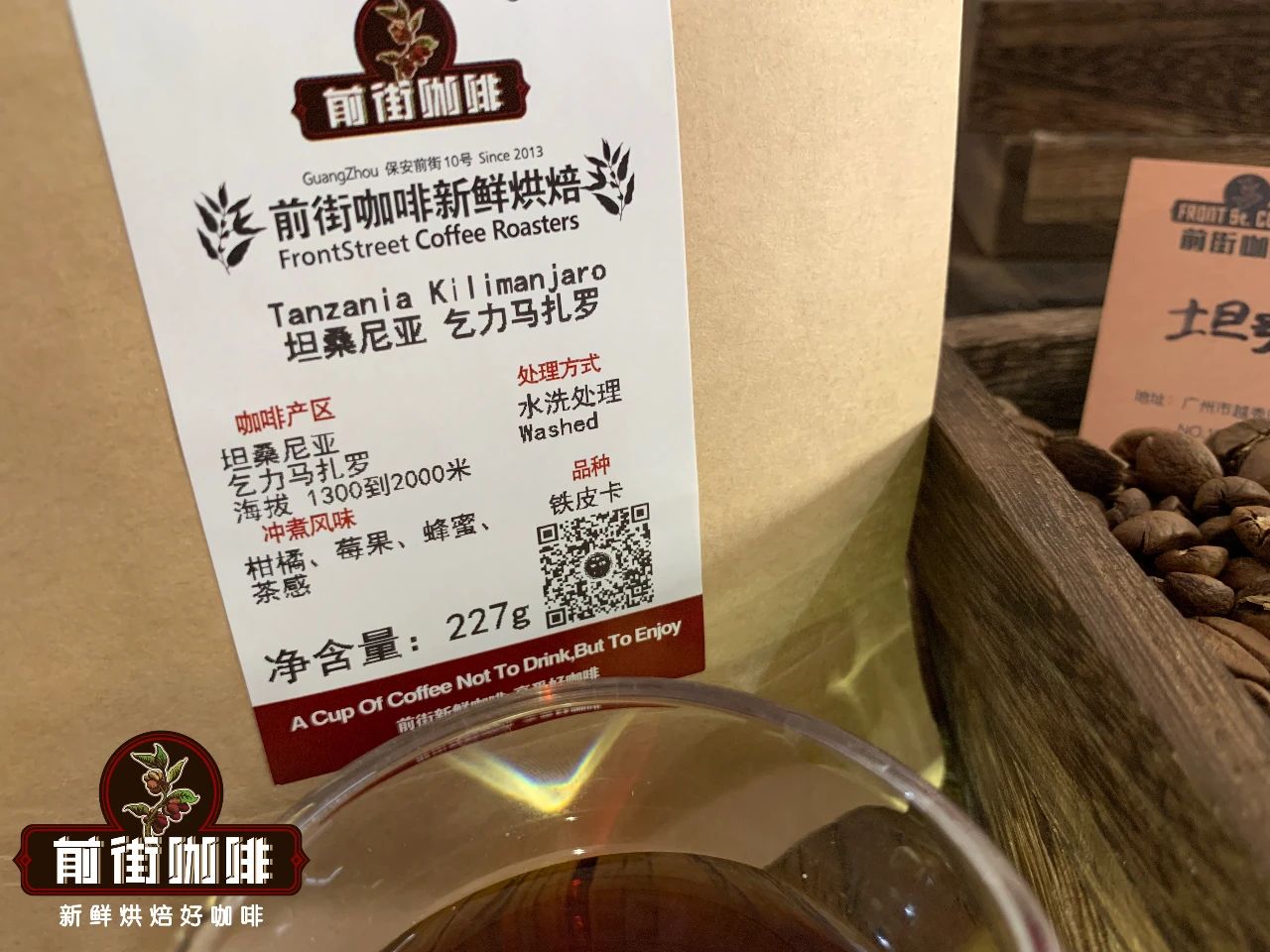
Front Street Tanzania Kilimanjaro Coffee
Region: Northern Highlands, Kilimanjaro volcanic area
Variety: Bourbon
Processing method: Washed
Grade: AA
Altitude: 1300-2000m
Tanzania
In Tanzania, coffee is called kahawa. This is a typical East African country, bordered by Kenya and Uganda to the north, Malawi, Mozambique, and Zambia to the south, and Rwanda and Burundi to the west. The country also has a long history of coffee cultivation, with a planted area of about 250,000 hectares.
When it comes to Tanzanian coffee, industry insiders often first think of Kilimanjaro. Indeed, this place gives rise to a distinctive "Kilimanjaro flavor"—mellow body, moderate acidity, and rich aroma, thus earning the reputation of "coffee gentleman."
Compared with Kenya, the neighbor of Front Street Tanzanian coffee, the bright acidity of Tanzanian beans is somewhat restrained, replaced by a softer and gentler posture, with more prominent sweet aroma, and a deep red-wine-like richness is also one of its hallmarks.
Although its fame is not as loud as Kenyan beans, Tanzania's annual output is roughly comparable to Kenya's, reaching about 50,000 tons. The earliest Arabica seeds were introduced from Reunion Island and were initially planted in Bayamoyo and Mogoro. In 1893, planting on the slopes of Kilimanjaro achieved the greatest success; in the 1950s, other varieties were successively introduced from neighboring Burundi and planted in western Tanzania. At present, the main planting areas are concentrated in high-altitude zones, accounting for 75%, but wild coffee trees are still constantly being discovered.
Tanzania's grading method is the same as Kenya's, both based on coffee bean size. During screening, green beans are passed through screens with fixed aperture sizes. The larger the screen number, the coarser the green bean particles.
AA grade: Screen Size between 17 and 18 mesh (7.20mm screen)
AB grade: Screen Size between 15 and 16 mesh (6.8mm~6.2mm screen)
PB grade: round green beans, accounting for about 10% of all coffee beans
C grade: Screen Size between 12 and 14 mesh (4.8mm~5.6mm screen)
Front Street Kilimanjaro coffee belongs to Tanzania's highest grade, AA, and adopts washed processing and medium-light roasting. After brewing, berry aroma emerges, and the entry has citrus acidity, soft and refreshing; the middle turns into honey-like sweetness, and the finish presents tea-like notes with a sweet aftertaste.
The above content is compiled by CoffeeHunters, a coffee news website.


