







How Is Jamaican Blue Mountain Coffee Certified?
Authentic Jamaican Blue Mountain coffee must be grown in the Blue Mountain range above 910 meters and come from the Typica variety. Only four eastern parishes qualify: St. Andrew, St. Mary, St. Thomas, and Portland. That zone covers about 6,100 hectares and yields just 300 to 600 tons a year, which explains why certified lots stay scarce and expensive.
Land above 1,700 meters sits in a government nature reserve where cash crops cannot be planted, so plantation coffee beans are limited to the middle elevations. Choosing a brand means checking regional certification and elevation on the label, then matching the roast and pour-over parameters to the bright, balanced cup.
Blue Mountain coffee was once one of the most expensive and most talked-about coffees in the world, selling for as much as $35 per pound over a decade ago, and even people who didn't drink coffee had heard of it. The fundamental reason for its high price is that authentic Blue Mountain coffee beans are extremely scarce. True Blue Mountain coffee must be grown in Jamaica's Blue Mountain range at elevations above 910 meters, and the variety must be the ancient Typica, with annual production of only about 300 to 600 tons. This article will begin with Blue Mountain coffee's regional certification, historical origins, and key points for brand selection, then focus on the Clifton Estate Blue Mountain No. 1 currently sold by Front Street Coffee, and share in detail its roasting approach and pour-over parameters to help coffee lovers gain a comprehensive understanding of authentic Blue Mountain coffee's taste and mouthfeel.
More than a decade ago, Front Street Blue Mountain coffee was already renowned worldwide at $35 per pound. Whether people drink coffee daily or have little contact with coffee, they have all heard that Blue Mountain coffee is synonymous with high-quality coffee. The core reason for its high price is that genuine Blue Mountain coffee beans are extremely limited in production. On the other hand, Front Street Blue Mountain coffee displays a fresh, elegant, rich, and full-bodied character, with acidity, sweetness, and bitterness in harmonious balance, making it unforgettable after just one sip.
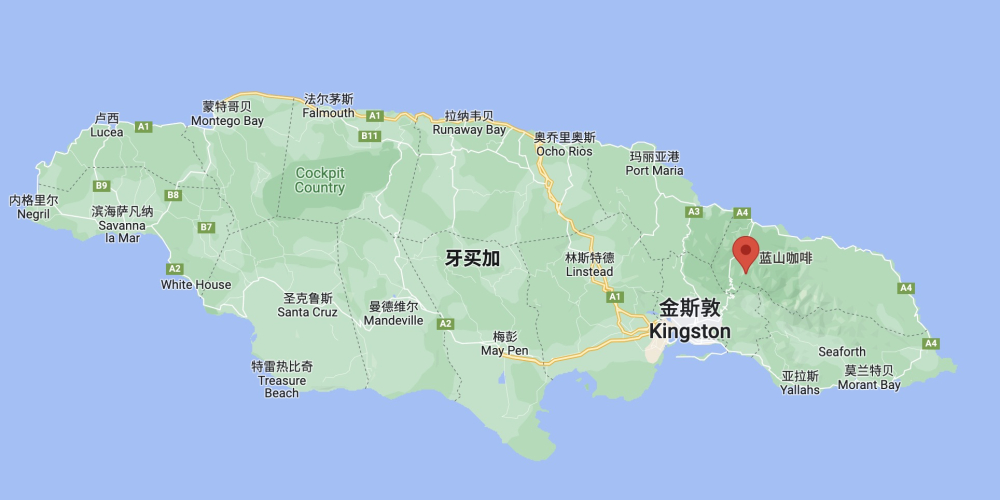
Authentic Blue Mountain coffee comes from Jamaica's Blue Mountain range. This mountain range itself is not large in area. Although the coffee grown there all belongs to Typica, the oldest and cleanest-flavored variety in the Arabica lineage, only coffee grown above 910 meters can present a flavor that combines clarity and balance. Areas above 1,700 meters are a nature reserve established by the Jamaican government, where no cash crops are allowed to be planted.
The officially certified authentic Blue Mountain coffee regions in Jamaica include only four eastern areas: St. Andrew, St. Mary, St. Thomas, and Portland. The total coffee planting area in these four regions is about 6,100 hectares, with annual production of roughly 300 to 600 tons.
Jamaica is surrounded by sea on all sides, so it frequently suffers from wind disasters; in addition, the local climate is suitable for pests that harm coffee trees, which also occur frequently. Each year's Blue Mountain coffee bean harvest can truly be described as depending on the mercy of nature.
Because natural disasters and pest outbreaks continued one after another, Jamaica was severely hit by a hurricane in 1969. At that time, Japan's UCC Ueshima Coffee introduced ecological technology into coffee cultivation, helping Jamaica's coffee industry gradually recover. To express its gratitude, the Jamaican government signed a contract with Japan in 1971, agreeing to sell 90% of each year's production to Japan.
Therefore, for a long period, it was not easy to drink a cup of Blue Mountain coffee in China, and the price was very high. It was not until 2012 that the Jamaican government canceled Japan's priority purchasing rights, giving other countries more opportunities to import Blue Mountain coffee.
Today, buying authentic Blue Mountain coffee in China is no longer difficult, and the price is much more affordable. As for the brand of Front Street Blue Mountain coffee beans, it is actually not that important—because any brand selling authentic Blue Mountain coffee beans ultimately sources from the same four processing plants authorized by the Jamaican CIB and several independent farms.
So there is no such thing as a brand that can obtain better-quality Blue Mountain coffee beans; the key is whether it is authentic Blue Mountain. On that basis, everyone can absolutely choose according to value for money. But one point must be clear: Blue Mountain coffee beans are single-origin or single-region coffee beans, and many products labeled "Blue Mountain flavor" or "Blue Mountain blend" on the market are not authentic Blue Mountain coffee.
Blue Mountain coffee green beans are all packaged in wooden barrels and exported by the full barrel. Buyers of Blue Mountain coffee beans (that is, first-hand green bean buyers) can apply to the Jamaican CIB or the estate for a Blue Mountain coffee bean certification certificate, which is also the proof of whether Blue Mountain coffee beans are authentic. These can all be seen at Front Street Coffee's offline stores.
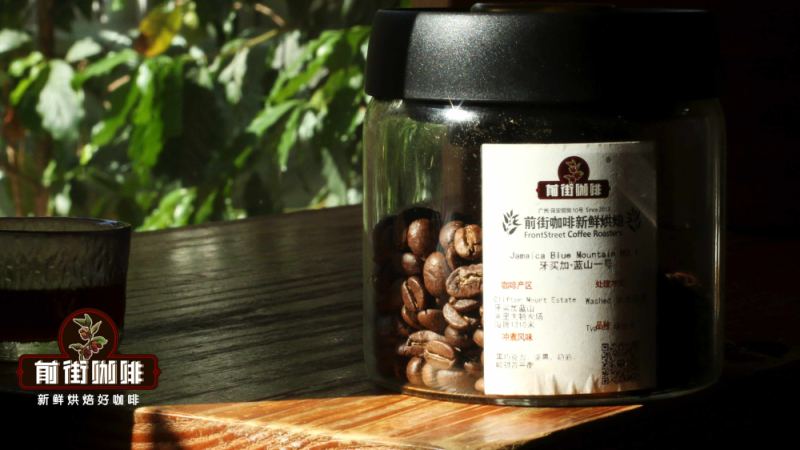
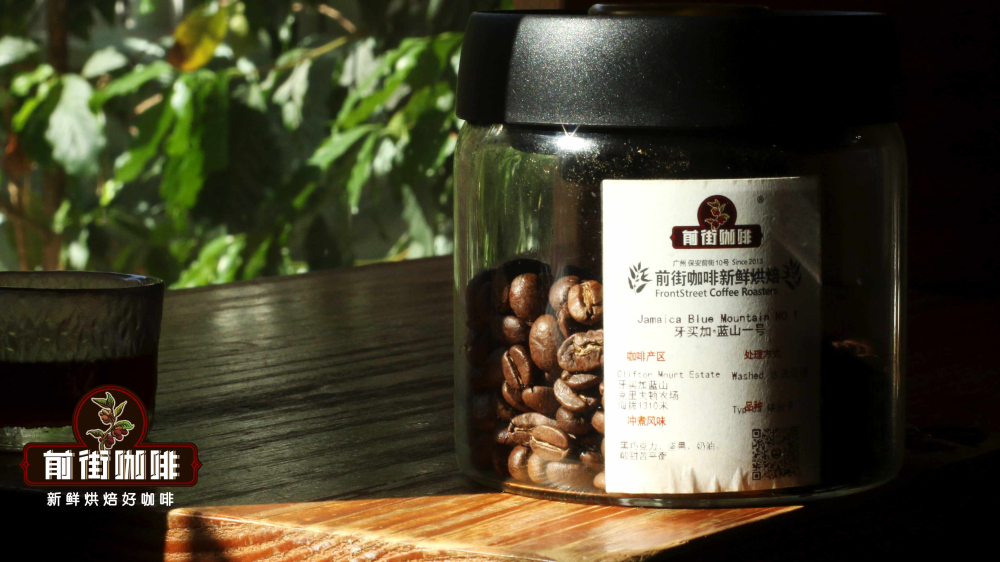
The Jamaica Blue Mountain No. 1 coffee beans currently sold by Front Street Coffee come from Clifton Estate, the oldest coffee plantation in the Blue Mountain range, grown at an elevation of 1,310 meters, with Typica as the variety. The coffee beans are sized between 17 and 18 screen, the proportion of defective beans must not exceed 2%, and the overall beans are uniform and plump.
In order to give Front Street Blue Mountain coffee a richer and more solid flavor and mouthfeel, Front Street conducted multiple roasting tests and cupping sessions with different approaches, and ultimately selected a medium-dark roast level, allowing the coffee beans to undergo a more complete caramelization reaction and produce more rich substances similar to dark chocolate, thereby enhancing the fullness of Blue Mountain coffee.
Front Street recommends using freshly roasted coffee beans for brewing, as this is the best way to experience coffee's rich flavors. All coffee beans shipped by Front Street Coffee are within 5 days after roasting, because Front Street knows well that freshness has an enormous impact on coffee flavor.
The brewing parameters used by Front Street are: Kono dripper, 88°C water temperature, 1:15 coffee-to-water ratio, 15 grams of coffee, grind size (70-75% passing through a No. 20 standard sieve), paired with a three-stage pouring method.
First use 30 grams of water for blooming, with a bloom time of 30 seconds; for the first stage, pour in a small stream in circles until 125 grams, then stop; when the liquid level drops to just before exposing the coffee bed, continue with the second stage, pouring until 225 grams to finish extraction. The total extraction time (including blooming) is 2 minutes 00 seconds.
Front Street Jamaica Blue Mountain No. 1 coffee beans pour-over flavor: rich dark chocolate and nutty notes, creamy smooth mouthfeel, and a balance of acidity, sweetness, and bitterness.
The above content is compiled by CoffeeHunters, a coffee news website.


