







How Does Coffee Blending Shape the Taste of an Americano?
Coffee blending means combining single-origin beans in set proportions so their strengths cover each other's gaps. A smooth but low-aroma bean can be paired with an aromatic one, producing a more balanced and layered cup. Blends can be mixed as green beans before roasting or combined after separate roasts, depending on each component.
With an American coffee machine, a Colombian and Brazilian blend gives chocolate and nutty notes that hold up when diluted with hot water. Front Street lists three espresso recipes, Specialty, Commercial, and Dark Cocoa, plus the differences between lattes, cappuccinos, flat whites, and affogato, and the key points for pouring a clean Americano.
To make a delicious Americano with an American coffee machine, the choice of blended beans and the approach to combining them are crucial. This article starts with the definition of coffee blending and the two methods of raw blending and roasted blending, sorts out the goals, principles, and steps of blending, explains the purposes of blending such as stabilizing flavor and balancing taste, and introduces the characteristics and limitations of single-origin SOE. It then gives three Front Street espresso blend recipes: Specialty Blend (Colombia Huila + Brazil Cerrado), Commercial Blend (Colombia + Brazil + Robusta), and Dark Cocoa Blend (Yunnan AA + Brazil), along with the distinctions and methods for lattes, cappuccinos, flat whites, affogato, and other fancy coffees, as well as the key points for making Americano black coffee.
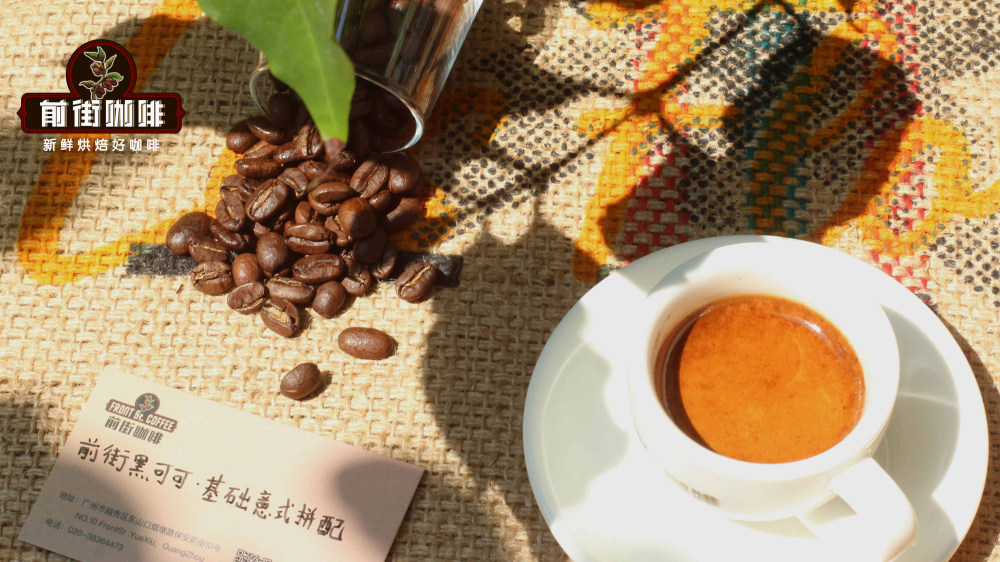
Blended coffee, also called mixed coffee, is made by combining multiple single-origin coffee beans in a certain proportion so that the strengths of each bean can be brought into play. Blended beans come from different origins, and the goal is usually to obtain a more balanced flavor. For example, if one bean is smooth in body but lacks aroma, you can add a bean with a prominent aroma so that their strengths and weaknesses complement each other, either forming a complementary relationship in taste or reinforcing one another, ultimately creating a new flavor with richer layers. According to the different timing of mixing, blending is further divided into two types: mixing green beans first and then roasting is called raw blending; roasting separately first and then mixing is called roasted blending.
Whether pre-mixing green beans or combining them after roasting separately, it all depends on the characteristics of each coffee in the recipe. Neither method is inherently wrong. The advantage of roasted blending is that the roast level can be set individually for each bean, allowing each component to reach its ideal state.
Before starting to blend beans, you first need to understand the flavor differences among coffee varieties around the world; beans have their own characteristics depending on origin. Because coffee beans differ in variety and origin, their personalities differ as well, with subtle distinctions in acidity, bitterness, sweetness, aroma, body, and so on. Single-origin coffee beans often emphasize the unique style of a certain type of coffee. Blended beans are mostly used for espresso, Americano, latte, cappuccino, and other espresso-based coffees; the taste is more balanced, smoother, and more stable, which can be said to be more popular in appeal.
General steps and principles of blending
Before blending, we should be clear about the following points:
1. The theme of the blend. What kind of taste you hope to blend, that is, determining the goal of the blend.
2. Understand the characteristics of each coffee bean. To blend coffee, you must first be thoroughly familiar with the characteristics of each single-origin coffee and understand the subtle relationship between roast level and coffee flavor, and all of this can only be achieved through cupping.
3. Determine the role each coffee bean participating in the blend should play.
Since multiple coffee beans are used in the blend, you must be clear about the role of each coffee bean: whether it is to highlight a mild bitterness, a bright acidity, or a heavy body, and so on.
Mixing different coffee beans is mainly done for the following purposes:
1. Stable flavor
Because coffee beans are an agricultural product, even the same kind of coffee bean will have a different flavor from year to year. So mixing several coffee beans together solves this problem very well and can keep the taste basically consistent every year.
Green bean processing method: that is, whether the green beans are processed by the washed method or the dry method. The processing method has a great relationship with coffee bean flavor.
Green bean origin: Coffee origins are generally divided into three major regions, including Central and South America, namely about 20 countries such as Brazil, Colombia, Guatemala, Mexico, El Salvador, Jamaica, and Peru; Southeast Asia, namely about 10 countries such as India, Indonesia (including islands such as Java and Sumatra), and Papua New Guinea; and the Arabia and Africa region, namely about 25 countries such as Ethiopia, Kenya, Tanzania, Arabia, and Uganda.
2. Balanced taste
Because one characteristic of an espresso machine is that it amplifies the most prominent flavor characteristic of the coffee beans, we almost never use a single variety of coffee to make espresso. Otherwise, if that coffee bean is relatively bitter, the espresso made will be extremely bitter, and if it is more acidic, it will be very sour. So we need to balance various tastes through blending.
Blending coffee is by no means simple addition. Rather, it is hoped that through the blender's unique understanding of coffee flavor, different coffee beans can make up for each other's shortcomings and create blended coffee beans with excellent flavor.
3. Stable flavor:
Because coffee beans are an agricultural product, even coffee beans of the same kind and from the same origin will have a different flavor from year to year. So mixing several coffee beans together solves this problem very well and can keep the flavor basically consistent every year.
The formation of the single-origin SOE trend:
SOE has become popular recently. SOE stands for single-origin espresso. Although it is not necessarily equivalent to specialty coffee, if you choose single-origin coffee beans with easily recognizable flavors as SOE, you can create espresso with a unique and typical flavor. For example, Yirgacheffe's typical citrus flavor, Kenya's fruity flavor, and so on. In addition, because espresso amplifies the coffee's taste, the specific flavor will be more prominent than in pour-over. However, although SOE performs prominently, because it comes from a single origin, its shortcomings are also relatively easy to amplify, so factors such as roasting and grind size will all affect the flavor. Therefore, it is not necessarily better to drink than blended coffee.
So, how do we blend?
(1) Front Street Espresso Blend No. 2 Recipe: Front Street Specialty Blend
Colombia: Brazil
Colombia Huila region
Located in southwestern Colombia, it is one of the main coffee-growing regions. Colombia generally has an altitude of 1,500–1,800 meters, mostly Bourbon and Caturra varieties, washed processing method, relatively high density, uniform bean size, and full bean shape (the distance from the center to the surface of the bean is relatively thick). Because the Huila region is dotted with famous coffee-growing areas, the names of various small areas have become brand names and circulate in the market. Although the cultivation conditions in this region are also very good, the cultivation infrastructure of coffee farms and surrounding conditions is still not very developed. The green bean drying equipment or washed processing facilities are not yet complete, which is a very regrettable point. Coffee from the Huila region has a strong taste and a relatively heavy body.
In particular, the nutty, chocolate, and caramel aromas and suitable acidity of coffee from the Huila region can be called high-grade specialty coffee. And caramel and other aromas and suitable acidity can be called high-grade specialty coffee.
Front Street Huila Coffee Flavor characteristics : Rich and solid in taste, with a pleasant acidity, aromatic and mellow, moderate acidity, and rich sweetness that is very thought-provoking. Because it is cheap and the beans are small, it is suitable for blending mixed coffee. The coffee has a strong taste and a relatively heavy body. Its nutty, chocolate, and caramel aromas and suitable acidity can be called high-grade specialty coffee, suitable for single-origin use or as an espresso blend base.
Brazil Cerrado region
Brazilian coffee generally grows at an altitude of 1,000–1,300 meters, so its density is relatively low. Mostly Bourbon varieties, using semi-washed processing. The moisture content is moderate, the bean texture is relatively soft, and the thickness from the bean surface to the center is relatively thin, so it is not suitable for roasting at too high a temperature; the temperature of the inner wall of the roaster will scorch the bean surface, which will produce a burnt bitter taste;
At the same time, if you want to express the characteristics of nuts, milk chocolate, and better body, and use it as a blend base, we adopt the method of dropping the beans at medium heat, maintaining the heat until the dehydration stage, and making fine adjustments as the temperature rises after first crack begins, promoting a more complete caramelization reaction. When the temperature rises to near second crack, the beans can be discharged.
Flavor characteristics : Comfortable sweet-bitterness, extremely smooth on the palate; with a faint grassy aroma, light fragrance with slight bitterness; sweet and smooth, with a pleasant aftertaste;
Front Street Specialty Blend Espresso Flavor : Sweet and fragrant taste. Using a medium-dark roast, when making espresso, the taste will have a soft slight acidity, light sweetness, and a nutty sweetness in the finish. The overall feeling is not too stimulating, peaceful, and the crema is medium.
(2) Commercial Blend:
Colombia: Brazil: Robusta
[Robusta] Its beans have strong resistance to pests and diseases and high yield. It is usually not as acidic as Arabica beans and often carries a slight woody aroma. Its caffeine content is 2.2%, higher than Arabica beans' 1.2%, and its chlorogenic acid content is also higher. It is also quite bitter and is usually used in commercial beans, costing less than Arabica beans.
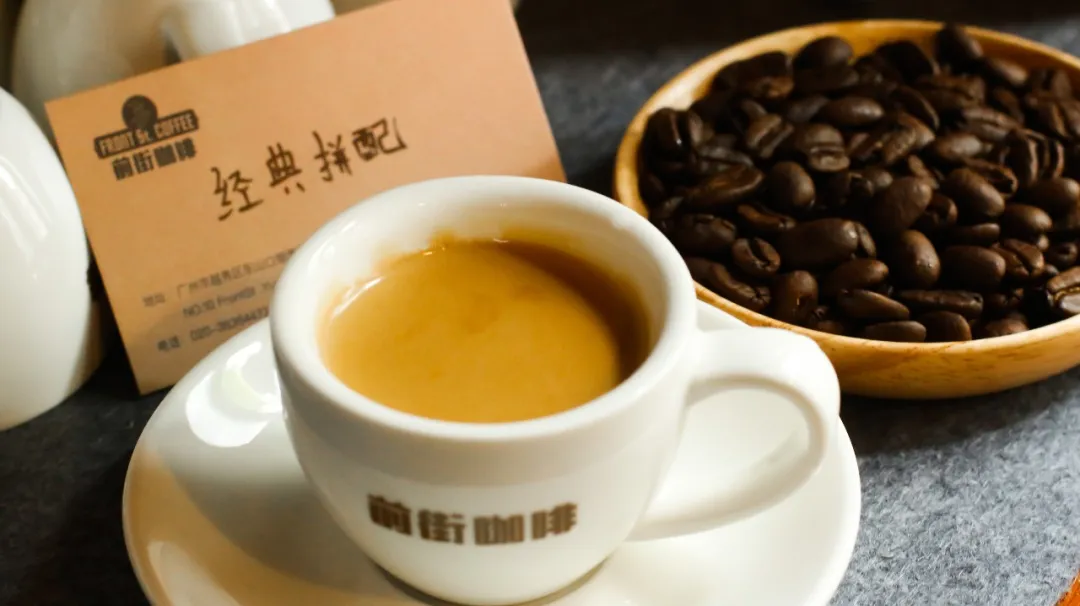
In terms of the flavor of a single bean, the coffee taste obtained from commercial beans is much inferior to that of specialty coffee beans. Generally, commercial beans are chosen for blending. Through blending, coffee with a very good taste can also be made, and it can be used to make lattes, cappuccinos, and other espresso coffees. And we use the commercial blend to make espresso. Because it contains Robusta beans, the crema will be richer, the taste is classic, with caramel sweetness, nutty and cocoa-like, dark chocolate flavors, balanced acidity and sweetness, a slight sweet-bitterness, and a lasting finish.
(3) The espresso moka pot coffee beans recommended by many baristas - Front Street Dark Cocoa Blend:
Yunnan AA: Brazil
Front Street Yunnan small bean is selected from the Catimor variety, which is the most commonly planted today. The Baoshan production area gives it the balanced and mild taste of Yunnan beans, with aromas of nuts, plum, chocolate, and brown sugar.
It needs more shade during cultivation and can only be harvested about once every two years. Yunnan's high-quality geographical and climatic conditions provide good conditions for coffee growth. The planting areas are in prefectures such as Lincang, Baoshan, Simao, Xishuangbanna, and Dehong. Yunnan's natural conditions are very similar to Colombia's: high altitude, large temperature difference between day and night, a mellow flavor profile, moderate acidity, rich and full-bodied taste, uniform beans, high oil content, and fruity aroma. Its quality and taste are similar to Colombian coffee.
Front Street Dark Cocoa Base Blend Flavor : With soft fruit acidity, caramel sweetness, nutty and dark chocolate flavors, smooth and syrupy, but the taste is on the lighter side.
When blending, there must be a distinction between primary and secondary components so that a more wonderful taste than single-origin coffee can be created. Before making a blending plan, first envision a more suitable combination method, then blend through appropriate roasting, and determine the best plan through cupping and later adjustments. I hope this helps everyone~
Finally, understand in one minute the differences between espresso, macchiato, latte, cappuccino, and Flat White
Fancy coffee Latte
In Italian it means "milk," so if you order a latte in Italy, you will only be served a cup of milk, not coffee; some cafes in China also have flavored lattes, such as matcha latte and purple sweet potato latte. Remember, they do not contain coffee.
Latte (one cup 200 ml): Single espresso 1 shot 30 ml + milk
Cappuccino (one cup 180 ml): Single espresso 1 shot 30 ml + thicker milk foam
Fancy coffee Affogato
In Italian it means "drowned." Pour espresso over a scoop of ice cream to drown it. It is not only visually appealing but also a very delicious coffee, deeply loved by women in summer.
Fancy coffee Flat White Flat White
Whether it was invented in Australia or New Zealand is still undecided. At first it was translated in China as "xiaobai," "pingbai," and "aobai." After being introduced to China by Starbucks, it was translated as "furuibai." Compared with an ordinary latte, its milk foam is thinner and more delicate and smooth, and the coffee taste is stronger.
When cappuccino enters the mouth, you will feel a thick layer of milk foam more than 1 cm thick, and the texture is relatively soft. Although Flat White also has some foam, it is relatively delicate, with a foam layer below 5 mm. The milk and espresso are highly integrated, and the texture is relatively silky.
Flat white (one cup 200 ml): The base is two shots of espresso, 60 g. In some places, on this basis, the espresso is extracted for a longer time, two shots of Ristretto (Ristretto: 1:1 Espresso)
Toffee Iced Latte Method: 1. Fill a glass five-tenths full with ice cubes, then add 10 g of toffee syrup. 2. Pour fresh milk + ice cubes into the glass until seven-tenths full, then stir evenly so that the syrup dissolves into the fresh milk to increase the specific gravity of the fresh milk. 3. Let the coffee slowly pour into the glass along the back of a spoon. The pouring speed must not be too fast, so as not to ruin the layered effect.
Americano black coffee: espresso + hot water
Taste characteristics:
The coffee taste extracted for Americano is mainly bitter, and this kind of black coffee has the highest purity. If you want to taste the flavors of different kinds of coffee beans, Americano is a very good choice.
Production method:
With an American coffee machine, making Americano is simpler than you might imagine: add water to the 1 mark, pour in 1 level scoop of coffee grounds, start it, and in about two minutes, a cup of fragrant Americano is ready.
Usually used: espresso blend beans, Mandheling, Honduras, Colombia, and Brazilian beans can all make delicious Americano.
The above content is compiled by CoffeeHunters, a coffee news website.


