







What Does the Arabica Definition Mean for Yunnan Coffee?
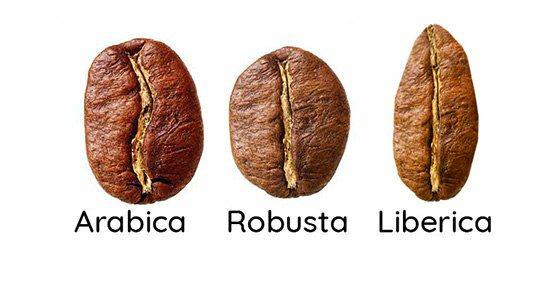
Small-bean coffee is simply Arabica. Before varieties were carefully classified, Arabica fruit was smaller than Robusta, the medium-bean type, and Liberica, the large-bean type, so it was called small-fruit coffee. Any Arabica grown in Yunnan therefore falls under Yunnan small-bean coffee, and its recent competition results have drawn more attention to Chinese production.
The better Yunnan growing belt sits at 1000 to 1500 meters in Lincang, Baoshan, Simao, Xishuangbanna, Dehong and Nujiang, where day-night temperature swings slow growth and build sugars and aromatics. Nestle once introduced Catimor there, while Typica and Bourbon have been trialed in Lincang. Brew for balance to bring out nutty, caramel and plum notes.
Yunnan small-bean coffee has frequently appeared in international competitions in recent years, and its flavor evaluations have also performed impressively. China's coffee industry is growing rapidly with the help of Yunnan. This article starts with the definition of the variety, sorts out the geographical advantages and historical context of Yunnan's main growing regions, reviews Nestle's past introduction of Catimor, and focuses on Front Street Coffee's experiment of growing Typica and Bourbon in Lincang, as well as the flavor differences among three Yunnan beans currently on sale. Finally, it includes Front Street's recommended brewing approach and specific parameters to help enthusiasts present Yunnan coffee's nutty, caramel, and plum notes in a more balanced way.
In recent years, Front Street Yunnan small-bean coffee has continued to gain attention. Whether in its performance on the international stage or in cupping flavor evaluations, it has delivered good results. Yunnan coffee has thus entered more people's field of view, and China's coffee industry is also accelerating forward with Yunnan's push.
What is small-bean coffee?
The most widely discussed in China is Yunnan small-bean coffee. So-called small-bean coffee actually refers to the Arabica variety. In an era when coffee varieties had not yet been carefully classified, Arabica had smaller fruit compared with Robusta (medium-bean variety) and Liberica (large-bean variety), so it was called small-fruit coffee or large-fruit coffee.
Yunnan coffee growing regions
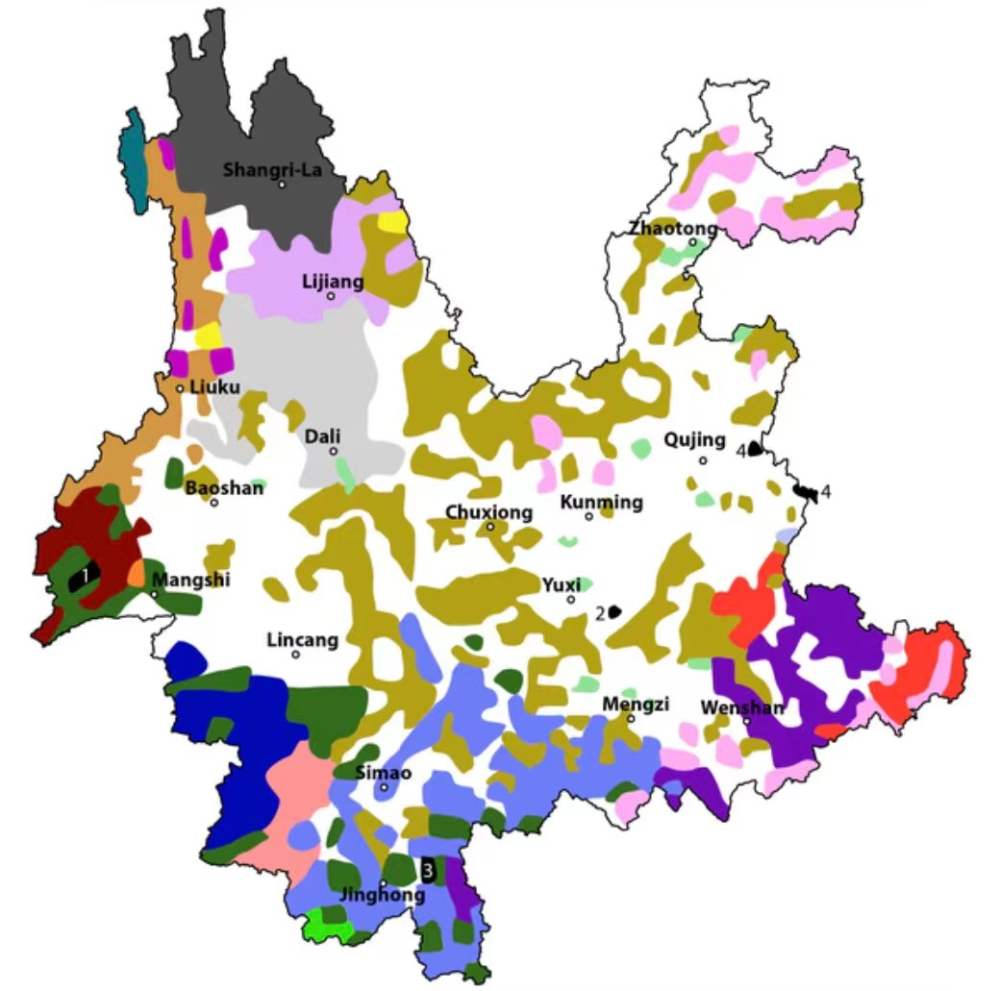
As long as it is Arabica cultivated within Yunnan, it can be included in the category of Yunnan small-bean coffee. The higher-quality Yunnan coffee growing belt is mainly distributed in areas such as Lincang, Baoshan, Simao, Xishuangbanna, Dehong, and Nujiang at elevations of 1,000 to 1,500 meters. The higher the elevation where coffee trees are located, the more obvious the temperature difference between day and night, and the growth pace slows accordingly. The plants can accumulate more nutrients, and sugars and aromatic substances are also richer, ultimately giving the coffee beans a better flavor performance.
Yunnan's uniquely favorable geographical conditions have allowed its coffee industry to grow rapidly. In 2014, whether in planting area or output, Yunnan accounted for more than 99% of the country. The average annual temperature in Lujiangba, Baoshan, is 21.5°C, with an extreme maximum temperature reaching 40.4°C, and there is basically no frost period throughout the year.
In 1988, Nestle took a liking to Yunnan as a suitable place and distributed coffee trees of the Catimor variety, which has stronger resistance to leaf rust, to local people. From then on, people began planting coffee again and supplied Nestle over the long term.
Because Catimor carries Robusta genes, its flavor is not entirely satisfactory, and the drinking experience is poor when consumed directly. For this reason, the public's impression of Yunnan coffee once remained at the level of instant coffee.
However, Front Street Coffee believes that truly excellent Yunnan coffee can fully show the unique flavor of Yunnan's producing regions under traditional natural or washed processing. To remove the unpleasant flavors in Yunnan coffee, change must begin at the source of the variety.
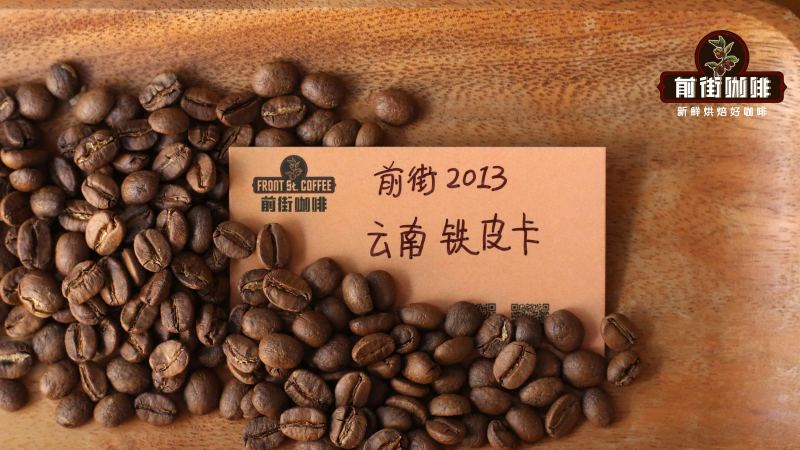
So in 2013, Front Street Coffee began growing Typica and a small amount of Bourbon in Lincang, Yunnan, for experimentation and research, and after harvest sold them in Front Street Coffee's online Tmall store and offline shops.
There are two reasons for choosing Typica. First, it is one of the oldest coffee varieties, with pure Arabica genes, elegant and clean flavor, and has long been regarded as a specialty coffee variety. Second, the earliest coffee trees planted in Yunnan were also Typica, brought in by French missionaries.
Although Front Street Coffee grows Typica, this does not mean Yunnan Catimor is bad. With the continuous spread of specialty coffee culture, Catimor in Yunnan's producing regions has now received more scientific cultivation and planting, and both flavor and quality have improved significantly.
Recommended Yunnan small-bean coffee beans
Front Street Coffee currently has three Yunnan coffee beans on sale. One is "Front Street 2013 Sun-Dried Typica Coffee Beans," priced at 40 RMB/100g; one is "Selected Producing Region Daily Beans - Yunnan Baoshan Washed Catimor Coffee Beans"; and another is "All-Red Cherry Sun-Dried - Catimor Coffee Beans from the Lujiangba Producing Region in Baoshan." Everyone can purchase them at Front Street's Taobao store or Front Street's Tmall flagship store.
These three beans all carry the signature flavors of Yunnan's producing regions: nuts, caramel, and plum-like notes. The differences are that "Front Street Sun-Dried Typica" has a cleaner flavor, balanced acidity, sweetness, and bitterness, with a prominent sweet aftertaste; "All-Red Cherry Sun-Dried" has the sweet-tart feeling of berries while retaining the characteristics of Yunnan's producing regions; and "Baoshan Washed Catimor" is a selected regional bean from Front Street, letting enthusiasts experience the regional charm of Yunnan coffee under traditional processing at the highest cost-effectiveness.
How should Yunnan small-bean coffee beans be brewed to taste good?
Front Street Coffee suggests that when brewing these three Yunnan coffees, a more balanced approach should be taken, without deliberately highlighting acidity or excessively polishing the finish.
Therefore, 15 grams of coffee powder is recommended, with a coffee-to-water ratio of 1:15; if you want a clearer flavor, you can use 1:16. Choose a V60 dripper, with a brewing water temperature of 88°C, in order to make the acidity softer. The grind should be medium-fine, about the size of fine granulated sugar (75% passing through a No. 20 sieve).
Specific brewing method: first pour 30g of water and bloom for 30 seconds; for the second stage, pour in a small stream in circles up to 125g, wait until the water level in the coffee bed drops halfway before continuing to pour, then still pour in a small stream in circles up to 225g. After all dripping is complete, the total extraction time is about 2 minutes 10 seconds.
The above content is compiled by CoffeeHunters, a coffee news website.


