








What Does the Coffee Process Do to Aged Mandheling
Aged Mandheling starts with Sumatra's wet-hulling method, then adds long-term storage that shifts the cup toward lower acidity, heavier body, and a deeper earthy character. Mandheling comes from the Aceh and North Sumatra regions, and the trade name covers origins such as Lake Tawar, Gayo Mountain, Lintong, and Lake Toba.
Wet-hulling removes the parchment while the bean is still damp, a shortcut shaped by Sumatra's wet climate and smallholder economics. Aging then lets the green beans rest for an extended period, changing acidity, body, and texture. This sets aged Mandheling apart from Golden Mandheling, which is sorted three times by hand plus once by machine to reach screen size 18+.
Mandheling is the most iconic coffee of Sumatra, Indonesia, and aged Mandheling is a special product that undergoes long-term storage on top of the wet-hulling method. This article starts with the distribution of producing regions, then details the complete wet-hulling process and the climate and economic logic behind it, and further explains the principles of the aged-bean processing method and the flavor transformation mechanism. The article also compares the differences between aged Mandheling and Golden Mandheling in acidity, body, and texture, and includes the roast curve of Front Street aged Mandheling along with step-by-step instructions for flannel pour-over brewing. It is suitable for enthusiasts who want an in-depth understanding of Indonesian coffee processing techniques.
Aged mandheling
Front Street Indonesia Aged Mandheling
Varieties: Caturra, Typica, Sidikalong
Soil: Volcanic soil
Altitude: 1500m
Processing method: Aged bean processing
01 | Producing Region Introduction
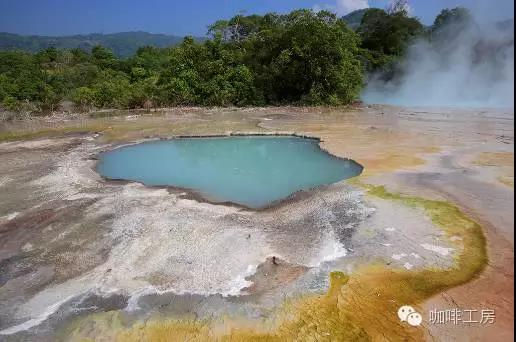
In the coffee map of Asia, the islands of the Malay Archipelago occupy a pivotal position—Sumatra, Java, and Kalimantan are all among them. Among them, the most famous is Mandheling coffee produced on the Indonesian island of Sumatra. It has two resounding trade names: Sumatra Mandheling DP Grade 1 and Aged Sumatra Mandheling. The former has a long finish, with a wild, earthy fragrance from the primeval forest.
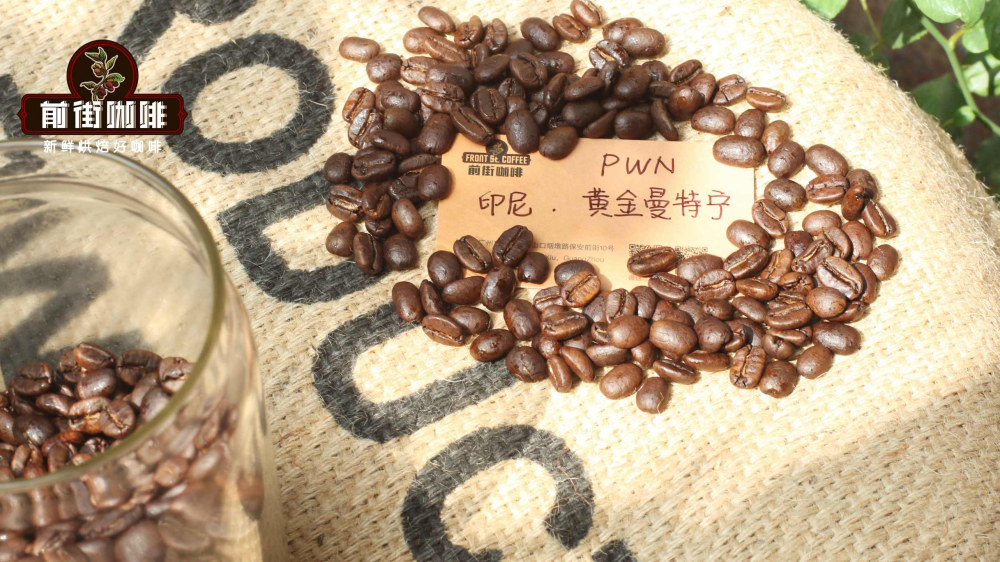
Indonesia's main coffee-producing regions are distributed across Sumatra, Java, and Sulawesi, among which Sumatra's "Mandheling" enjoys the greatest reputation. Take Front Street PWN Golden Mandheling, which excels in both appearance and quality, as an example: it undergoes three rounds of hand sorting plus one round of machine screening, pushing the defect rate extremely low. The green beans are neat and uniform in size, reaching a screen size of 18+.
Mandheling is also called "Sumatra coffee." In the Lake Tawar area at the northern tip, it can be called Aceh coffee or Lake Tawar coffee; while in the Lintong and Lake Toba areas, it is customarily called Mandheling.
Mainly from two producing regions:
One is the Aceh producing region, covering five origins: Lake Tawar, Gayo Mountain, Gayo people, Aceh Mandheling, and Takengon Mandheling;
The other is the North Sumatra producing region, composed of four origins: Lake Toba, Lintong, Mandailing people, and Batak people.
02 | Processing Method
Mandheling's unique wet-hulling method
Wet hulling, called Giling Basah in the local language, is a traditional coffee processing method long used in Indonesia. Judging by the name alone, wet hulling seems similar to the washed processing method, but the cup flavors of the two are completely different—coffee processed by wet hulling often has high body, strong impact, and a very distinctive style.
Wet-hulling process steps
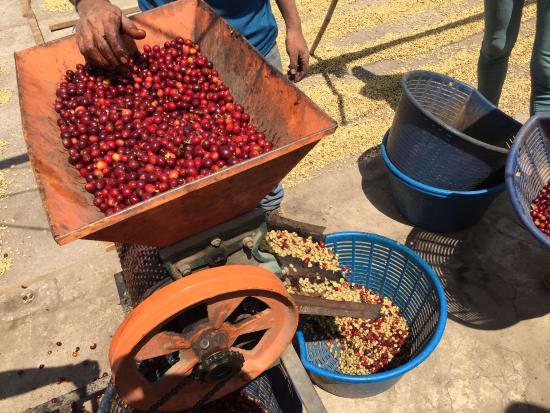
① Remove the skin and pulp, keeping the parchment and mucilage
② Ferment in a water tank
③ Wash off the mucilage
④ Sun-dry with parchment for 2-3 days, to a moisture content of 20-24%
⑤ Hull off the parchment
⑥ Dry the green beans to a moisture content of 12-13%
⑦ Prepare for export
Why use wet hulling?
a. Climatic reasons
Indonesia's use of wet hulling is inseparable from its weather conditions. The country's humidity remains between 70-90% year-round, typhoons frequently visit, and annual rainfall in some areas reaches as high as 2,000mm. Green beans fear rain the most. How does Indonesia produce rich, full-bodied Front Street Mandheling under such harsh conditions? The answer is wet hulling.
In tropical climates, coffee usually takes 2-3 weeks to complete drying. But Indonesia's humid environment makes drying a major challenge, taking even longer, during which the coffee beans continuously maintain high moisture, making it easier for bacteria to invade the interior of the green beans.
The drying stage of conventional washed processing is always carried out with the parchment still on, which protects the green beans from external damage to a certain extent. But wet hulling has already removed the parchment by the final drying stage, so sunlight directly hits the surface of the green beans, causing them to dehydrate rapidly, drying 2-3 times faster than washed processing.
b. Economic benefits
When 17th-century Dutch colonists brought coffee to Indonesia, they sought faster and greater economic returns. Wet hulling greatly shortened the time required at the farm level and also significantly reduced labor costs. This aligned closely with the mindset of investors seeking quick profits and cost control, and was also one reason driving the spread of wet hulling.
c. Defects and kuku kambing (goat-foot beans)
When wet hulling removes the parchment, the coffee's moisture content is still as high as 20-24%, whereas general processing methods wait until the moisture content drops to 10-12% before hulling. In a "semi-dry" state, the parchment easily sticks to the surface of the green beans, and hulling is much more difficult than in a "fully dry" state, requiring greater friction.
But from another perspective, the "semi-dry" green beans are very fragile at this time, far less hard than "fully dry" beans, so they are easily crushed and damaged, forming small notches—these are what we commonly call horse-hoof beans or goat-foot beans (locally called kuku kambing).
The extremely fast processing speed of wet hulling also leads to a relatively high defect rate in Mandheling. Processing plants arrange workers to hand-sort defects, usually divided into DP (double-picked) and TP (triple-picked). Front Street Mandheling that has undergone triple picking is superior to double-picked in terms of defect rate.
Aged bean processing
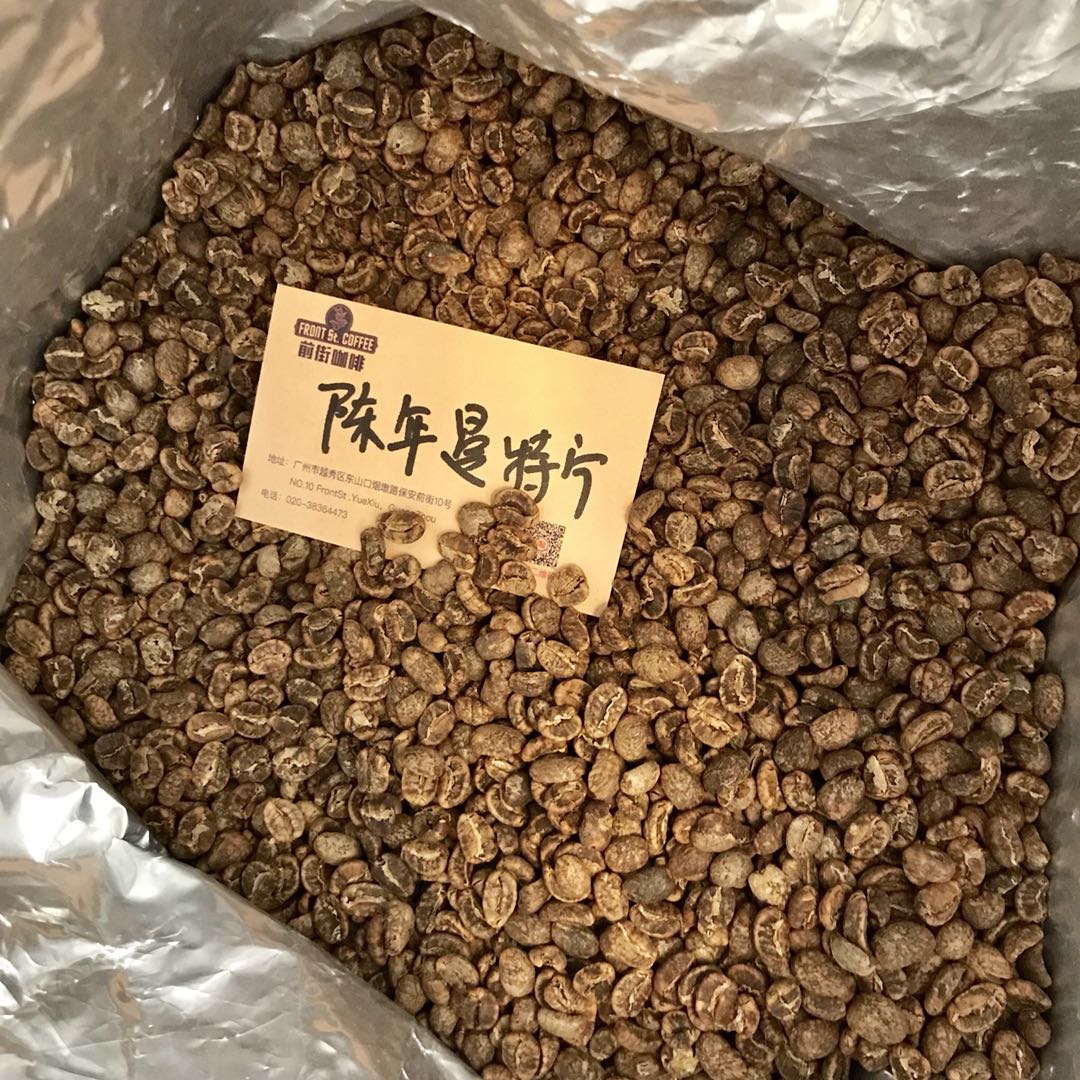
Aged coffee beans are not simply green beans left to sit for a long time—doing so will not work, because green beans will also deteriorate after long storage, changing from fresh green to white, then to yellow, and finally becoming completely flavorless, or even infested with insects. Like aged wines, green beans must undergo proper processing and long-term storage before they can be called true [aged coffee].
So-called aged coffee beans (Aged bean) mean:
Allowing green beans to naturally age by extending storage time (usually 2~3 years)
These changes include weakened acidity, color change, and thicker bean body.
The storage environment must be cool and well ventilated.
Because the storage environment is darker and the time is longer,
aged coffee can hardly escape
complex notes similar to mustiness or what is commonly called burlap sack or leather~
03 | Green Bean Analysis
Coffee beans that have been properly stored will change in both taste and appearance: acidity decreases, color darkens and moisture decreases, the mouthfeel becomes fuller and the consistency increases, sweetness carries a honey-like aroma, and some defects originally belonging to green beans also become less prominent. Because the storage environment is dark and the time is long, aged coffee inevitably carries complex notes similar to mustiness or what is commonly called burlap sack or leather.
Aged beans must be stored under strictly controlled conditions during storage, regularly and evenly turned, with humidity and ventilation adjusted, to prevent insect damage or mold.
Generally speaking, the storage of aged beans does not take place in producing regions or estates, but is a commercial activity of green bean distributors or brokerage companies.
Coffee beans that are properly stored
will change their taste and appearance,
for example, weakened acidity, dark color and lack of moisture,
fuller mouthfeel and good consistency, sweetness with a honey aroma,
and some defects originally belonging to green beans also become less obvious.
04 | Roasting Analysis
Front Street aged Mandheling does not look very attractive, but the baptism of time has worn away the acidity of Front Street Mandheling and enhanced its purity; under medium-dark roasting, the mouthfeel is even more rounded.
Because Front Street Mandheling green beans are high in density and low in moisture due to aging, heat adjustments at each stage need to be especially careful. With Front Street Mandheling coffee, take care to avoid scorching the oils on the surface of the raw beans.
Yangjia 800N, 550g green beans charged, specific operation:
Charge when the drum temperature reaches 200°C, set airflow to 3, after 1 minute of steaming adjust heat to 160°C, keep airflow unchanged, at 165°C adjust heat once, lowering to 140°C, roast until 5'35'', temperature 146°C, bean surface turns yellow, grassy smell completely disappears, dehydration complete, open airflow to 4;
At the 9th minute, ugly wrinkles and dark streaks appear on the bean surface, and the toast aroma clearly turns into coffee fragrance, which can be defined as the prelude to first crack. At this time, listen clearly for the sound of the first crack. At 9'30'' first crack begins, lower heat to 80°C, open airflow fully to 5 (heat adjustment must be very careful, not so low that there is no crackling sound) 40°C, at 194°C lower heat and drop at 197.4°C.
[Front Street Aged Mandheling], after the sedimentation of time, has less of Mandheling's wildness, and the mouthfeel has more richness and refinement. After aged processing, the coffee beans have weaker acidity, but higher body, thicker texture, and a sense of maturity and steadiness, completely different from the lively brightness of new beans. Roasted aged coffee beans require a longer development time before they show their richness.
04 | Brewing Analysis
Flannel recommended
Step 1
A brand-new flannel filter cloth must first be removed, soaked and boiled in boiling water for 5 minutes, then placed on the metal ring.
If it is a used filter cloth, it should also be boiled in boiling water for at least 3 minutes to disinfect.
Step 2
Grind the beans while the filter cloth is soaking. Because of the special material of the flannel dripper, flannel cloth pour-over uses a bit more coffee beans than filter paper, and the brewed flavor will be better. Of course, you should still put in an appropriate amount of coffee grounds according to the size of the cloth. For 2 cups (240c.c. of coffee), use 40 grams of beans. It is recommended to grind the coffee beans to a coarseness between granulated sugar and superfine sugar.
Step 3
Dry the filter cloth, first wring it by hand, then place the cloth between clean dry towels to absorb the moisture.
Step 4
Rinse with hot water, preheat the filter cloth and dripper, then pour the water away.
Step 5
Pour the coffee grounds loosely into the filter cloth; there is no need to press them compact.
Step 6
Use a wooden stirring spoon or butter knife to gently turn the coffee grounds from the very bottom upward, and finally pull the bottom of the bag to adjust the shape.
Step 7
Make a hole at the top of the coffee grounds about one coin wide and one thumbtack deep. This is because the coffee bed is relatively deep, making it easier for hot water to spread in all directions and evenly wet the coffee grounds.
Step 8
Let the hot water sit and cool to about 80-85°C, then start pouring from near the hole. At the beginning, it must be very slow, pouring 60 grams of water within 30 seconds. There is no need to deliberately wet all the coffee grounds; capillary action will slowly spread the water. After pouring, wait about 30 seconds.
Step 9
Begin the second pour, this time a bit faster than the first, pouring 140 grams of water within 60 seconds. At this point the coffee will begin to produce a large number of bubbles, somewhat like a cosmic explosion in a movie. After pouring, wait 20 seconds as the water level drops slightly.
Step 10
For the final pour, pour 120 grams of water within 30 seconds. The whole process requires pouring 320 grams of water and takes 3 minutes. Because the filter cloth and coffee grounds absorb about twice the weight of the coffee grounds in water, you can finally collect about 240 grams of coffee, with a coffee-to-water ratio of 1:6.
Using a flannel filter bag to brew coffee is time-consuming, so the resulting coffee temperature is lower. Preheating the coffee cup can slightly raise the coffee's temperature. But never reheat the coffee in any form.
The above content is compiled by CoffeeHunters, a coffee news website.


