







What Makes Yellow Bourbon Coffee Taste Balanced?
Yellow Bourbon is a high-quality Brazilian variety that delivers balanced sweetness with nutty and chocolate notes. Brazil grows about one-third of the world's coffee, yet many drinkers still assume its beans are only commercial grade, overlooking specialty lots from farms such as Queen's Farm, which produces a natural-process Yellow Bourbon.
Roasting and brewing shape the cup: Front Street Coffee recommends the KONO dripper, 87°C water, a 1:15 coffee-to-water ratio and a staged pour. Coffee seeds first reached Brazil in the 17th century through a European officer who obtained them from Guiana, and today shade trees help offset warming on the harvest.
Brazil, as the world's largest coffee producer, is often misunderstood as only producing commercial beans, but in fact it also has champion-level specialty coffee. This article starts with the legends of Brazilian coffee, discusses the impact of the pandemic on the harvest and the role of shade trees in mitigating climate warming, then focuses on the Yellow Bourbon, a high-quality variety, introducing its flavor characteristics and the natural-process Yellow Bourbon from Queen's Farm. Finally, it includes Front Street Coffee's roasting and brewing recommendations, including the KONO dripper, 87°C water temperature, 1:15 coffee-to-water ratio, and staged extraction method, giving you a complete understanding of this bean's balanced sweetness and nutty-chocolate notes.
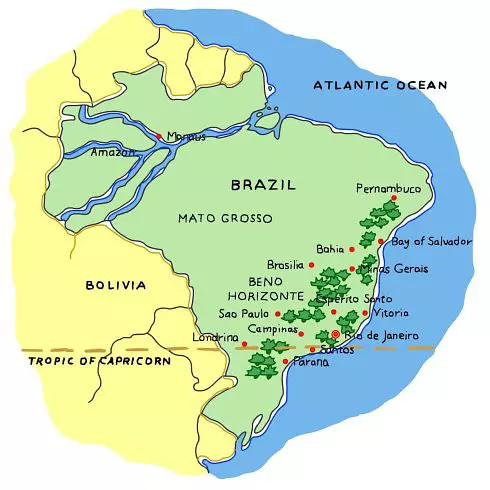
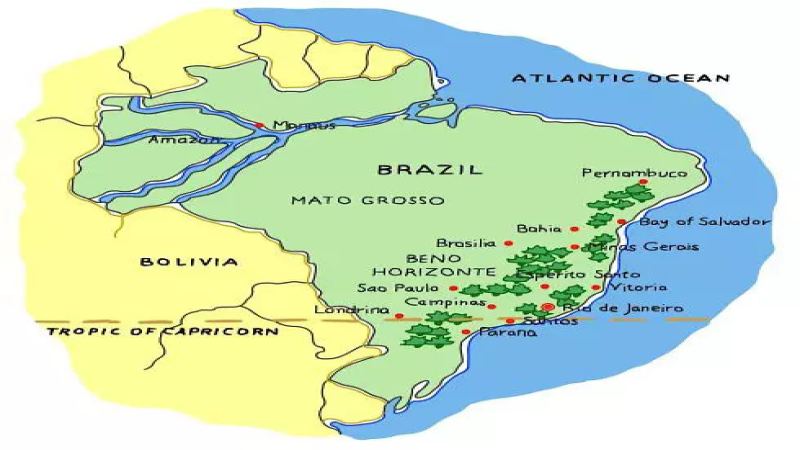
Brazil is the country with the highest coffee production in the world, accounting for about one-third of total global output, making it a true coffee powerhouse. Because Brazilian beans are often used in espresso blends and are relatively inexpensive, many people mistakenly assume that Brazilian coffee is mediocre in quality. Front Street Coffee would like to say that this view is not accurate—Brazil not only has high-quality coffee, but has also produced champion-level specialty beans.
The Legendary Story of Brazilian Coffee
There is a rather dramatic legend about the origin of Brazilian coffee. In the 17th century, European colonists fell into a dispute over the partition of Guiana (a country in northern South America) and specifically invited a European military officer stationed in Brazil to go to Guiana as an arbitrator. During his mission, the officer discovered the value of local coffee and asked the governor for coffee seeds, but was refused (at the time, taking coffee out of the country was strictly prohibited). Unwilling to give up, the officer turned to the governor's wife, trying to obtain the seeds through romance, and eventually got his wish. The coffee seeds thus came to Brazil with him.
Brazilian Coffee in Recent Years Has Been Affected by the Pandemic
The title of number one producer has brought Brazil considerable economic income, but coffee cultivation requires a huge amount of manpower. Brazil was once the last country in the Western Hemisphere to abolish slavery, precisely because planting and harvesting coffee required a large labor force. Now, affected by the COVID-19 pandemic, Brazil fears that the pandemic will break out severely with the arrival of the harvest season, thereby delaying coffee exports, so it is expected that this year's Brazilian coffee harvest will be delayed.
The Benefits of Shade Trees
Global warming may cause Brazil's coffee-growing areas to shrink significantly, and the latest research confirms that shade trees can help buffer temperature increases, which is undoubtedly good news for growers. Research shows that covering 50% of a planting area with shade tree species can preserve as much as 75% of the region's production capacity.
Among Brazil's many coffee varieties, Yellow Bourbon is one of the quite outstanding variants in quality. Ordinary Bourbon turns from green to yellow and then to red, while Yellow Bourbon remains yellow in appearance throughout. Grown at high altitude and wet-processed, Yellow Bourbon has an excellent flavor, with a faint citrus aroma, balanced and smooth acidity, and rich, abundant fruity notes and hazelnut flavors. Its distinctive sweetness and body are superior to ordinary Brazilian commercial beans.
The Bourbon variety originated on Bourbon Island in the Indian Ocean (now called Réunion Island). It is a subspecies produced by a mutation of Typica and, together with Typica, belongs to the oldest extant coffee varieties. Its green fruit turns bright red when ripe. Yellow Bourbon, on the other hand, comes from a cross between Bourbon and other varieties. Because of its lower yield and poor resistance to wind and rain, it has not been widely planted, but when grown at high altitudes it shows excellent flavor performance.
The Balance of Brazilian Coffee
Brazil's altitude is relatively low among Central and South American countries, and it also lacks microclimates. As a result, the coffee beans grown there have low but sufficiently smooth acidity, a heavy nutty taste, chocolate-like sweetness, and excellent body. However, some coffee enthusiasts are critical of the acidity of Brazilian beans, feeling that it is too mediocre and not impressive enough. This also shows that coffee culture is simply like this—there is praise and criticism, and a bean's rise to fame must withstand both praise and criticism.
Today we are introducing coffee from Queen's Farm, which belongs to the Yellow Bourbon variety. The source of Yellow Bourbon can be traced back to Réunion Island in Madagascar, the birthplace of the Bourbon variety. Due to the influence of a recessive gene, Brazilian Bourbon coffee has yellow fruit. Yellow Bourbon beans are naturally sweet and clean. Using the natural process makes the acidity slightly lower, yet it harmonizes well with the sweetness, resulting in good balance and tropical fruit aromas.
[Front Street Coffee Brazilian Bourbon Coffee: Queen's Farm Coffee]
Region: Mogiana
Altitude: 1400–1950m
Variety: Yellow Bourbon
Processing Method: Natural Process
Roasting Recommendations
This bean has a low moisture content, a solid texture, and a very strong ability to absorb heat, so the roasting time must be controlled steadily and not too hastily. In order to achieve a good flavor expression and bring out the aroma, a medium roast is used.
Machine: Yangjia 800N, 550g green beans charged
Charge temperature: 200°C
First crack: 9'14", 188.9°C
Development after first crack 1'48", discharged at 197.5°C
Brewing Recommendations
Dripper: KONO dripper
Water temperature: 87°C
Dose: 15 grams
Coffee-to-water ratio: 1:15
Grind size: medium-coarse grind (70% passing through a Chinese standard No. 20 sieve)
Brazilian Bourbon Coffee Brewing Method
Staged extraction: Bloom with 30g of water for 30 seconds, then pour in a small circular stream until the water reaches 125g for the first stage. When the water level drops and is about to expose the coffee bed, continue pouring until 225g and stop. When the water level drops and is about to expose the coffee bed again, remove the dripper. (Start timing from the beginning of the bloom.) The extraction time is 2'00".
Flavor description: The taste has obvious sweetness, with a faint lemon aroma, rich nutty flavors, and a pronounced dark chocolate note in the finish. The overall impression is relatively round and smooth. It is a coffee bean that represents the overall characteristics of Brazilian coffee while also showing its own unique liveliness.
For professional coffee knowledge exchange and more coffee bean information, please follow Coffee Workshop (WeChat public account: cafe_style)
For more specialty coffee beans, please add the private WeChat of Front Street Coffee: qjcoffeex
The above content is compiled by CoffeeHunters, a coffee news website.


