







Myanmar, a Southeast Asian country often associated with telecom fraud in northern Myanmar and internal turmoil, is rarely known to also be a coffee-growing region. Front Street Coffee takes you into this obscure origin. Myanmar is located in a tropical monsoon climate zone, high in the north and low in the south, with mountains, plateaus, and alluvial plains interwoven, providing an ideal growing environment for coffee. Coffee was introduced during the British colonial period in the late 19th century, and missionaries began planting it in Shan State in the 1930s. In the 1980s, the government cooperated with the United Nations to replace opium poppies with coffee, and only then did the industry truly begin to develop. Today, Shan State and Mandalay are the main producing areas, dominated by smallholder farming, with Arabica accounting for 80% for export. This article provides a detailed introduction to Myanmar coffee's cultivation history, producing area distribution, varieties, and industry status.
When it comes to Myanmar, what comes to most people's minds first may be telecom fraud in northern Myanmar and internal unrest, but when it comes to coffee cultivation, very few people know about it. Today, Front Street Coffee takes everyone to visit this relatively obscure coffee origin.
Myanmar
The Republic of the Union of Myanmar is located in Southeast Asia, facing the Andaman Sea to the southwest, bordering India and Bangladesh to the northwest, adjacent to China in the northeast, and connected to Thailand and Laos on the southeast side, with a total area of 676,578 square kilometers.
The national flag of Myanmar is rectangular, composed of three equal-width horizontal bands of yellow, green, and red from top to bottom, with a large white five-pointed star in the center, spanning the three color bands and pointing upward. Yellow symbolizes unity, wisdom, happiness, and the close solidarity of all ethnic groups; green symbolizes fertile land, harmony, tranquility, and verdant growth; red symbolizes bravery and decisiveness; and the white five-pointed star represents purity, integrity, friendliness, and strength.
Myanmar has both land and maritime territory, with a total coastline of 3,200 kilometers. The overall terrain is high in the north and low in the south, surrounded by mountain ranges in the north, west, and east. The north is a high mountain region, the west has the Naga Hills and Arakan Mountains, and the east is the Shan Plateau. Hkakabo Razi near the Chinese border, at 5,881 meters above sea level, is the highest point in the country. Between the western mountains and the eastern plateau is the Irrawaddy River alluvial plain, with low and flat terrain.
Myanmar has a tropical monsoon climate. Most of the country lies south of the Tropic of Cancer and is tropical, while a small part lies north of the Tropic of Cancer and is subtropical. Summers are hot and humid, with frequent rainfall from June to September, while winters from December to April are dry and mild. Such terrain—with hills, valleys, and mountains interwoven—combined with hot days and cool nights, an excellent ecological environment, and relatively few natural disasters, provides ideal conditions for coffee cultivation.
Coffee Producing Areas
At the end of the 19th century, British colonists invaded and controlled this land. In the 1930s, Catholic missionaries introduced coffee to Shan State in northern Myanmar and began planting it. By the 1980s, the local government cooperated with the United Nations on a project aimed at replacing illegal opium poppy cultivation (used for opium production) with coffee trees, and only then did the coffee industry truly begin.
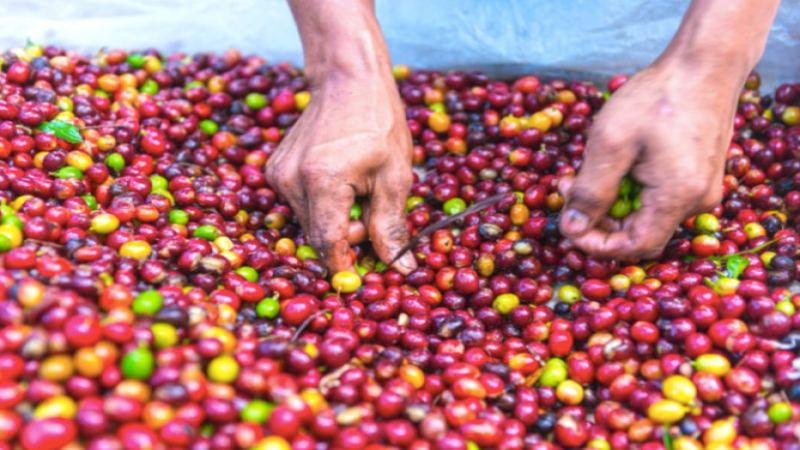
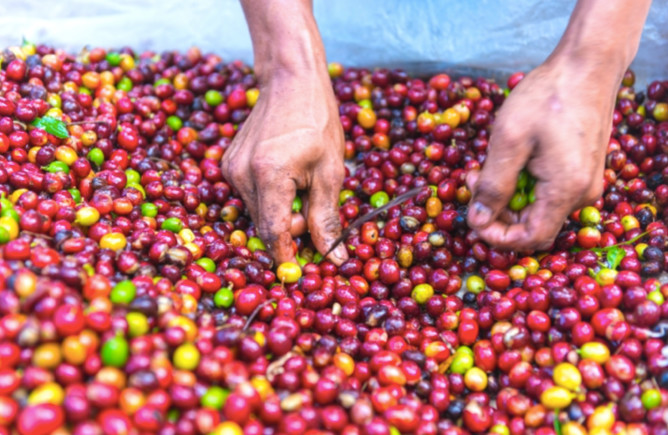
Most coffee produced in Shan State is grown by smallholders, and most smallholders cultivate less than one hectare. About 80% of the coffee grown is Arabica, used for export; another 20% is Robusta, mainly for domestic sales. Common varieties include Caturra, Catimor, Bourbon, Typica, S795, and SL34. After harvesting, the cherries are sorted and graded, then sent to processing stations.
Myanmar's coffee cultivation is mainly concentrated in the Naungcho area, Ywangan area, and Pwela area of Shan State, as well as the Pyin Oo Lwin area of Mandalay Region. In addition, Chin State, Bago Region, the Danthankyi area, and the Pwela area have now also begun cultivating coffee.
Shan State: Located in northern Myanmar and bordering Xishuangbanna, Yunnan, China, it is the largest and most populous state in Myanmar. Most of the region is surrounded by the Yunnan-Guizhou Plateau and has the Salween River, one of Asia's longest rivers. Coffee is grown at elevations between 800 and 1,800 meters.
Mandalay Region: Located in central Myanmar, it combines plateaus, mountains, plains, and hills, with diverse climate types and fertile soil brought by extinct volcanoes, making it very suitable for agricultural production. Coffee is mostly grown at elevations between 900 and 2,000 meters.

Current Status of the Coffee Industry
At present, Myanmar is continuing to promote the development of its coffee industry. In 2024, the country expanded its coffee planting base to 279,000 acres (about 170,000 mu), with more expansion plans in the future. It plans to expand Myanmar's coffee planting area to 300,000 acres (about 1.82 million mu) and significantly increase local coffee production after five years.
The above content is compiled by CoffeeHunters, a coffee news website.


