








How Do Moka Pots Fit Into Latte Art Etching Practice?
Most ripple latte art faults come down to positioning and pour control rather than talent. Left-right asymmetry almost always means the milk pitcher and the coffee cup are not in a straight line, while uneven line density traces back to uncontrolled swinging force and overly thick lines come from foam that is too thick or a pitcher held too close to the cup.
Training starts with an empty pitcher to locate the force point, then moves to practicing with water before using milk. Thick, dense crema is the other prerequisite, and a medium-dark blend of beans from Brazil, Indonesia and Vietnam extracts it reliably on home espresso machines and on moka pots, so how to make coffee with machine or stovetop gear both stay within reach.
To pour beautiful ripple patterns, practicing hard alone is not enough. The key prerequisite is having an espresso with rich crema. This article breaks down several common problems in ripple latte art one by one: asymmetric patterns often stem from the milk pitcher and coffee cup not being in a straight line; uneven line density is mostly due to uncontrolled swinging force; overly thick lines may be caused by milk foam being too thick or the habitual practice of keeping the pitcher close to the cup. It also shares a complete training path from finding the force point with an empty pitcher to simulating with water, and recommends Front Street Classic Blend, helping coffee enthusiasts extract dense crema stably at home, suitable for home machines and moka pots.

A friend asked Front Street Coffee how to practice the pitcher-swinging motion during ripple latte art. This article can be seen as a sequel to "How to Pour Beautiful Ripple Lines?" If you haven't read that one yet, I suggest clicking in to take a look first, as we won't repeat what was covered before.
Many people may not realize that to pour beautiful ripples, repeated practice is certainly important, but there is also a prerequisite—you need an espresso with good crema. If you have high standards for crema, you might as well go straight for Front Street Classic Blend. This coffee is composed of beans from Brazil, Indonesia, and Vietnam, with a medium-dark roast, making it easier for you to extract thick, dense crema. Both home espresso machines and moka pots can handle it.
Let's discuss this by situation:
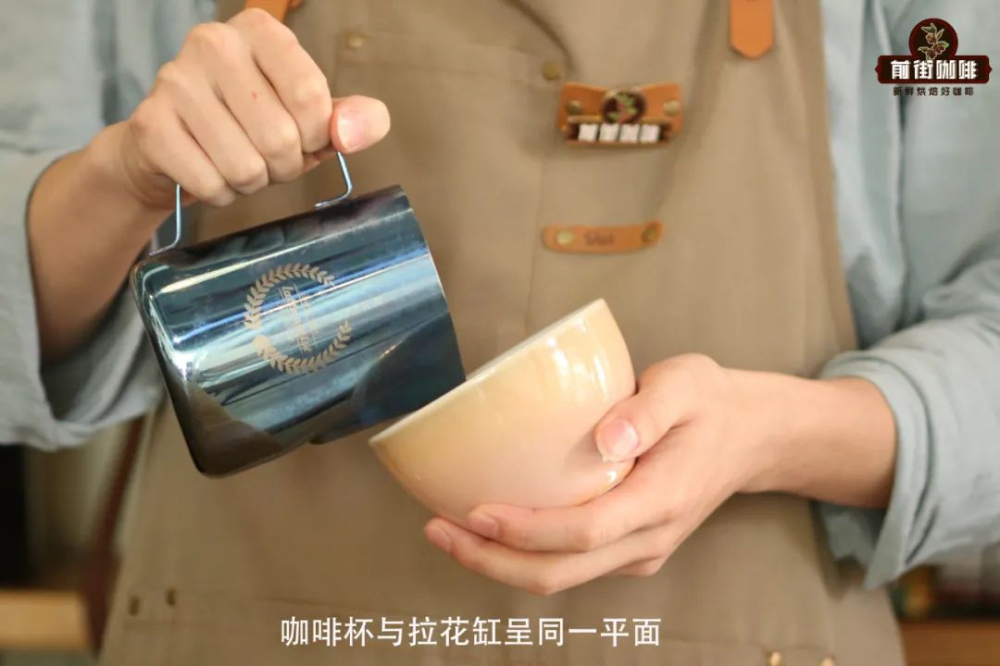
The first problem: left-right asymmetry in the pattern. There is only one reason—the milk pitcher and coffee cup are not placed in a straight line. How to understand "in a straight line"? When viewed from directly to the side, you should only see the flat outlines of the pitcher and cup, not their three-dimensional forms.
Then looking down from above, the coffee cup's handle faces toward your body's inner side, so that when pouring, the pattern faces directly toward the operator (only for right-handed pitcher holding). At the same time, the center lines of the pitcher and cup remain parallel, and the pattern will naturally be symmetric.

The second problem: during rippling, one side's lines are crowded densely while the other side is sparse. There are two possibilities: one is caused by the symmetry issue mentioned above, and the other is uneven force when swinging the pitcher—that is, swinging with a larger amplitude to one side and a smaller amplitude to the other.
Front Street Coffee's suggestion is: don't rush to practice with milk first. Start by finding the feel of the motion with an empty pitcher, like in the video below:
First, experience where the force point is when swinging the pitcher. As shown in the video, the thumb plays a fixing role, while the other four fingers generate force, using the pitcher handle as a pivot to make the pitcher swing back and forth.
If you already understand the principle of generating force, you can switch to water for practice, as in the video below:
This back-and-forth pitcher swinging exercise is the most critical part. You need to control both the water flow and the swing amplitude simultaneously. Practicing with water is different from practicing with an empty pitcher because the resistance of the water changes the feel when swinging. You need to practice until the water flow and swing amplitude stay in sync, which requires patience and persistence. From the video, you can also see that as the amount of water in the pitcher decreases, swinging becomes easier and easier.
In the end, there is no special trick to this—it all relies on muscle memory. If you can't swing the pitcher well, it's definitely because you haven't practiced enough.
The third problem: ripple lines are too thick. There are also two possibilities: one is that the milk foam is beaten too thick; the other is the habitual practice of keeping the pitcher close to the cup when pouring, which is the hardest to change. Previously, when pouring large white hearts or pushing tulips, keeping the pitcher spout close to the cup rim indeed made it easier to pour stably, but when applied to rippling, it becomes a constraint. When swinging the pitcher, it is easily obstructed, and since the spout is too close to the liquid surface, the white lines become very thick and lose their aesthetic appeal.
The above content is compiled by CoffeeHunters, a coffee news website.


