







How does coffee bean structure shape Robusta and Arabica flavor?
Robusta and Arabica differ in the bean itself, not just in reputation. Robusta accounts for roughly forty percent of global production, grows faster and tolerates harsher climates at lower altitudes, and its green beans are smaller and rounder with nearly twice the caffeine of Arabica. That caffeine acts as a natural insect repellent, but the same compounds contribute to the rougher, more bitter cup the variety is known for.
The comparison runs through botanical traits, chemical makeup, origin and processing, cupping scores and espresso blending. Arabica dominates specialty menus with delicate, varied acidity, while Robusta is often excluded outright. Yet roasters note that about ten percent Robusta in a commercial blend adds body and a fuller crema, and that well-farmed Robusta can taste better than mediocre Arabica.
Robusta and Arabica are the two most frequently compared varieties in the coffee world. The former accounts for about forty percent of global production, is highly adaptable and high in caffeine, yet has long borne the stereotype of being rough and bitter; the latter dominates the specialty coffee mainstream with its delicate and varied flavors. This article breaks down, one by one, their botanical characteristics, chemical composition, origin and processing, cupping performance, and espresso blending logic, explaining the fundamental differences between the two in flavor and mouthfeel, and exploring whether Robusta can shed its low-tier label if given equal attention in cultivation and post-processing. At the same time, drawing on Front Street Coffee's commercial blending experience, it analyzes how a 9:1 ratio of Arabica to Robusta achieves the classic espresso flavor.
For more specialty coffee knowledge, welcome to follow our WeChat official account: Front Street Coffee (FrontStreet Coffee)
Robusta's most notable growing advantage is that it grows faster than Arabica and is more tolerant of harsh climates, and currently about forty percent of global coffee production comes from this variety. However, in actual production and post-processing, it receives far less attention than Arabica. Because of its poor flavor reputation, the specialty coffee circle often simply excludes it. But Front Street Coffee (FrontStreet Coffee) has always believed that if Robusta were given equal attention in cultivation and processing, it could absolutely transform into a delicious cup of coffee.
Front Street's view is that high-quality Robusta can outperform mediocre Arabica in taste. For example, premium Robusta is often used to blend traditional espresso, and Front Street's commercial blend is exactly like this—adding about 10% Robusta beans makes the final extracted espresso richer in mouthfeel and fuller in crema. So in the end, which bean to choose comes down to personal taste preference.
What exactly is Robusta?
Robusta originated in West Africa and is suited to being grown at lower altitudes and higher temperatures. The rest of global coffee production basically falls into this variety. Its green beans are smaller and rounder in shape, and its caffeine content is nearly twice that of Arabica. It is precisely this high caffeine that forms a natural insect-repellent barrier, helping it resist most pests, so Robusta is cheaper to grow and more affordable in price. In addition, brewing it produces a richer crema (coffee oils), which is also why Robusta is commonly found in blend formulas.
The appearance characteristics of Robusta
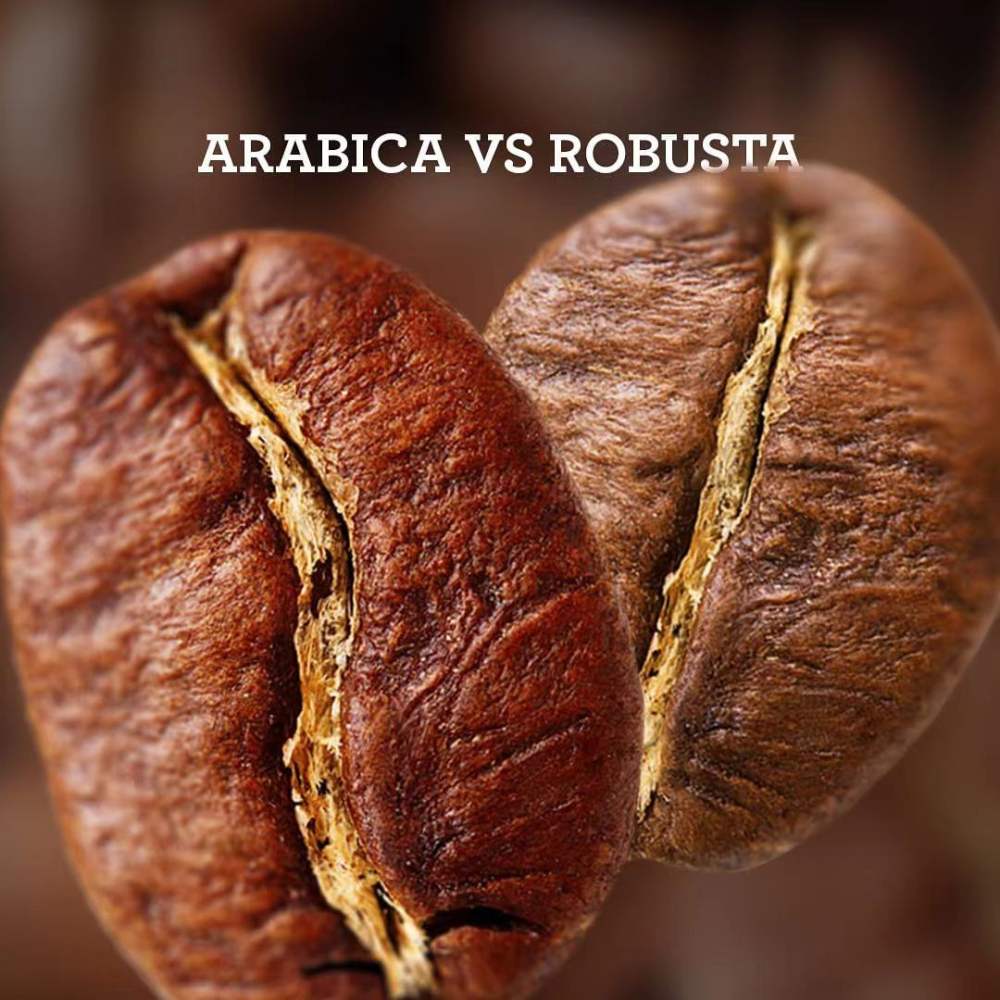
Robusta is one bean per fruit. It looks rounder and C-shaped; the center line is in the shape of a "1", and the green bean color tends toward yellow-brown.
The divide between Robusta and Arabica
First, one thing must be made clear: in terms of the complexity of flavor and aroma, Arabica surpasses Robusta, partly because the chemical compositions of the two varieties themselves differ.
Compared with Robusta, Arabica is lower in caffeine, amino acids, and chlorogenic acid, but its total oil content is 60% higher. Chlorogenic acid brings astringency, so Arabica's lower chlorogenic acid level is more favorable for coffee quality development. Many aromatic volatile compounds attach to the oils and are released during brewing, so oil content can explain to some extent the gap between the two in flavor quality, especially in espresso, where it is particularly evident.
Robusta is often criticized for having a rubbery taste and bitterness, and combined with its higher caffeine content, specialty coffee roasters and baristas often keep their distance from it. This bean usually circulates in the lower-tier market and is used as part of blend formulas.
Coffee quality is determined not only by the chemical properties of the bean, but also by a series of human choices. The delicious Arabica we drink today is both a gift from nature and the result of choices that have continuously emphasized quality factors over centuries. The subsequent decisions people make in production, post-processing, roasting, and brewing all further influence coffee's sensory quality.
And throughout the entire supply chain, people invest far more time and resources in Arabica than in Robusta, which directly affects the final flavor in the cup.
Front Street Coffee (FrontStreet Coffee) believes that Robusta's cupping scores are usually low because its flavor quality is often unsatisfactory, and this is directly related to how it is processed. Robusta is often traded directly after being mixed with large numbers of defective beans, and cupping quality is not the farmer's primary concern. But what if it were properly processed? This could not only change farmers' production methods, but also affect other links in the supply chain.
Espresso blends
Blended coffee, also called mixed coffee, is simply mixing different single-origin coffee beans in proportions so that each one's strengths are fully released. Blends are made from coffee beans from different origins, with the goal of achieving a more balanced taste. For example, if one bean is smooth in mouthfeel but lacking in aroma, another bean with a prominent aroma can be added, letting their strengths and weaknesses compensate for each other, complementing or reinforcing each other in taste, thereby creating a richer new flavor. Sometimes the green beans are blended first and then roasted, which is called pre-roast blending; sometimes they are blended after roasting is completed, which is called post-roast blending.
Whether pre-blending green beans or roasting separately and then blending, it depends on the characteristics of the coffees in the formula, and both methods are acceptable. Post-roast blending allows each bean to receive a different degree of roasting, bringing out the best in each component.
Before blending beans, you need to first understand the flavor characteristics of different coffee varieties around the world, as beans show different features depending on origin. Because of differences in variety and origin, different coffee beans also have different personalities, with subtle differences in flavor dimensions such as acidity, bitterness, sweetness, aroma, and body. Single-origin coffee beans tend to focus more on expressing the unique characteristics of a certain type of coffee. Blends are mostly used for espresso drinks such as Espresso, Americano, Latte, or Cappuccino, with a more balanced, smoother, and more stable taste, one could say a taste that appeals to a broader crowd.
Front Street Coffee's (FrontStreet Coffee) commercial blend uses 90% Arabica paired with 10% Robusta. Judging purely by bean flavor, the coffee taste of commercial beans is indeed considerably inferior to specialty coffee beans. Commercial beans are generally chosen for blending, and after blending they can still make a decent-tasting coffee that can be used for lattes, cappuccinos, and other espresso drinks. And when Front Street Coffee's (FrontStreet Coffee) commercial blend is made into Espresso, because it contains Robusta beans, the crema is richer, the taste classic, with caramel sweetness, nutty, cocoa, and dark chocolate flavors, balanced acidity and sweetness, a slight hint of pleasant bitterness, and a lasting finish.
Roasting espresso blends
Usually espresso chooses a setting with a heavier taste, so espresso with higher acidity is rarely seen. Generally, coffee beans will use an espresso formula with almost no acidity value, or be roasted darker to remove acidity, because to pair with rich, fragrant milk, the coffee's bitterness and heaviness must be sufficient.
It is conceivable that dark-roasted coffee beans have a higher weight-loss rate and slightly stronger bitterness, so people look for green beans with stronger bitterness to make the formula, and Robusta green beans happen to increase the coffee's bitterness. At the same time, Robusta's caffeine content is also higher than Arabica's and its acidity value is lower.
Beans used to brew espresso need to extract substances more easily than pour-over, but how is that done? Front Street's roasters use a longer roasting time than for pour-over beans, but it is not necessarily required to raise the temperature or roast dark.
When roasting espresso beans, Front Street Coffee (FrontStreet Coffee) hopes to let this bean achieve the ideal extraction result through solubility while creating bright acidity, which often requires a longer roasting time to make the coffee bean structure looser. Perhaps the development stage after first crack, or even before first crack, or both stages are key, but we think the latter (before first crack) is the more critical stage.
When Front Street Coffee's (FrontStreet Coffee) colleagues cup such beans, they may taste somewhat unbalanced, but as long as sweetness dominates, we find that such beans perform very well when made into espresso, highlighting the acidity and achieving a final balanced taste.
Extending the roasting development time makes the coffee flavor more delicate and also makes it easier to complete extraction in a short time. Because it changes the coffee's characteristics, this roasting feature is easy to identify during cupping, but if brewed well, you can enjoy a cup of coffee that is well developed in both roasting and extraction.
How Front Street extracts espresso
Bean information
Commercial blend: Colombia, Brazil, Robusta
Blend ratio: 3:6:1
Extraction
Coffee powder dose: 20 grams
Powder-to-liquid ratio: 1:2
Coffee liquid weight: 40 grams
Extraction time: 28–32 seconds
Flavor: caramel sweetness, nuts, cocoa, balanced acidity and sweetness, slight pleasant bitterness, lasting finish.
Re-examining Robusta
To be honest, if Robusta received the same care and attention as Arabica, its cupping scores might improve, and people would value this variety more. But if there is no market demand for "quality Robusta," farmers also lack the incentive to improve quality at the farm stage.
Some organizations are trying to reverse the market's negative associations with Robusta and cultivate a market for quality Robusta. CQI launched the Fine Robusta program in 2010 and published the "Fine Robusta Standards and Protocols" in 2019.
As the coffee industry sees the growing impact of climate change, growing crops suited to land conditions may become increasingly important. As demand grows and more land becomes unsuitable for growing Arabica, the coffee industry needs to look for alternatives.
Without human protection, what ultimately survives may well be Robusta
Front Street Coffee (FrontStreet Coffee) believes that Robusta's reputation is usually poor, but the bean itself should not be blamed. Robusta is usually harvested by machine, which means the harvest includes rotten and unripe beans, as well as insects, branches, and other debris. Such a combination is destined to produce a bad cup of coffee.
Although Arabica may still be consumers' first choice, Robusta has already begun to prove its value.
How can Robusta's quality be improved?
Let's follow Front Street and look at how Robusta is generally processed, and what measures can be taken at each link in the supply chain to improve its quality.
Production and processing
Robusta's bad reputation stems from cultivation, especially agricultural techniques that are improperly handled after harvest. The problem begins with poor picking practices and incorrect storage methods; many farmers do not dry the coffee completely to a moisture content of 11%–13%. These poor practices all affect the final coffee taste, giving it a sour, musty, moldy, and other off flavors.
Front Street feels that some simple measures can improve Robusta's coffee quality, such as picking only ripe fruit, processing immediately, completing the drying process on raised beds, and maintaining a good storage environment.
Essentially, all the best techniques used to process Arabica should be adopted, with slight adjustments, for processing Robusta. Of course, the resulting flavor will not be as rich as Arabica, but it may yield other flavors that many consumers and roasters have never tasted. Front Street says that if Robusta is properly processed, and the green beans are sun-dried, it can have a very clean coffee flavor, bright acidity, and a light mouthfeel.
When cupping Robusta, it is hard to avoid comparing it with Arabica. Robusta's unique flavor characteristics only emerge under pressure extraction. This is why we always make the final decision based on espresso extracted from the sample. If you are interested in tasting the best Robusta coffee, Front Street Coffee (FrontStreet Coffee) suggests tasting it separately from Arabica, and presenting Robusta as espresso for comparison.
Taking Robusta seriously means the coffee industry has a responsibility to provide technical support to producers, so that there is a chance to improve production and processing procedures. But we also need to create a stable market for consistently high-quality Robusta through regular purchasing. This seems to be the only way out of the vicious cycle of low quality and low price.
In the coffee industry supply chain, the only player capable of developing this business on a large scale may be importers. Specialty coffee roasters have a responsibility to work closely with the most transparent importers and to support the process of creating market demand for quality Robusta. Front Street believes we are all part of the coffee supply chain. We need to reconsider some beliefs and biases that are detrimental to coffee producers, especially those people who have no choice between growing Arabica and growing Robusta.
We need to use more critical thinking and less coffee snobbery. Before labeling Robusta as inferior, we should give this ugly duckling the same opportunity as Arabica, so that it has a chance to become the swan we admire.
The above content is compiled by CoffeeHunters, a coffee news website.


