








What Milk-to-Coffee Ratio Makes a Balanced Latte?
A balanced latte rests on three things: the quality of the beans and milk, the ratio of espresso to milk, and the technique used to extract and combine them. There is no fixed ratio, but a range of 1:5 to 1:8 is a common starting point, adjusted to how the espresso actually tastes in the cup.
Espresso blend beans set the flavor direction, and milk should match them rather than mask the coffee or turn the drink watery. Steaming fine, dense microfoam and pouring with correct integration technique produces a uniform surface without large bubbles. Traditional blends lean nutty and chocolate, while some beans bring out milk sweetness.
To make a balanced latte, the key lies in the choice of ingredients, the ratio of coffee to milk, and the extraction and integration techniques. Front Street Coffee believes that the quality of coffee beans and milk is the foundation. Espresso blend beans directly influence the flavor direction of the latte, while milk should be chosen to match the coffee, avoiding either a milk flavor so strong it masks the coffee's aroma or a watery texture that makes the drink thin. There is no fixed ratio for milk coffee; it is generally recommended to float between 1:5 and 1:8, adjusted specifically based on the flavor performance of the espresso. Only by extracting a qualified espresso, steaming fine and dense milk foam, and mastering the correct integration technique can the coffee and milk fully combine to form a "golden ring" with a uniform surface color and no large bubbles. This article will elaborate on material selection, ratios, and operational steps.

Front Street Coffee has always felt that to achieve a satisfying latte, the core elements are none other than three points: the quality of the coffee beans and milk, the ratio of coffee liquid to milk, and the operational details during extraction and integration.
First point: Choose suitable materials
Making a latte seems to have a low threshold—it can be found on almost every coffee shop's menu—but the flavor of lattes from different shops varies greatly. The main reason behind this lies in the differences in the milk and coffee beans selected.
The flavor performance of coffee beans can directly determine the overall direction of the latte. Most espresso blend beans on the market give iced lattes a heavy nutty, chocolate tone and a strong coffee taste; some beans can highlight the sweetness and richness of milk. To present a rich caramel chocolate and butter cookie flavor, Front Street Coffee uses Front Street Classic Blend coffee beans. This blend combines coffee from three major regions—Brazil, Indonesia, and Vietnam—and after medium-dark roasting, the coffee crema and body are significantly enhanced. It can be seen that the selection of espresso beans is crucial to the taste of the latte.
The choice of milk is equally important. For full-fat fresh milk alone, there are more than ten common types on the market. Some have a rich milk flavor and heavy texture, while others are as light as water. The standard for choosing milk is not to pursue thickness and a strong milk flavor blindly, but to find the one that matches the coffee. A milk flavor that is too strong will suppress the coffee's own flavor, while milk with an obvious watery feel will make the latte bland.
Second point: A reasonable milk-to-coffee ratio
If the ratio of coffee to milk is not handled properly, the ideal drinking effect cannot be achieved. Too much milk will dilute the coffee flavor; too little milk will make the bitterness too prominent. Therefore, when making a latte, the ratio of coffee liquid to milk must be well controlled.
Front Street Coffee believes that there is no universally applicable fixed ratio for a latte; everything depends on the flavor performance of the espresso and how well it pairs with the milk. However, the approximate range can be referred to as 1:5 to 1:8.
If you prefer coffee that is not so bitter, you can choose Front Street Strawberry Candy espresso. This espresso recipe is specially designed for friends who love floral and fruity notes. It blends coffee beans from three major origins—Costa Rica, Colombia, and Ethiopia—and carries the aromas of roses, citrus, grapes, and dried blueberries. When made into an Americano, it shows a clear, sweet flavor like fruit gummies.
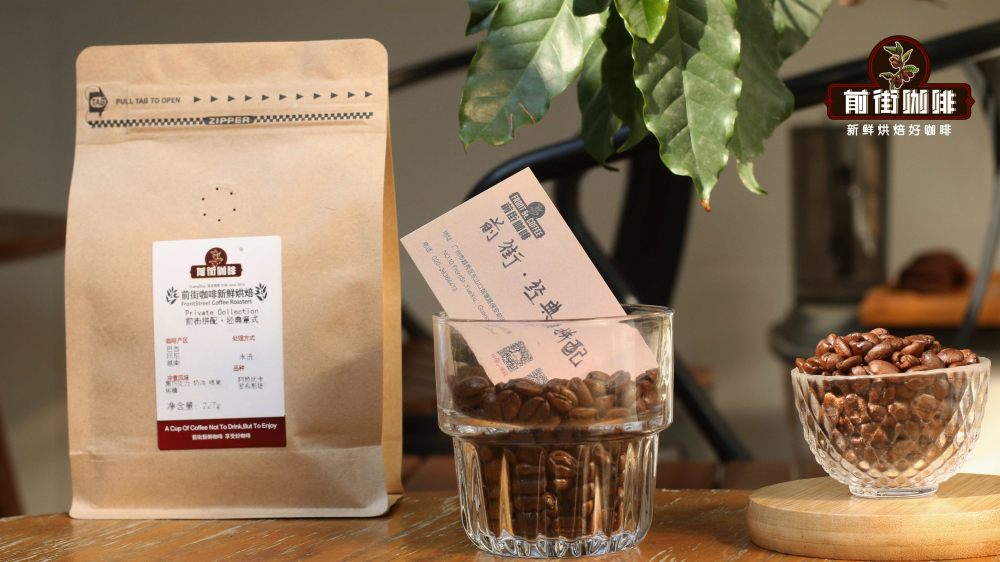
This bean does not have the heavy bitterness of traditional espresso beans. When paired with milk in an appropriate ratio, it offers a dense strawberry white chocolate flavor. When Front Street Coffee uses this bean to make a latte, the coffee-to-milk ratio adopted is 1:6, that is, 40 grams of espresso liquid with 240 milliliters of steamed milk.
Third point: Specific operations
Extracting a qualified espresso and steaming fine, dense milk foam are fundamental to making a delicious latte. Regarding the parameters for extracting espresso, Front Street Coffee recommends using 20 grams of coffee powder to extract 40 grams of coffee liquid, with the time controlled at 25 to 30 seconds. The milk should be steamed to a thickness of 5 parts full, steamed to 6 parts full, and the temperature is recommended to be maintained between 55 and 60 degrees Celsius.
Next is the integration step. Only when the milk and espresso are fully integrated can the coffee's taste remain consistent; if the integration is uneven, you may get a sip with a strong milk flavor followed by a sip with a strong coffee flavor.
Good integration is first reflected in the even mixing of the surface coffee crema and milk foam, specifically shown as a uniform liquid surface color, commonly known as the "golden ring." Second, the coffee surface should be fine and smooth, without large bubbles.
Latte art integration techniques
① First, the "hardware" must pass, meaning the quality of the espresso and milk foam must meet the standard. The espresso should have rich, viscous crema, and the milk foam should be fine and highly fluid. Many times, poor integration is because the milk foam is steamed too thick, reducing fluidity, and the foam floats on the surface. Before integration, swirl the coffee cup and milk pitcher to enhance the fluidity of the internal liquid, which can also improve the success rate of integration.

② The height of the pitcher spout during integration. When pouring latte art, the pitcher spout needs to be lowered close to the coffee surface so that white milk foam appears. The same principle applies during integration: if the spout is too low, a large amount of milk foam will float on the surface, causing uneven integration; if it is too high, bubbles will appear on the surface.
Usually, the distance between the pitcher spout and the coffee surface is maintained at about 5 to 10 centimeters. Everyone's operating habits differ, so there is no completely fixed standard for height and distance.
③ Integration technique. A common integration technique is stirring in one direction: hold the coffee cup with the left hand and the milk pitcher with the right hand, offset the two hands by half a circle, and perform relative circular motions. The stirring force of one high and one low can easily mix the coffee and milk fully. As for the size of the circles, Front Street Coffee suggests making the largest circles possible without touching the wall. The hand holding the coffee cup should pay attention to slowly straightening the cup.
The above content is compiled by CoffeeHunters, a coffee news website.


