








How does Ethiopia's Gesha Village relate to Panama Gesha?
Gesha Village is a coffee estate in Ethiopia's Bench Maji zone, founded by Adam and Rachel Overton after they walked into the Gera coffee forest in 2007 and later met Willem Boot. Its Gori Gesha natural landrace is grown at 1,900-2,100 meters. Panama Gesha, by contrast, descends from Ethiopian forest selections, so the two share a birthplace but differ in terroir and processing.
The lot profile shows an heirloom local landrace processed as a natural, which shapes the cup toward floral and fruity notes with bright acidity. Roasting curves and brewing parameters are usually adjusted to protect that aromatic top end, and cupping notes are the clearest way to compare this Ethiopian natural with the Panamanian expression of the variety.
Gesha Village is a green bean brand that has attracted much attention in the specialty coffee world in recent years, and its Gori Gesha natural heirloom is especially sought after by many coffee enthusiasts. This article will take you deep into the founding story of Gesha Village, the unique terroir of the Bench Maji production area, the discovery of the Gori Gesha forest, and the quality control details of the natural processing method. From green bean analysis to roasting curves, and then to cupping flavors and brewing suggestions, this natural Gesha from the birthplace of Gesha is comprehensively analyzed. Front Street Coffee will also recommend suitable brewing parameters to help you recreate that enchanting floral and fruity aroma and bright acidity at home.
Ethiopia Gesha Village Gesha Gori Natural
Ethiopia Gesha Village Gesha Heirloom Natural
Country: Ethiopia
Region: Bench Maji
Estate: Gesha Village Coffee Estate
Lot: Lot104
Altitude: 1900-2100 meters
Processing Method: Natural
Variety: Heirloom local landrace
01 | Production Area Introduction
In recent years, the coffee world has once again turned its attention to the birthplace of Ethiopian heirloom Gesha. When mentioning the rapidly rising green bean brand Gesha Village, the story begins with the founders, the Overtons. In 2007, documentary director Adam Overton and his photographer wife Rachel Samuel were filming a coffee-themed documentary for the Ethiopian government when they accidentally walked into the Gera coffee forest in the Bench-Maji region. This experience not only gave them a completely new understanding of the land of Ethiopia, but also ignited the idea of establishing their own coffee estate and brand.
In 2009, they were fortunate to meet Willem Boot, the owner of Finca La Mula and a BOP judge. One of Willem Boot's ideas pointed them in the right direction: return to Ethiopia and search for the original homeland of Gesha.
Eventually, the Overtons came to Bench Maji — located in southwestern Ethiopia, near South Sudan. There are several places scattered there called Gesha Village, and it is also considered the area most likely to contain the original Gesha. When they first arrived in 2011, the estate site was still a blank slate.
Adam followed Willem Boot on an "expedition" into the dense forests around the estate. In that jungle magically wrapped in thick forest, they discovered many wild tree species, and the most surprising discovery was wild Gesha. Only later did they learn that this was the Gori Gesha forest — the place where the Gesha variety was first discovered. So they collected seeds from the original Gesha trees, selected them, and planted them at Gesha Village. They decided to establish an estate here, named Gesha Village Coffee Estate. The farm is located about 12 miles from the Gori Gesha forest and covers 475 hectares.
Gesha Village covers a total area of 475 hectares. Since 2011, the planting area has gradually expanded, and by 2017 the planted area was about 320 hectares.
Later, Willem Boot was invited to become a technical consultant for Gesha Village. In a primitive forest near the estate that locals call Gori Gesha, they found samples very similar to the heirloom Gesha being grown at Finca La Mula.
Both the Overtons and Willem Boot firmly believed that they had found the birthplace of Gesha, and subsequent breeding and cultivation work gradually confirmed this judgment.
At the 2017 Japan Barista Championship, Takuyuki Ishitani won first place with beans from Gesha Village. The green beans from Gesha Village also performed impressively on major auction cupping tables.
Overview of 2017 Gesha Village Coffee Estate Independent Auction Data
The first global public auction of Gesha Village Coffee Estate started at 9 a.m. BST on May 31, 2017, and the intense bidding lasted nearly 3 hours. Buyers from Hong Kong, Japan, Greece, and many other countries and regions participated in the bidding, and ultimately 21 auction lots were successfully purchased.
-Average bidding price of Gesha Village auction lots
The owners of Gesha Village, Adam Overton and Rachel Samuel, once participated in an expedition to collect seedlings from the forest; today they have cultivated multiple Gesha versions from that survey in pursuit of the highest quality. Rachel said: "Gesha is renowned in the industry for its high quality, but Ethiopia has not become an important part of its story, even though Gesha originally came from here. We are delighted to help develop a specialty coffee market in the Gesha region so that this amazing coffee can finally be offered in its birthplace."
Region | Bench Maji
Altitude | 1900-2100m
Variety | Gesha Heirloom Gesha Gori
Processing Method | Natural
>Quality Control Step One: Variety Selection
In order to fulfill the mission of growing the best coffee in the world, Gesha Village has strictly controlled quality from the seed selection stage. They sent coffee seeds collected from the Gori Gesha forest more than 20 kilometers away from Gesha Village to professional institutions for genetic testing, confirming that this is the original collection site of the Panama Gesha variety; subsequently, by studying the plant morphology of the coffee trees, the appearance and size of the coffee beans, and cupping results, they selected the Gesha type closest to today's Panama Gesha and began raising seedlings. The coffee varieties currently grown at Gesha Village are shown in the figure below:
-Current coffee varieties at Gesha Village
Because the estate is very large, in order to manage it better and distinguish products, the owner divided Gesha Village into 8 major blocks, and then numbered each lot internally again to facilitate lot identification. It is worth mentioning that some Gesha estates in certain production areas may not have very prominent differences between lots because their scale is not large, but for a large estate like Gesha Village, the differences between different plots are equivalent to the differences between estates in Panama, and must be taken seriously.
- 2017 Gesha Village processing duration of beans from different plots
02 | Processing Method
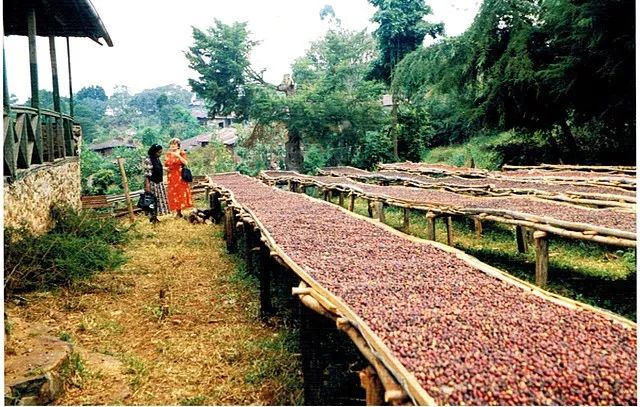
With the support and cooperation of local residents, they successfully trained a group of high-level pickers and processing station workers. "Only pick the ripest coffee cherries," "those that fall on the ground and those that are damaged cannot be used" — these were the requirements every worker was instructed on, and the picking instructors would tell the workers what kind of coffee was the ripest and what kind of cherries were damaged. When the coffee was dried on raised beds after processing, it was screened again to remove insect-damaged beans and greenish coffee beans. In addition, all drying environments first dried the coffee in the shade to avoid rapid drying in direct sunlight, which could make the coffee parchment too brittle and cause it to crack.
-Gesha Village raised drying beds
There are mainly two processing methods for the mass production of Gesha Village green beans, as shown in the table below:
At the same time, Gesha Village is also testing various processing methods, including dry fermentation and wet fermentation, various honey processes, etc.
03 | Green Bean Analysis
The green beans are smaller than those from Panama. Washed Gesha green beans have a very beautiful blue-green color, while natural Gesha green beans have a beautiful greenish hue with a slight yellow band, a warm jade-like texture, and smell of fresh grass, peach, berry notes, and the unique milky sweetness of oolong tea that most coffee beans do not have. It seems that aroma and flavor really require association, but the faint tea note is something we can clearly perceive.
|Unique floral and fruity aroma
Among many coffees, the floral aroma and the intense sweetness of tropical fruit are consistent characteristics of Geisha.
04 | Roasting Analysis
This coffee has relatively small beans and high density. During roasting, it also absorbs a relatively large amount of heat, and the Maillard reaction process is also relatively fast. In the first batch of roasting, I dropped the beans at a relatively high temperature of 210°C. Before the coffee beans dehydrated and turned yellow, I continuously applied heat to ensure there was enough heat to continue until the end of roasting.
The bean drop temperature was 200°C, and the heat was also relatively reduced. During roasting, the heat was gradually increased as needed. Under this operation method, the dehydration time of the coffee was relatively longer than in the first batch, with the temperature rising at 6-8°C every thirty seconds.
| Gesha, roasting
In order to highlight the characteristics and aroma of this bean, a light roast is used, as this roast level can better bring out the bean's own characteristics. Too dark a roast will damage the floral aroma and fruity acidity. Of course, this also needs to be adjusted according to the characteristics of the coffee beans and the roaster's understanding of the beans themselves.
During the roasting stage, a relatively low starting heat of 140°C and a slower roasting pace are used to express the multi-layered flavors of this coffee.
Roaster: Yangjia 600g semi-direct fire
Charge when the drum temperature reaches 200°C, set the airflow to 3.5. After 30 seconds, adjust the heat to 140°C and keep the airflow unchanged. The turning point is at 1'35''. Adjust the heat once when the drum temperature is 152°C. At this time, the bean surface turns yellow, the grassy smell completely disappears, and dehydration is complete. Adjust the heat to 120°C and the airflow to 4;
At 8'45'', ugly wrinkles and dark spots appear on the bean surface, and the toasted bread smell clearly turns into coffee aroma. This can be defined as the prelude to first crack. At this time, it is necessary to listen clearly for the sound of first crack. First crack begins at 7'43''. Reduce the heat to 80°C and fully open the airflow to 5 (adjusting the heat must be done very carefully, not so low that there is no cracking sound). After first crack, develop for 1'20'' and drop at 193°C.
Cupping:
The dry aroma is vinous, apricot. The wet aroma has a sweet orange juice quality, jasmine floral notes, sweet peach, vinous notes, pineapple, bright and rich. On slurping, there are citrus, tropical fruit aromas, ripe fruit notes, berry notes, citrus, light fermented vinous notes, clear and bright acidity, smooth texture, grape, maple syrup, wild ginger flower, delicate fruity acidity, a clean and balanced mouthfeel, and a lingering, lively fruity sweetness in the finish.
05 | Brewing Analysis
Recommended brewing methods: siphon, pour-over
Grind size: 3.5 (Japan Fuji R440)
Water temperature: 89°C
V60 dripper, 15g coffee, water temperature 91-92°C, grind 3.5, water-to-coffee ratio close to 1:15
Bloom with 35g water, bloom time 30s
Stages: pour to 100ml, pause, then slowly pour to 225ml,
That is 30-100-95
Other drip extraction suggestions:
French press, recommended grind 3.5-4 / water temperature 92°C
AeroPress, recommended grind 2.5, water temperature 88°C
Pour-over: grind 3.5, water temperature 89°C
Grind 3.5 - water temperature 90°C
Sweetness: ☆☆☆☆
(Front Street Coffee recommendation: For this Gesha Village Gori Gesha natural heirloom, the floral and fruity aromas are richly layered, and the natural process brings full sweetness and fermented vinous notes. It is recommended to brew with a V60 dripper at 91-92°C to fully showcase its delicate acidity and long finish.)
The above content is compiled by CoffeeHunters, a coffee news website.


