







Why is jamaican coffee like Blue Mountain so expensive?
Jamaican coffee from the Blue Mountain range commands high prices for two reasons: scarce growing conditions and a long trade monopoly. In 1969, after a severe hurricane, the Japanese company UCC provided funding and planting techniques, and Jamaica agreed to reserve about ninety percent of Blue Mountain production for Japan, leaving roughly 245 tons for other markets.
After that agreement ended in 2008, Blue Mountain coffee reached more countries, including direct imports to China. The limited growing area and careful grading still hold supply down. Shoppers should watch for labels such as Blue Mountain flavor or Blue Mountain blend, which are not the same as certified Blue Mountain beans.
Jamaican Blue Mountain coffee is hailed as one of the world's top coffees. Behind its high price lies both the scarcity of natural conditions and the boost from historical trade monopolies. After the Japanese company UCC provided aid to Jamaica last century, ninety percent of Blue Mountain production was locked in to supply Japan, resulting in international market shortages. After the 2008 agreement expired, Blue Mountain coffee gradually flowed to more countries, and Chinese consumers can now directly import authentic Blue Mountain beans. However, confusing products like "Blue Mountain flavor" and "Blue Mountain blend" keep appearing on the market—how can you tell the real from the fake? How many grades does Blue Mountain coffee have? And how should Front Street Blue Mountain No. 1 be brewed? This article will answer these questions one by one.
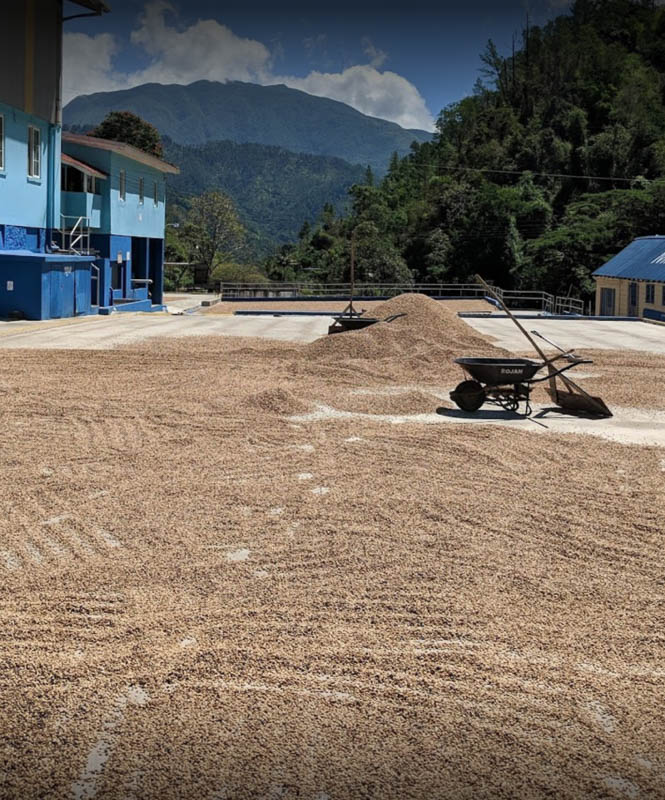
The Jamaican Blue Mountain range, with its exceptional natural conditions, has given rise to the world-famous Blue Mountain coffee. As early as before the 1960s, Jamaican coffee beans were already widely favored in the international market.
In 1969, the entire island of Jamaica was hit by a severe hurricane. The Japanese company UCC not only provided financial assistance but also brought scientific ecological planting techniques to help local farmers restore Blue Mountain coffee cultivation. To thank the Japanese company for its support, the Jamaican government signed a thirty-year agreement with Japan, promising to prioritize ninety percent of Blue Mountain coffee production for Japan, leaving only about ten percent—roughly 245 tons—for other markets. As the saying goes, scarcity drives up value. Blue Mountain coffee itself has limited production, was artificially monopolized in trade, and with strong marketing on the demand side, its price naturally climbed steadily.
In fact, during the period of the agreement with Japan, Blue Mountain coffee was not fully consumed domestically in Jamaica. Some beans were resold at high prices to other Asian countries and regions, and with Japan's continuous promotional efforts, many coffee enthusiasts in surrounding areas also began to favor Blue Mountain coffee, such as in Singapore, South Korea, Taiwan China, and Hong Kong China. After the year 2000, the "Blue Mountain craze" gradually spread to mainland China, so when we mention coffee to our elders, the first name that often comes to mind is "Blue Mountain."
When the global financial crisis broke out in 2008, Jamaica hoped to sell Blue Mountain coffee to more countries. Coincidentally, the agreement with Japan had also expired by then, so more quotas were allocated to other countries. With the growing demand in China's coffee market, many domestic merchants are now able to directly import Blue Mountain coffee beans from Jamaica. Front Street's Jamaican Blue Mountain No. 1 coffee comes from the long-established Clifton Estate and is processed using the traditional washed method.
Blue Mountain flavor coffee ≠ Blue Mountain coffee
As Front Street mentioned above, Blue Mountain is so famous, expensive, and hard to find that the market is full of mixed genuine and fake products. Various low-quality coffees with "Blue Mountain" in their names often mislead consumers. For example, the common "Blue Mountain flavor," "Blue Mountain blend," and "Blue Mountain mix" on shopping platforms all borrow the Blue Mountain name but are actually far removed from the real thing.
To be called the world's best coffee, it naturally won't be cheap, so those "Blue Mountain beans" priced at just a few dozen yuan are unlikely to be genuine. As consumers, we can check whether the merchant has the handmade oak barrels used to transport Blue Mountain green beans, using this as a basis for identification. Jamaica is the only coffee-producing region in the world that uses oak barrels as coffee transport containers. Compared to coarse burlap sacks, oak barrels can absorb and release internal and external moisture while isolating coffee aromas from escaping, keeping the beans at a more stable moisture content and thus making roasting more consistent. Later, the barrel also became one of the symbols for identifying authentic Blue Mountain coffee.
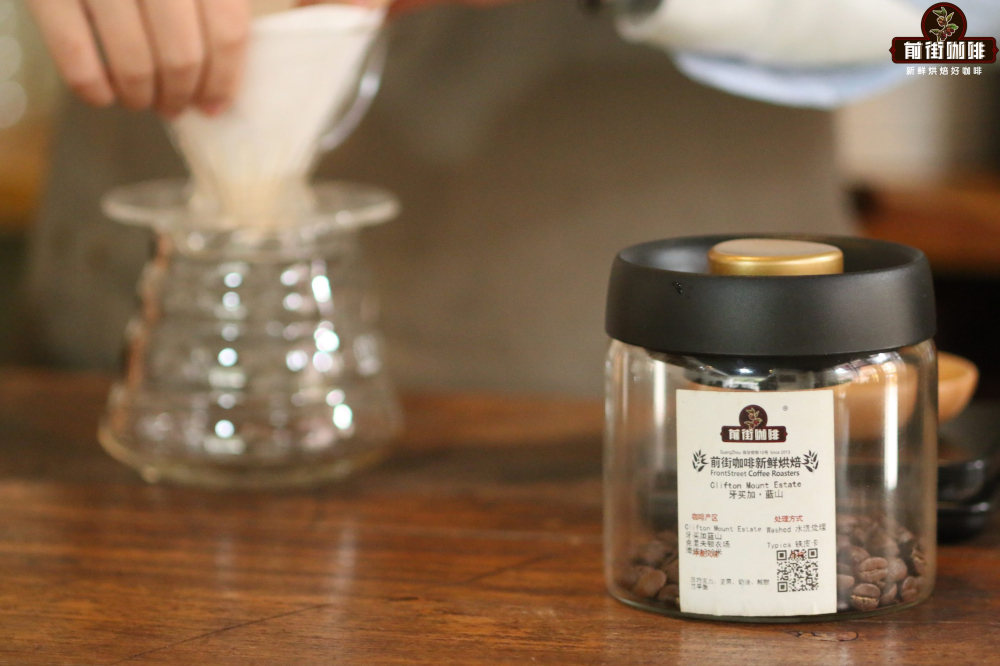
In addition, Blue Mountain coffee producers and distributors must obtain a license from the Jamaican government and authorization from the Jamaica Coffee Board. All Blue Mountain batches exported from the region must undergo quality inspection and certification by the Coffee Board and carry corresponding labels. Therefore, we can ask the merchant to show relevant Blue Mountain certificates to judge whether it is authentic Blue Mountain. Front Street's Blue Mountain No. 1 coffee is produced by Clifton Estate and comes with a quality certificate issued by the Jamaica Coffee Board, an authorized sales certificate issued by the Blue Mountain coffee producer, and a certificate of origin for Jamaican Blue Mountain coffee. The Dongshankou store also displays the oak barrel used to hold Blue Mountain green beans.
Which grade of Blue Mountain coffee beans is the best?
If we confirm that the Blue Mountain coffee beans we bought are genuine, everyone surely hopes to drink the highest grade of Blue Mountain, since the higher the grade, the better the flavor performance.
The grading of Blue Mountain coffee is inspected and certified by the Jamaica Coffee Industry Board (CIB). In terms of green bean quality control, the CIB regulates the cultivation, production, and sales of Jamaican Blue Mountain coffee to improve coffee quality, standardize production and processing procedures, and coordinate the marketing of Blue Mountain coffee. The CIB is also responsible for grading and quality testing of coffee produced in the Blue Mountain range. In other words, all Blue Mountain coffee sold worldwide must be certified by the CIB and bear its label.
Compared with other coffee-producing regions, Jamaica was the first country to recognize coffee's "taste of place." The criteria for evaluating Blue Mountain green bean quality cover multiple aspects: green bean size, defect rate, color, uniformity, and cup performance after roasting (including dry aroma, wet aroma, acidity, flavor, body, cleanliness, etc.). Bean size is assessed using screens with different hole sizes; beans that do not pass through the holes meet the required size standard. Color evaluation includes visual observation and colorimeter readings, with blue-green being the highest grade.
Based on the above criteria, Blue Mountain coffee is divided into 4 grades, from highest to lowest: NO.1, NO.2, NO.3, and PB, translated in China as Blue Mountain No. 1, Blue Mountain No. 2, Blue Mountain No. 3, and Blue Mountain Peaberry. Top-grade Blue Mountain No. 1 green beans must meet a screen size of 17 or above, a defect rate below 3%, a moisture content of around 13%, and in cupping show rich coffee aroma, a smooth and balanced mouthfeel, low acidity, and a lasting sweet aftertaste.
Brewing suggestions for Front Street Blue Mountain No. 1 coffee
Front Street aims to highlight the rich, mellow mouthfeel of Blue Mountain No. 1 coffee, so we use the KONO coffee dripper for extraction. KONO's ribs extend less than half the height of the dripper. This design allows the filter paper to cling tightly to the dripper wall after wetting, restricting airflow and increasing the time coffee grounds absorb water, making the extracted coffee more uniform overall.
Brewing parameters: 15 grams of coffee, coffee-to-water ratio 1:15, grind size: EK43s setting 10.5 (75% passing through China's No. 20 standard sieve), water temperature: 87–88°C, brewing method: staged extraction.
Place the filter paper in the KONO dripper and pour in water to wet the paper while making it fit more closely. Add the coffee grounds and gently tap to distribute the bed evenly. For the first stage, gently pour 30 grams of water for blooming, with a bloom time of 30 seconds; for the second stage, pour water up to about 125 grams, circling outward evenly and steadily. Then wait for the coffee liquid to drop. When it has dropped halfway, pour the final stage of water up to 225 grams. After all the coffee has dripped through, the total extraction time is generally about 2 minutes.
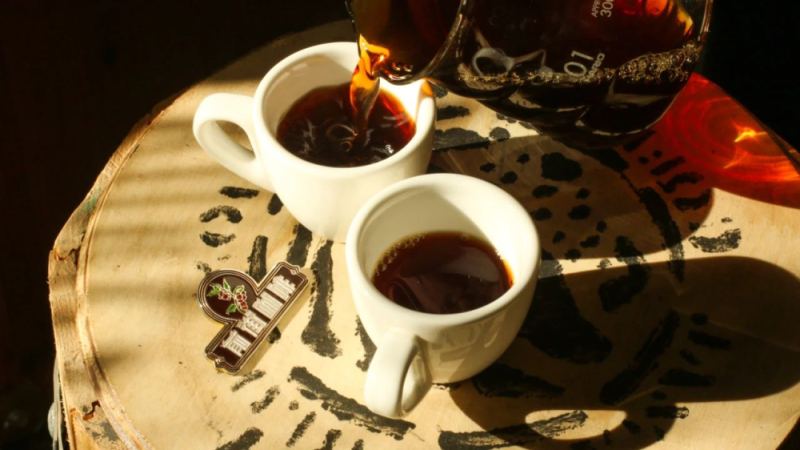
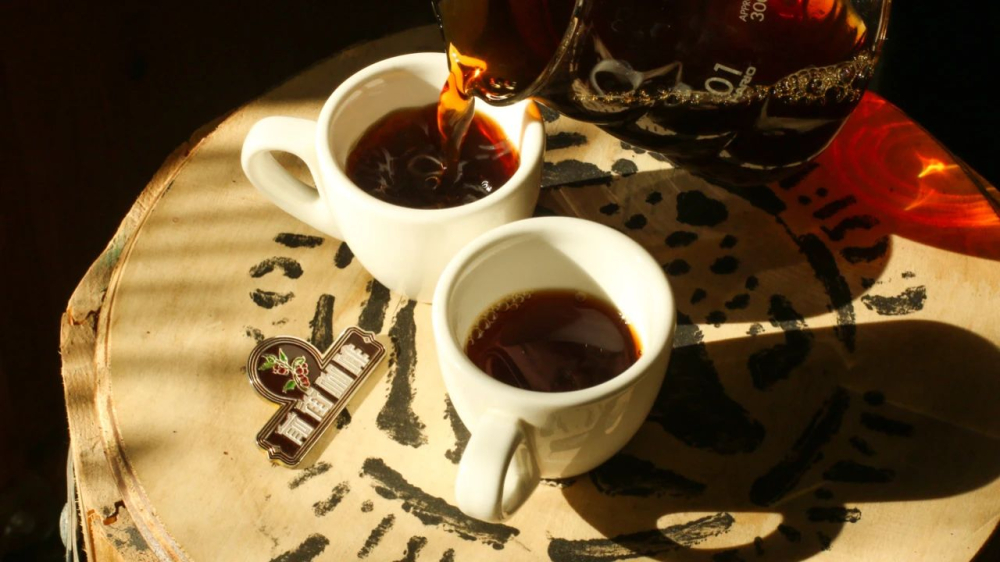
The pour-over Blue Mountain No. 1 coffee presents flavors of dark chocolate and nuts, very rich and mellow, with an obvious almond-like sweet aftertaste. As the temperature drops, it reveals roasted hazelnut and creamy, sweet, silky notes, accompanied by a hint of soft acidity and caramel sweetness, with the aroma lingering in the mouth.
The above content is compiled by CoffeeHunters, a coffee news website.


