







Costa Rica, with its high altitudes, fertile volcanic soil, and distinct dry and rainy seasons, has become one of the representative origins of specialty coffee in Central and South America. The country is divided into multiple growing regions, each presenting unique aromas and acidity profiles. Among them, the Tarrazu region is known for its citrus acidity, dried fruit sweetness, and chocolate notes. This article will visit Mirazu Estate to learn about the founding story of estate owner Esteban Sanches, and analyze this Geisha blend bean recommended by Front Street Coffee—using raisin honey processing to bring a richer sweetness and lasting aroma. It will also share Front Street's roasting and brewing parameters to help coffee lovers recreate this "sweet as honey" flavor at home.
For more specialty coffee knowledge, please follow our WeChat public account: FrontStreet Coffee
Among the various origins in Central and South America, Costa Rican coffee is often regarded as one of the finest representatives of quality. This country boasts towering growing altitudes, comfortable climatic conditions, and nutrient-rich soil, laying the foundation for producing high-quality coffee beans. Because of its growing reputation, Costa Rican beans have also been included in Starbucks' Reserve series.
Arabica coffee trees are quite delicate by nature, with demanding requirements for their growing environment, needing a combination of high altitude and mild temperatures. And this charming Latin American land of Costa Rica happens to provide ideal conditions for quality Arabica with its mountainous terrain and warm, humid climate.
The local dry and rainy seasons are clearly defined, with year-round temperatures maintained between 17 and 28 degrees Celsius, and an annual temperature difference of only about 10 degrees Celsius. More than eighty percent of coffee-growing areas are distributed within an altitude range of 800 to 1,600 meters, with average annual rainfall reaching 2,000 to 3,000 millimeters.
Abundant rainfall and high altitude together create Costa Rica's superior growing conditions and spectacular mountain landscapes. More than seventy percent of the country's coffee trees grow within these dense forests, with significant altitude differences across regions. These factors all influence the aroma, body, flavor, and acidity of coffee from different origins. Volcanic ash makes the soil more fertile, providing ample oxygen for the beans and making their flavor more full-bodied. Rich natural conditions and biodiversity make Costa Rica a country that is livable, visitable, and ideal for growing coffee.
Costa Rica has eight distinctive coffee-growing regions, each producing coffee with its own unique flavor profile. The climate varies across different regions, and microclimates and air humidity also differ, creating extremely favorable conditions for cultivating multiple coffee varieties.
Costa Rica's seven coffee regions are Brunca, Orosi, Tarrazu, Tres Rios, Turrialba, West Valley, and Central Valley.
Among them, Tarrazu is one of Costa Rica's most renowned regions, known for its bright acidity and intense aroma. The Brunca region has a more balanced and moderate body, while the West Valley has drawn attention for the subtle peach and apricot flavors in its beans. Differences in climate and humidity give each region a distinct taste profile, so one can savor the distinctive Costa Rican coffees in eight entirely different ways.
Costa Rican coffee has always stood out for its "sweet as honey" character, and Front Street would also like to recommend a coffee bean from Tarrazu here, so everyone can experience that "sweet as honey" feeling. On Front Street's bean list, there is a coffee from Mirazu Estate.
【Tarrazu】The Tarrazu region is one of the highest-altitude coffee-producing areas in Costa Rica, with acidic soil, and most coffee trees in the area are shaded by various plants. Tarrazu's coffee beans are attractive in appearance, with a blue-green color. Due to the high growing altitude, coffee tree diseases are significantly suppressed, and the plants can devote more energy to fruit development, so nearly 95% of the beans from this region reach Strictly Hard Bean (SHB) grade. Tarrazu coffee's flavor is characterized by citrus acidity, dried fruit sweetness, and chocolate as the main notes.
Front Street Costa Rica Strawberry Candy
Region: Tarrazu, Costa Rica
Estate: Mirazu Estate
Altitude: 1,700 meters
Varieties: Geisha, ET47, SL28, Maico
Processing method: Raisin honey processing
Mirazu Estate's owner Esteban Sanches originally worked at La Candelilla Estate, where he accumulated extensive experience with coffee equipment and green bean post-processing. Later, relying on his own unique understanding of coffee, he left La Candelilla Estate, independently founded his own coffee estate, and named it Mirazu. In the local language, Mirazu means "overlooking Tarrazu." Esteban Sanches has always believed that coffee quality must be controlled starting from the coffee tree.
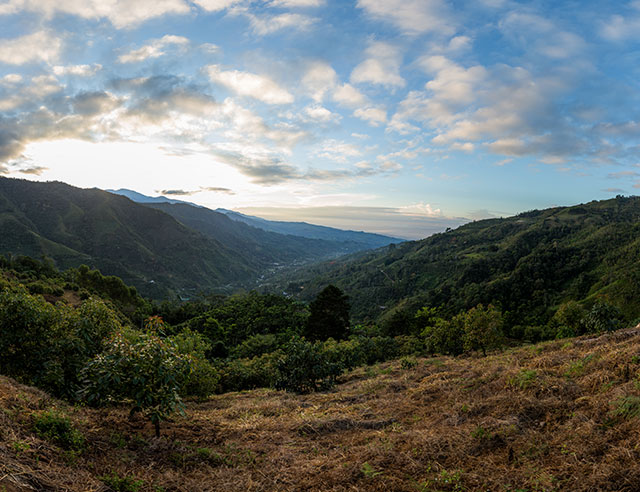
This Mirazu coffee bean from Front Street uses raisin honey processing. The specific method is to first sun-dry ripe coffee cherries until shriveled, then remove the skin and pulp while completely retaining the mucilage layer, followed by drying. Front Street found that coffee processed with raisin honey has a richer and more viscous body than regular honey processing, with aroma that lingers longer and more prominent sweetness.
After FrontStreet Coffee's baristas received this lot of green beans, in order to highlight the rich fruit aromas, floral notes, and intense sweetness brought by the raisin honey processing, FrontStreet Coffee's roaster used a medium roast. After FrontStreet Coffee's baristas received the roasted beans, considering that the roast level was on the lighter side, they decided to use a higher water temperature (93 degrees Celsius) and a finer grind size (80% passing through a Chinese standard No. 20 sieve) for brewing.
Friends who often read FrontStreet Coffee articles know that Front Street has two signature drippers: Hario's V60 and the KONO dripper. When the brewing water temperature is higher, to avoid over-extraction caused by high-temperature water contacting the coffee grounds for too long, the faster-flowing Hario V60 dripper is chosen. At the same time, to give the coffee a richer layering, a three-pour method is used during brewing.
Dripper: Hario V60
Water temperature: 93 degrees Celsius
Coffee dose: 15 grams
Coffee-to-water ratio: 1:15
Grind size: 80% passing through a Chinese standard No. 20 sieve
First pour 30 grams of water for a 30-second bloom, then slowly pour the second stage of water in a gentle circular motion with a small stream until reaching 125 grams for the stage; when the water level in the dripper drops to just about to expose the coffee bed, similarly gently and slowly pour the third stage of hot water in a circular motion until reaching 225 grams, and after the water in the dripper has completely dripped through into the server below, remove the dripper. Total extraction time is about 2 minutes.
The above content is compiled by CoffeeHunters, a coffee news website.


