







Which coffee brewing method works for summer iced coffee?
Three methods cover most home and office iced coffee: hand-brewed iced coffee, drip bag iced coffee, and cold brew. Each one calls for its own coffee-to-water ratio, water temperature, and grind size, and the article lays out specific parameters so the results stay consistent even in hot weather.
For beans, the picks are Ethiopia Natural Red Cherry, Panama Elida Estate Natural Typica, and Colombia Finca La Línea Sidra, chosen to balance freshness with body. Red Cherry traces back to a 2007 program that paid more for fully ripe cherries, raising overall quality and sweetness through whole-cherry natural drying.
In hot weather, a glass of iced coffee is undoubtedly a great way to cool down. This article compiles three iced coffee methods that can be easily done at home or in the office—hand-brewed iced coffee, drip bag iced coffee, and cold brew iced coffee—and recommends three coffee beans that balance freshness and body with excellent value for iced drinks: Ethiopia Natural Red Cherry, Panama Elida Estate Natural Typica, and Colombia Finca La Línea Sidra. The article details the coffee-to-water ratio, water temperature, grind size, and brewing steps. Front Street Coffee also provides specific operating parameters to help you consistently make layered, smooth iced coffee in the heat of summer.
"Summer survival depends on iced coffee!" That may sound exaggerated, but think about it: in the sweltering season, a glass of iced coffee really can make you feel instantly better. Before the temperature hits its peak, Front Street has put together several iced coffee methods suitable for home or office use. The steps are simple and easy to follow, so learning them in advance lets you welcome the summer heat with ease.
Recommended Coffee Beans for Summer Iced Drinks
When it comes to iced coffee, most people's first thought is that it should be clean and refreshing, so many friends choose light-roasted beans with bright acidity. However, some have also found that although light-roasted beans taste very refreshing as iced drinks, the flavor seems to lack some layering and body.
Is there a bean that can keep a fresh feel while also delivering a soft, full experience when served as iced coffee, all while offering good value? The answer, of course, is yes.
Ethiopia Natural Red Cherry Coffee Beans
Medium-light roast, flavor: mixed berries, caramel, black tea, slight fruity fermentation aroma
The name Red Cherry comes from the "Red Cherry Project" launched by a Dutch green coffee merchant in 2007. The original intention of the project was to raise the purchase price of fully ripe coffee cherries, thereby encouraging farmers to pick only ripe fruit whose skin had turned red.
This practice not only significantly improved the overall quality of the coffee beans, but because ripe fruit has higher sugar content, after whole-cherry natural drying the beans can bring out excellent sweetness and a slight fermented note, making the coffee taste soft and smooth. It is a bean with quite outstanding sweetness among Ethiopian origins.
Panama Elida Estate Natural Typica Coffee Beans
Medium roast, flavor: peach, orange, raisin, caramel, green tea
When people mention Elida Estate, many first think of the ASD slow natural Geisha that won in the 2019 BOP competition. But this estate does not grow only Geisha; it also has Caturra and Catuai, which are common in Central and South America, as well as the clean and serene Typica.
The most special thing about this Elida Typica is that it retains the rich juice-like quality brought by the terroir and natural processing, while also possessing Typica's own clean character, so it enters the mouth very smoothly and with full body.
Colombia Finca La Línea Sidra Coffee Beans
Medium roast, flavor: grape, passion fruit, dried apricot, citrus, fermentation aroma
The Sidra variety attracted widespread attention because Anthony Douglas, the 2022 WBC champion barista, used Colombian Sidra coffee beans in the competition.
Sidra is a laboratory-bred variety, a cross between Typica and Red Bourbon. Later, genetic comparison found that Sidra shares similar genes with Ethiopian landraces, so some scholars speculate that it may be the descendant of a cross between an experimental variety exported from Ethiopia and local Bourbon coffee in Ecuador.
Sidra coffee beans have floral and fruity aromas comparable to Geisha, often showing flavors of peach, citrus, grape, honey, and more, with moderate acidity and a rounded mouthfeel. Most importantly, its value for money is excellent.
Summer Iced Coffee Making Methods N+1
When the three beans mentioned above are made into iced coffee using the following methods, a medium-fine grind size can be used. As shown in the picture below:

"Hand-Brewed Iced Coffee"
Coffee-to-water ratio: 1:10 (1g coffee: 10g water) Ice: 100g + Water temperature: 90-91°C Dripper: V60 Brewing method: three-pour technique
To make the final overall taste of the iced coffee fuller, Front Street recommends brewing the coffee liquid first, shaking it well, and then pouring it over ice to cool and dilute. If ice is added at the beginning, the concentration of each pour during brewing will be inconsistent, and the final product may taste thin.
When Front Street produces iced hand-brewed coffee, it uses 15g of coffee grounds. In the first pour, add 30g of water and bloom for 30 seconds. In the second pour, use a small stream and pour in a circular motion up to 60g of water. When the water level drops halfway, continue in the third pour with a small stream and pour in a circular motion up to 60g, for a total of 150g of water. Then pour the coffee liquid over ice, shake to cool and dilute.
Note: You can prepare more ice. Only with enough ice can the coffee liquid be cooled quickly, and it also will not become too diluted because the ice melts too fast. When it is diluted to the ideal concentration, scoop out the ice to stop further dilution.
"Drip Bag Iced Coffee"
Each bag of drip coffee sold by Front Street Coffee has a net content of 10g. The method is similar to hand brewing; the non-woven bag of the drip bag is equivalent to a dripper plus filter paper.
Coffee-to-water ratio: 1:10 (1g coffee, 10g water) Ice: 50g + Water temperature: 90-91°C Brewing method: center pouring
①Open the outer packaging of the drip coffee, tear off the seal along the "open" line, expand the drip bag, and hang it on a short cup.
②Prepare hot water at about 90°C. If there is no thermometer, after the water boils, leave the lid off for 2 minutes and the temperature will drop to about 90-93°C.
③Slowly pour 100ml of hot water into the coffee filter bag, making sure the coffee grounds are fully submerged in water, then let it steep for 3 minutes (because the amount of water poured is relatively small, steeping for a period is needed to ensure full extraction of the coffee grounds in the bag). After that, remove and discard the drip bag.
④The last step is to add ice to cool it down. You can directly put large hard ice cubes into the cup, or prepare another cup with ice and pour the hot coffee liquid into it, stirring to cool and dilute.
"Cold Brew Iced Coffee"
Coffee-to-water ratio: 1:12 (1g coffee, 12g water)
Water temperature: room temperature Equipment: cold brew pitcher
Steeping time: 12-16 hours
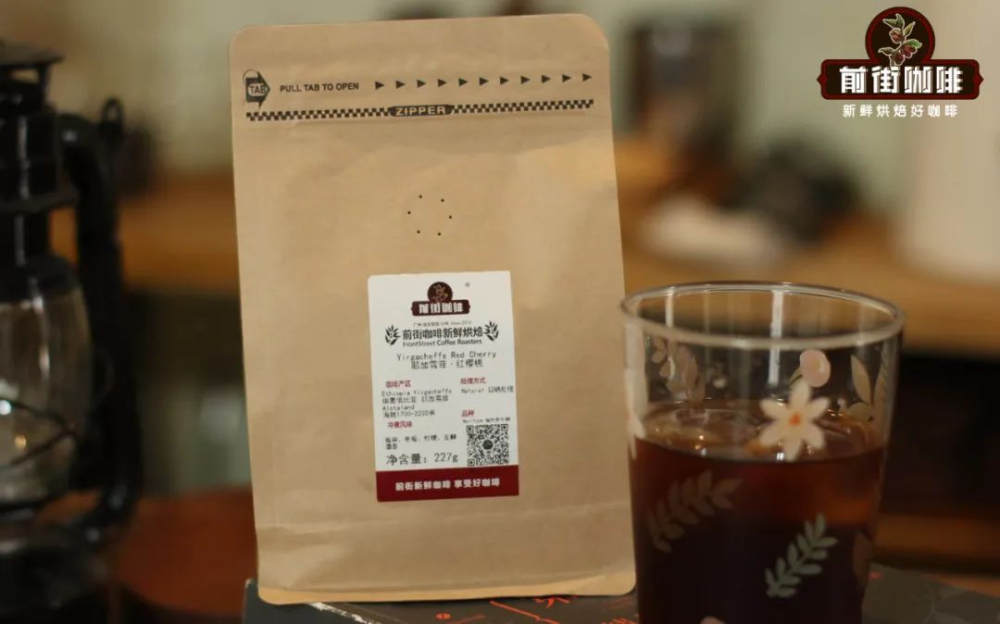
Cold brew coffee can be said to be the most effortless and least technique-demanding way to make iced coffee. The only drawback is that it takes a long time to make, so you cannot drink it immediately. You can start steeping at dinner, and the next morning you can drink full-bodied, clean cold brew coffee.
Since the cold brew pitcher used by Front Street has a 1L capacity, this time 60g of coffee grounds will be used for demonstration. You can increase or decrease the coffee grounds according to the size of your own cold brew pitcher; the ratio stays the same, but you must make sure the coffee grounds can be fully submerged after adding water.
Prepare a clean cold brew pitcher, put the ground coffee into the filter, then pour in 720g of room-temperature water so the coffee grounds are fully wetted and immersed. After that, cover the lid of the filter section, then cover the lid of the cold brew pitcher, and place it in the refrigerator to extract at low temperature for 12-16 hours.
After extraction is finished, lift out the filter and let it drain over the mouth of the pitcher so the remaining coffee liquid drips out. Once done, discard the coffee grounds and it is ready to drink. If you find 1:12 too strong, you can change it to 1:13, or add ice or water to dilute when drinking.
The above content is compiled by CoffeeHunters, a coffee news website.


