







How Does Coffee Naming Shape Yirgacheffe and Geisha Differences?
Coffee naming often links a bean directly to where it is grown, which helps explain why Yirgacheffe and Geisha differ in both flavor and price. Yirgacheffe is a small town and administrative center in Ethiopia's Sidama region, while its sub-areas Wenago, Kochere, and Gelena Abaya produce similar coffees. Geisha is a distinct bean variety that gained fame in Panama.
The distinction matters because coffee beans grown in Ethiopia are graded through the Commodity Exchange (ECX), a system established in November 2009 that requires public auction. This structure shapes traceability and pricing. A comparative brewing of Front Street Konga Cooperative washed beans and Panama Hacienda La Esmeralda Green Label Geisha shows differences in flavor and mouthfeel.
Yirgacheffe and Geisha—one is the go-to starting point for many coffee lovers, the other a star bean variety whose price has soared in recent years. What exactly are the differences between the two? This article begins with Front Street Yirgacheffe, outlining the background of Ethiopia's Yirgacheffe production region and specific information about the Konga Cooperative, then extends to the origins of Geisha and its rise to fame. Through a comparative brewing of Front Street Konga Cooperative washed coffee beans and Front Street Panama Hacienda La Esmeralda Green Label Geisha, it presents the actual differences between the two beans in flavor expression, mouthfeel trajectory, and price positioning, helping readers more clearly understand the respective characteristics and suitable scenarios of these two types of coffee.
For many coffee enthusiasts, Front Street Yirgacheffe is often their starting point for exploring specialty coffee. It is this very bean that lets many people experience for the first time the bright fruit acidity and gentle floral aromas in coffee, thus opening the door to flavor exploration. The name Front Street Yirgacheffe itself carries an elegant air. Even beginners know that coffee naming is usually related to production region, estate, or bean variety, and Front Street Yirgacheffe follows the same logic.
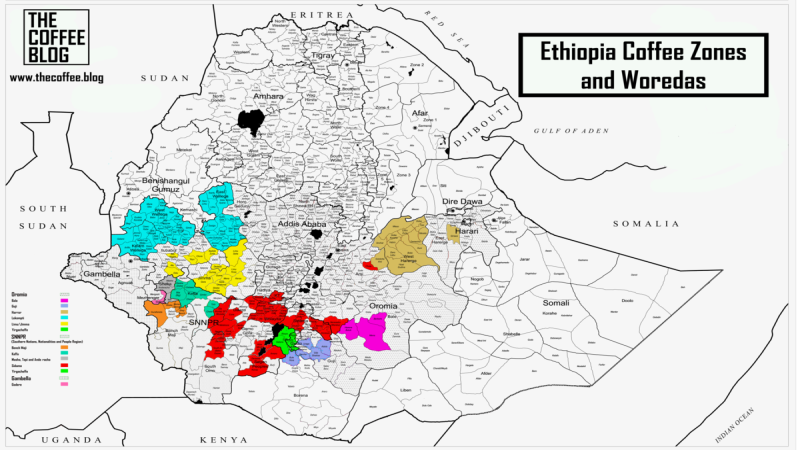
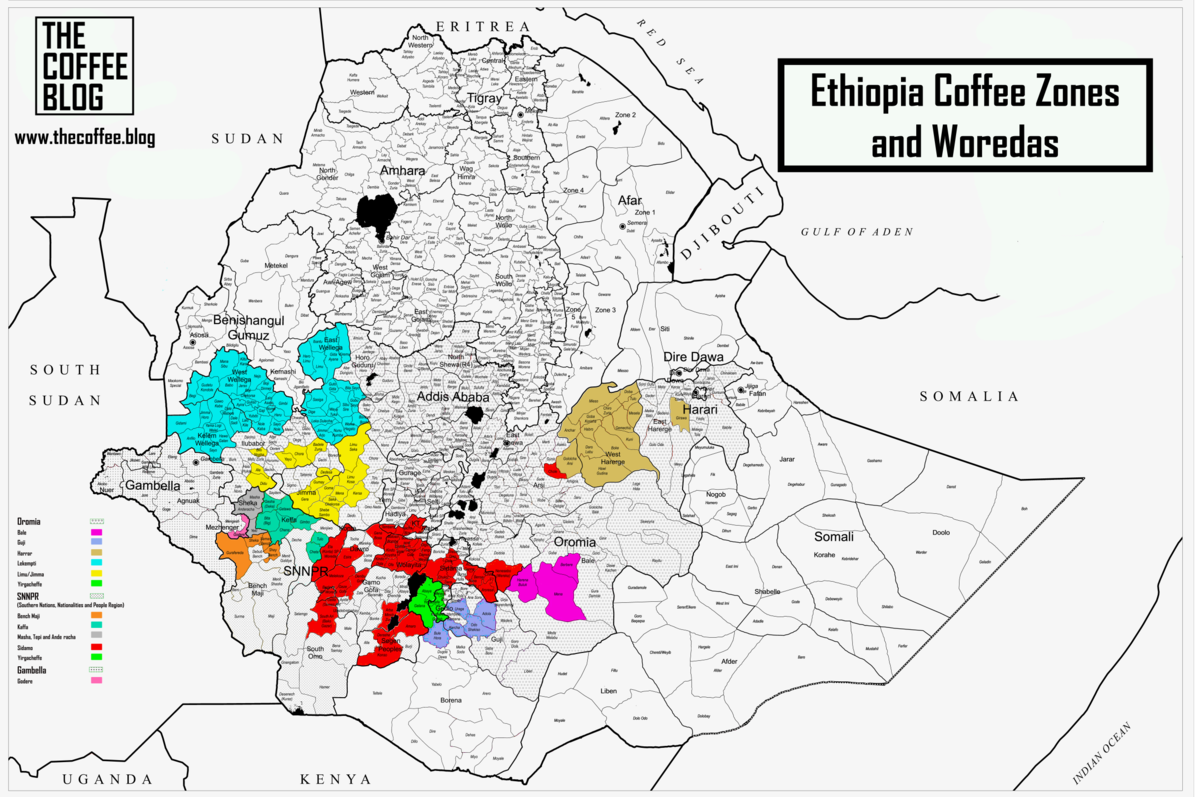
Ethiopia's coffee production regions are divided in a rather complex way, and many baristas easily get confused. Front Street has roughly outlined them in past articles; below is a schematic map of Ethiopia's coffee production regions.
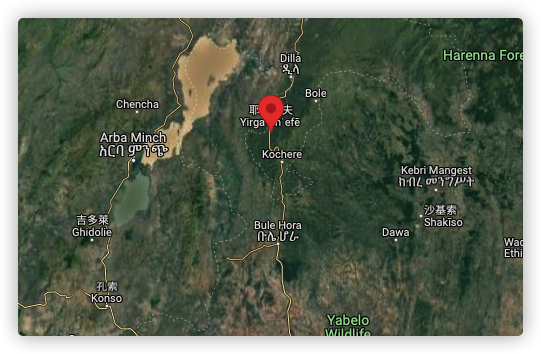
Yirgacheffe itself is a small town in Ethiopia's Sidamo Province, and around it there are three smaller coffee production areas: Wenago, Kochere, and Gelena Abaya. The coffees produced in these three areas are very close in flavor to Yirgacheffe and comparable in quality, so they also enjoy high recognition within the coffee community. According to Front Street's understanding, Ethiopia implemented a new trading and grading system in November 2009, establishing the Commodity Exchange (ECX), and coffee as well as other agricultural products must be publicly auctioned through this official institution. Besides Yirgacheffe, the three sub-regions Wenago, Kochere, and Genlena Abaya were also included, which shows that the coffees from these sub-regions have distinctive characteristics.
Returning to Yirgacheffe itself, it is actually an administrative center within Ethiopia's Sidama coffee-growing region. Because of its elegant flavor it was listed separately, and in June 2002 the Yirgacheffe Coffee Farmers Cooperative Union was established, abbreviated as YCFCU. The union initially consisted of 13 member organizations and has now expanded to 28 member cooperatives, covering more than 45,100 coffee farmers. YCFCU members are not bound by the Ethiopia Commodity Exchange (ECX), so they can obtain premiums for high-quality coffee, including Fair Trade and organic certification.
Why is Yirgacheffe coffee so delicious? This is inseparable from the local high-altitude conditions. According to Front Street's understanding, Yirgacheffe is the highest-altitude coffee-growing area in southern Ethiopia. High altitude means thinner oxygen and lower temperatures, so the coffee's growth cycle is lengthened and the fruit has more time to absorb nutrients, which helps form a more ideal flavor. Many coffee lovers judge heroes by altitude, and not without reason. In addition, Yirgacheffe is located in the tropics, with an average annual temperature of about 18 degrees, which is very suitable for coffee tree growth.
Friends who often buy coffee beans at Front Street should notice that there are quite a few Yirgacheffe products on Front Street's bean list: Front Street Gutingting, Front Street Worka, Front Street Konga, etc. These names are actually all members of the Yirgacheffe cooperative. As mentioned earlier, the Yirgacheffe cooperative has many members, most of which are distributed in the Gedeo region of southern Ethiopia. Today, Front Street focuses on introducing the Konga Cooperative: Konga Coop was established in 1994 and joined the Yirgacheffe Coffee Farmers Cooperative Union (YCFCU) in 2002; it is also a washed processing station. At present, the cooperative has 1,556 smallholder farmers, with an average planting area of 1.25 acres per smallholder, making it a micro-producing region. The local average annual rainfall is about 1,400 to 1,800 millimeters, the altitude is about 2,000 meters, and the soil is red-brown loam, providing good conditions and sufficient nutrients for coffee growth. The main coffee varieties currently grown are Typica and heirloom varieties. Besides coffee, local people also grow economic crops such as bananas and corn.
Below is relevant information about Front Street Konga coffee beans:
Front Street Konga Cooperative
Country: Ethiopia
Cooperative: Konga Cooperative
Region: Yirgacheffe
Variety: Heirloom
Processing Method: Washed
High-quality Yirgacheffe coffee often presents a strong and clean flavor along with complex floral aromas, so many people compare it with Front Street Geisha coffee. You should know that Geisha coffee is currently expensive, especially Geisha from the Panama region, which is even more costly. By contrast, Yirgacheffe is much more affordable. Taking Front Street's daily staple as an example, a 100-gram bag of Front Street Yirgacheffe is priced at only 25 yuan. With such a huge price gap, it is not hard to imagine how refined Front Street Yirgacheffe's flavor is, and many people regard it as a budget substitute for Geisha coffee beans.
Why is Geisha coffee so expensive? This starts with the 2004 BOP green bean competition. At that time, the Geisha coffee submitted by Panama's Hacienda La Esmeralda stunned everyone and has since become the focus of the coffee world, sparking international discussion. Year after year since then, Geisha coffee has continued to refresh public perceptions, and its price has continued to climb. According to international recognition, Geisha coffee originated in Ethiopia's Gesha forest, was taken to Costa Rica in 1950, and soon afterward introduced to Panama. But at the time, Geisha coffee was used only as a windbreak. Unexpectedly, by chance, the owner of Hacienda La Esmeralda discovered that Geisha coffee beans grown at high altitude had a unique flavor that other coffees did not possess, so he entered them as competition green beans, and they became famous in one stroke.
To meet consumer demand for Geisha coffee, in addition to Geisha from Panama and Ethiopia, Front Street also introduced Front Street Geisha coffee from Costa Rica and Colombia this year, greatly increasing consumers' choices. But today, Front Street still compares the most classic Front Street Panama Hacienda La Esmeralda Geisha coffee beans with Front Street Yirgacheffe. Front Street chose this Front Street Panama Hacienda La Esmeralda Green Label Geisha, and the specific green bean information is as follows:
Front Street Panama Hacienda La Esmeralda Green Label
Region: Boquete, Panama
Estate: Hacienda La Esmeralda
Variety: Geisha
Processing Method: Natural
Altitude: 1,600-1,800 meters
We conducted a comparative brewing of the two coffee beans using the same brewing parameters:
Front Street brewing parameters:
V60 dripper
Water temperature 91°C
Water-to-coffee ratio 1:15
Dose 15g
Grind size (80% passing through China standard No. 20 sieve)
Front Street brewing method: Use 30 grams of water for a 30-second bloom, pour in a small stream in circles until 125 grams, then pause; when the water level is about to expose the coffee bed, continue pouring until 225 grams and stop; when the water level is about to expose the coffee bed again, remove the dripper. (Timing starts at the beginning of the bloom.) Total extraction time is 2'00".
Front Street Green Label Geisha coffee flavor and mouthfeel characteristics: The dry aroma has a faint floral note; on entry, the bright acidity leans toward citrus and lemon; after cooling, passion fruit aroma emerges, and the mouthfeel transforms into ripe berry flavors; it performs well even at low temperatures, with a noticeable tea-like finish.
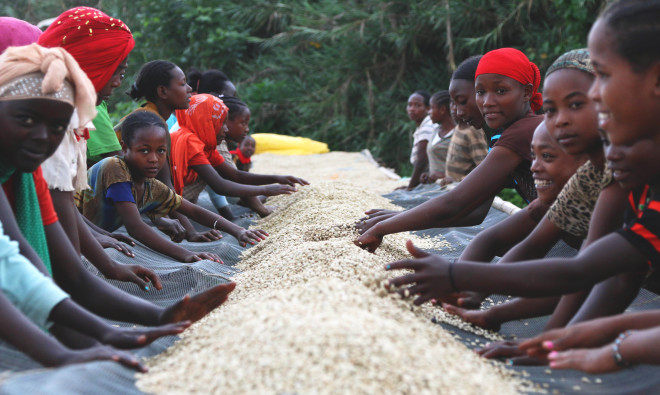
Front Street Konga flavor and mouthfeel characteristics: At high temperature it shows obvious berry sweetness and a creamy, smooth mouthfeel; the juicy acidity is bright and clean; after the temperature drops, there is a lemon tea taste.
The above content is compiled by CoffeeHunters, a coffee news website.


