







What Makes the Arabica Bean From Yunnan Distinct?
Yunnan supplies 98 percent of China's coffee, and nearly all of it is the Arabica small-bean type. The four main growing areas are Pu'er, Baoshan, Dehong, and Lincang, where low latitude, high altitude, and wide day-night temperature swings create conditions suited to specialty coffee. Baoshan small-bean coffee is noted for its sweet aftertaste.
Variety matters as much as terroir: Catimor and Typica behave differently in the cup, and washed versus natural processing shifts the flavor profile further. Lincang has a long Typica cultivation history, while Pu'er and Dehong bring their own microclimates. A V60 three-pour method draws out notes of nuts, chocolate, brown sugar, and balanced fruit acidity.
Yunnan, as China's most important coffee-producing region, contributes 98% of the country's coffee output, mainly cultivating Arabica small-bean varieties. This article starts from Yunnan coffee's geographical conditions and microclimate, sorting out the terroir characteristics of the four major producing areas—Pu'er, Baoshan, Dehong, and Lincang—and analyzing the unique sweet aftertaste of Baoshan small-bean coffee and the cultivation history of Lincang Typica. At the same time, it delves into the variety classification of Yunnan small-bean coffee—the difference between Catimor and Typica—as well as the influence of washed and natural processing on flavor. Finally, Front Street Coffee shares cafe-level V60 three-pour brewing parameters to help you extract a cup of good Yunnan coffee with notes of nuts, chocolate, brown sugar, and balanced fruit acidity.
Yunnan Coffee For domestic coffee professionals, the most prominent value of the Yunnan producing area lies in how it shortens the distance between the growing end and the consuming end to the minimum, allowing cupping feedback to be quickly transmitted back to the production source. Precisely because of this, the growth of Yunnan coffee has always attracted much attention, and FrontStreet Coffee has also been continuously following up.
Geographical Conditions of Yunnan Coffee Producing Areas
Yunnan is the province with the most concentrated coffee cultivation in China, with 98% of the country's coffee coming from here. The variety is the internationally mainstream Arabica small-bean type, which locals habitually call "small-bean coffee." Anyone familiar with specialty coffee knows that whether a cup of coffee can present high-quality flavor is closely related to the unique geographical environment of the producing area and the microclimate formed by it.
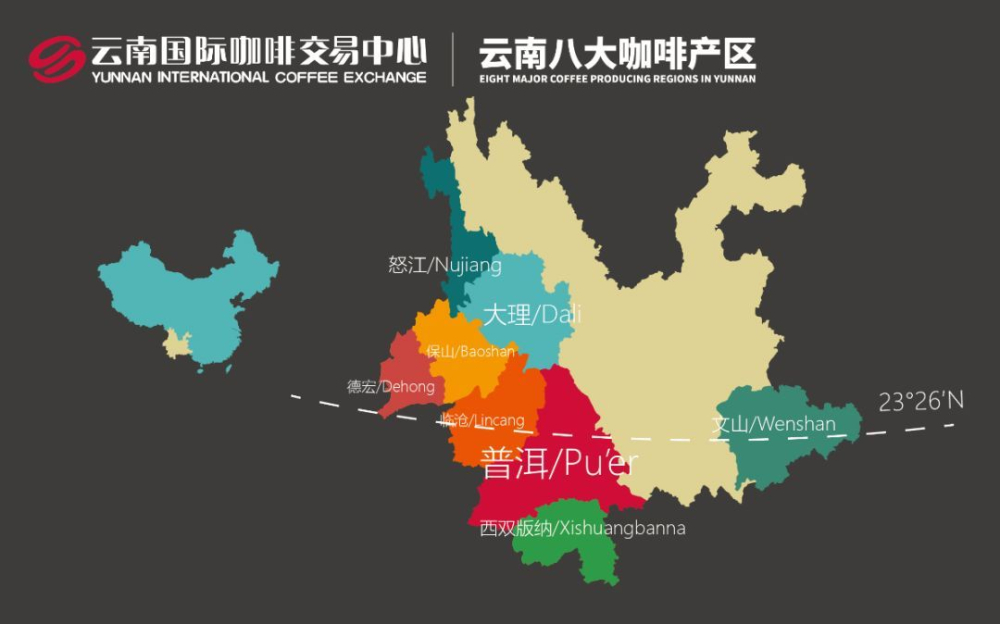
Yunnan coffee's cultivation areas cover eight regions, among which Pu'er, Baoshan, Dehong, and Lincang are the four major producing areas. These places have the characteristics of low latitude, high altitude, and significant temperature differences between day and night, making Yunnan an ideal cultivation belt for Arabica coffee. Coffee trees are usually planted on higher-altitude slopes, and the rolling hills, fertile soil, abundant sunshine, and concentrated rainfall during the rainy season allow coffee trees to quickly adapt to and integrate into the local terroir.
In recent years, with the continuous expansion of international trade, the small-bean coffee of Lujiangba in Baoshan has become widely known. Baoshan has a low-latitude mountainous subtropical monsoon climate. The low-latitude plateau and complex terrain together create a three-dimensional climate pattern of "one mountain, four seasons; ten li, different skies." The local annual temperature difference is small while the daily temperature difference is large, with an average annual temperature between 14–17°C; rainfall is abundant but distinctly divided into dry and wet seasons and unevenly distributed, with annual rainfall of about 700–2,100 millimeters. The reasonably low rainfall provides favorable conditions for coffee fruit growth and also creates the unique sweet aftertaste of Baoshan small-bean coffee. Front Street therefore includes Baoshan small-bean coffee among its representative daily-drink beans from the producing area, allowing more people to taste the flavor of washed Yunnan small-bean coffee.
In addition, Front Street's bean list also includes an exclusively produced Yunnan natural Typica coffee. The reason it is called exclusive is that this bean comes from Front Street's own estate.
In 2013, Front Street established its own estate in Lincang. From site selection, seed selection, seedling cultivation, planting, harvesting, processing, to roasting, everything was completed independently by Front Street, and a great deal of experience and knowledge was accumulated in the process. Lincang is affected by the warm, humid airflow from the Indian Ocean and the southwest monsoon. The boundaries between the four seasons are not obvious, but the dry and rainy seasons are distinct. There is relatively more rain, long sunshine hours, and an average annual sunshine duration of more than 2,000 hours. The frost period is short, and some areas are frost-free year-round; the three-dimensional climate is obvious, with average annual temperatures in mountainous areas of 13–15°C. Front Street specifically chose the most original Arabica variety—Typica. After 5–6 years of cultivation, in 2020 Front Street finally harvested its first batch of results and processed them naturally, naming it "Front Street 2013."
Is Yunnan small-bean Typica or Catimor?
In the early period, Yunnan planted two ancient Arabica varieties, Typica and Bourbon. In recent years, in order to increase yield, Yunnan has switched large areas to Catimor, with other varieties accounting for only a small proportion. In other words, what we now commonly call Yunnan small-bean actually refers to Yunnan Catimor.
Although Catimor is classified under the Arabica species, it is not of pure Arabica lineage. Catimor is a hybrid descendant of Timor (belonging to the Robusta species) and Caturra (a Bourbon variant), carrying 25% Robusta lineage. It is precisely this portion of genes that gives Catimor strong resistance to pests and diseases and high-yield characteristics.
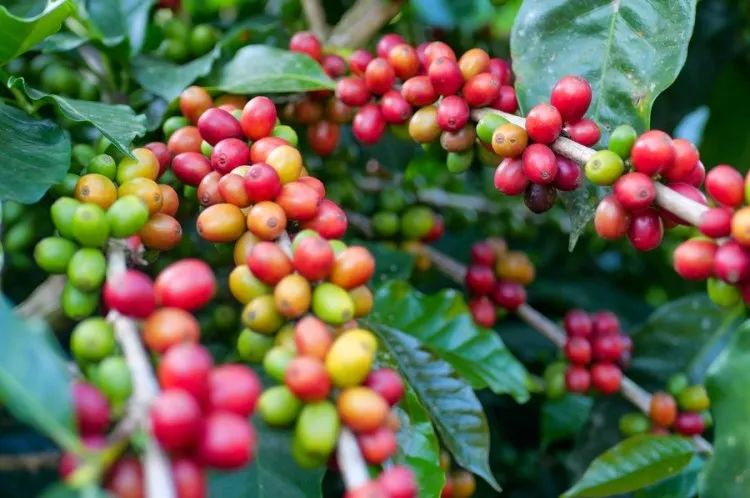
The Catimor tree is relatively short, small in size, and heavily branched, suitable for compact planting, and can grow vigorously without shade. It not only has strong resistance to leaf rust, but also possesses a certain tolerance to common coffee berry disease and others, which helps increase the fruit-setting rate. The fruit also ripens faster than other varieties, and yield naturally increases accordingly. However, the Robusta genes also bring shortcomings in Catimor's flavor. If it is planted in low-altitude areas, the coffee tastes rather bitter, and if improperly processed, it may also develop irritating astringency, mustiness, or earthy flavors. If planted at an altitude of 1,200 meters, the aroma expression is relatively neutral, and its richness is also inferior to pure Arabica beans such as Caturra.
Processing Methods of Yunnan Coffee
Although there are many Yunnan coffee beans on the market that use special processing to highlight aroma, Front Street believes that to truly understand Yunnan small-bean coffee, one should start with traditional natural processing methods and taste the flavor of Yunnan coffee itself. Therefore, the three Yunnan coffees retained on Front Street's bean list all use washed and natural processing.
As the representative face of Yunnan, Front Street chose washed processing for its Yunnan Baoshan small-bean coffee. Washing removes the pectin layer through fermentation and rinsing before drying, allowing Yunnan small-bean to present the flavor profile unique to the producing area. Front Street 2013 coffee, on the other hand, uses the natural drying method. Front Street ensures that only fully red cherries at just the right ripeness are harvested and turns them irregularly to ensure even drying. The mesh of the drying beds helps the fruit breathe and avoids negative over-fermented sensations.
Brewing Suggestions for Yunnan Small-Bean Coffee
In terms of roasting, Front Street believes that Yunnan coffee should have both a full-bodied coffee aroma and a certain level of acidity, so it chooses a medium roast level.
As for brewing, Front Street believes that no matter which extraction method is used, the prerequisite is to ensure the coffee beans are freshly roasted. After roasting, coffee enters its optimal tasting period after a 4–7 day resting period. Once this stage passes, the aroma will volatilize more rapidly, and the flavor and mouthfeel will be greatly reduced. Front Street is well aware of the importance of freshness, so all shipped coffee beans are freshly roasted within 5 days, and all coffee served in-store is also confirmed to be within its tasting period.
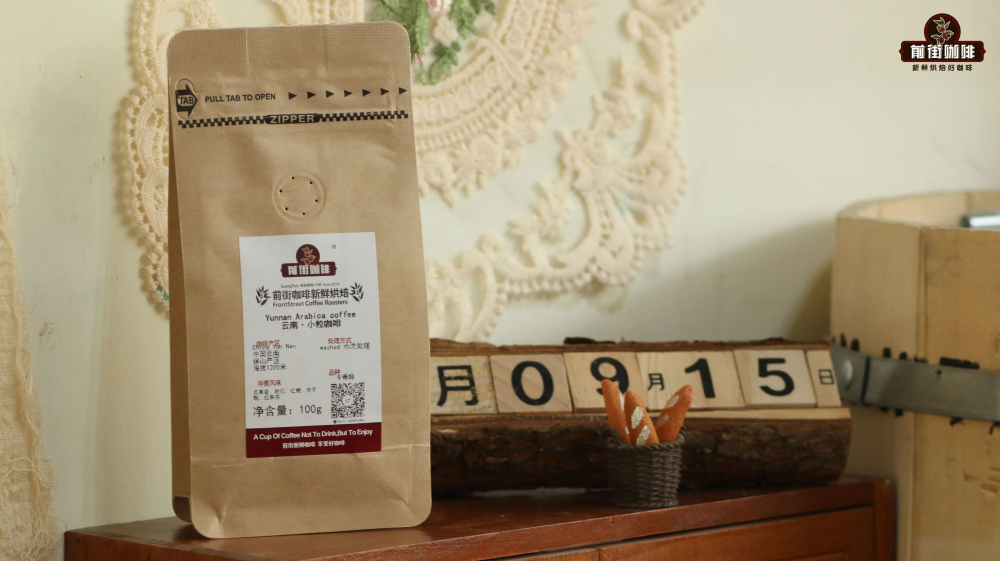
Next, Front Street brews a cup of its own roasted Yunnan small-bean daily-drink coffee in the way it serves it in-store. Considering that Yunnan small-bean coffee leans toward a balanced mouthfeel, meaning it should not have excessively high acidity or heavy bitterness, Front Street uses a V60 dripper, paired with a medium-fine grind size and medium water temperature for extraction.
Dripper: V60
Water temperature: 90°C
Grind size: 80% passing rate with a No. 20 standard sieve
Coffee-to-water ratio: 1:15
Coffee dose: 15 grams
Use three-pour extraction: after the coffee is ground and poured into the filter paper, start from the center and pour 30g of water to bloom for 30 seconds. Note that throughout the process, use a small stream of water and circle steadily from the inside outward; for the second pour, add 95g of water, and when the coffee liquid has almost finished draining, begin pouring the third pour of 100g, until all the coffee has filtered through, then remove the dripper. The total time is about 2 minutes, with an error of about 10 seconds either way.
Small-bean Catimor coffee has a dry aroma of nuts and berries. On the palate, you can taste the sweetness of nuts, herbs, chocolate, and brown sugar, as well as a balanced acidity like plum, with a slight faint fruit acidity in the aftertaste.
For professional coffee knowledge exchange and more coffee bean information, please follow Coffee Workshop (WeChat public account: cafe_style)
For more specialty coffee beans, please add the private WeChat of FrontStreet Coffee: qjcoffeex
The above content is compiled by CoffeeHunters, a coffee news website.


