







Why Does Sidamo Coffee Taste So Distinct?
Sidamo is one of Ethiopia's most recognized specialty coffee regions, known for complex floral and fruity aromas and rich tropical fruit flavors. The name comes from the Sidama ethnic group, who settled southern Ethiopia as early as the ninth century and once formed the Sidama Kingdom. Sidamo Province was established in 1942, and the coffee industry keeps the spelling Sidamo.
Natural processing helps give Sidamo its layered fruit character, and the region's high altitude and heirloom varieties add to the profile. The Sidama people keep their own language, a 13-month calendar, and the Fichee-Chambalaalla New Year, which is listed by UNESCO. Lots such as Arlo Village, Eto, and Shantawene show the region's range.
Sidamo is one of Ethiopia's most iconic specialty coffee regions, beloved by coffee enthusiasts for its complex floral and fruity aromas and rich tropical fruit flavors. This article begins with the historical origins of Sidamo, tracing its ethnic background, administrative boundary changes, and regional distribution characteristics, while offering an in-depth analysis of how the natural processing method gives Sidamo coffee its distinctive flavor profile. It also introduces outstanding representatives such as Front Street Arlo Village, Front Street Eto, and Front Street Shantawene, providing you with a comprehensive understanding of Sidamo coffee's regional information and flavor characteristics.

For more specialty coffee knowledge, please follow our WeChat official account: FrontStreet Coffee
Anyone who loves Ethiopian coffee is surely familiar with the name "Sidamo." It appears frequently in the detailed descriptions of various single-origin beans and is often cited within the industry as a symbol of specialty coffee.
The Story of Sidamo
After consulting relevant literature, Front Street learned that Sidamo Province was established in 1942, and its name derives from a local ethnic group—the "Sidama"—who once established the Sidama Kingdom. There have long been differing opinions on whether this land should be called Sidamo or Sidama, but in the coffee industry, the spelling "Sidamo" is more widely circulated, so people tend to use the name "Sidamo."
The main inhabitants of the Sidamo producing region are the Sidama people, who settled in southern Ethiopia as early as the ninth century AD. This ethnic group not only has its own language—Sidama—but also retains a unique calendar, festivals, and other traditional cultural customs. The Sidama language belongs to the Cushitic language family and differs significantly from Amharic, Ethiopia's official language.
The Sidama calendar is particularly distinctive: a year is divided into 13 months, with the first 12 months having a fixed 28 days each and the 13th month having 29 days; a week consists of only 4 days, and a month contains 7 weeks. The various festivals built around this calendar are also highly unique, such as the Sidama New Year Fichee-Chambalaalla, whose name comes from a woman's name and has been inscribed on UNESCO's Representative List of the Intangible Cultural Heritage of Humanity.
After 1995, Ethiopia began implementing a federal system of governance, and in order to respect the cultures of the various ethnic groups within its borders, the government redrew boundaries based on the settlement areas and languages of major ethnic groups. Sidama was therefore placed under the newly established Southern Nations, Nationalities, and Peoples' Region, and the area accordingly restored its historical name: Sidama.
However, even before the administrative reorganization, Sidamo Coffee had already gained worldwide fame for its distinctive aroma. Therefore, compared to "Sidama," people are more accustomed to using the name "Sidamo." Moreover, when the Ethiopian government applied for trademark protection for Sidama coffee, it also chose the old name Sidamo® as the registered trademark. To this day, domestic consumers still habitually refer to this origin as "Sidamo."
How Is the Sidamo Producing Region Distributed?
From a geographical perspective, the Sidamo producing region is located in the highlands of southern Ethiopia, adjacent to Lake Awasa in the East African Rift Valley and bordering Kenya. The area has a high altitude, moderate rainfall, fertile soil, and a large number of native tree species, providing extremely ideal conditions for coffee cultivation. Coffee trees in this region are mostly distributed between 1,550 and 2,200 meters above sea level. High altitude means coffee cherries ripen more slowly, which allows for the development of more complex and intense aroma structures, and the harvest season is also slightly later than in other parts of Ethiopia.
The administrative entanglements left over from history have caused Sidamo to interweave with other administrative regions, making it one of the most complex and difficult-to-understand producing regions in the world. Compared to other producing areas, Sidamo covers a large and extensive area. The Ethiopia Commodity Exchange (ECX) has divided it into five zones—A, B, C, D, and E—based on geographical indications, with each zone further containing several sub-regions, encompassing more than 50 cooperatives and over 200 washing stations in total. Under the influence of different altitudes, humidity levels, soils, and microclimates, coffee flavors can also show subtle differences from village to village.
As the specialty coffee industry continues to advance, some sub-regions with larger production volumes and outstanding quality have gradually been separated out and identified and exported as independent origins. For example, Guji, located at the southernmost tip, was once part of the Sidamo A zone. Later, because its exceptional coffee quality was discovered by more and more international buyers, its coffee industry rose rapidly and ultimately embarked on a path of independent development. So today, saying "Sidamo Hualei" is actually inaccurate; the correct expression should be "Guji Hambela Hualei."
In the producing region map drawn by the well-known specialty coffee green bean trader Trabocca, the core producing area of Sidamo is located within the newly established Sidama State, and also covers parts of the Oromiya Region and the SNNPR Region.
As things currently stand, the Bensa, Arbegona, Bura, Bona Zuria, and Shantawene areas included in the Sidamo A zone have, because they repeatedly appear on the lists of international green bean competitions, made the coffee from these places far surpass other areas of Sidamo in terms of recognition, quality, and reputation.
What Is the "Sidamo Taste"?
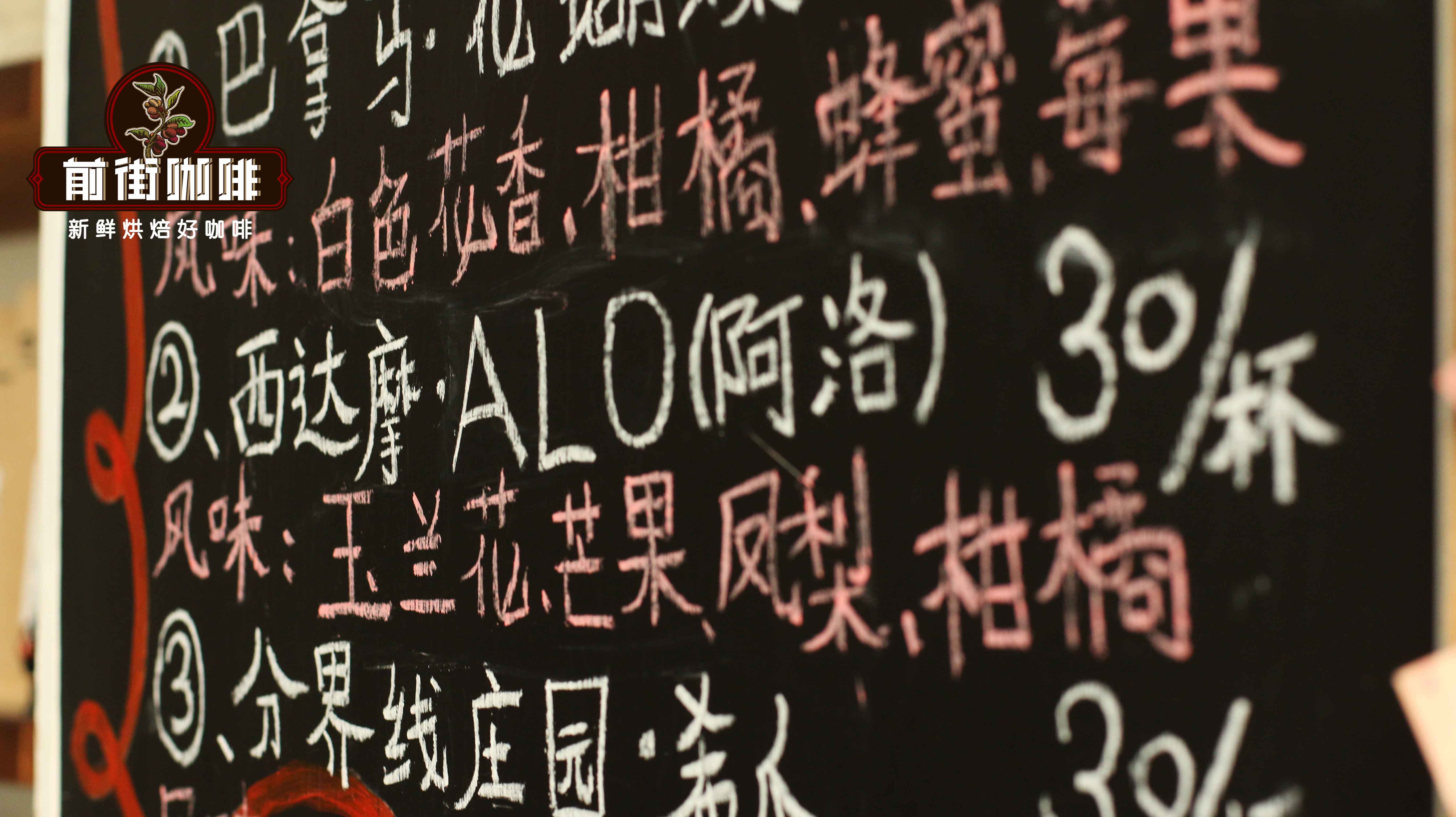
When it comes to Sidamo, many people, like Front Street, will first think of natural-process coffee and various tropical fruit flavors. For example, Front Street Arlo Village, Front Street Eto, and Front Street Shantawene are all quite representative outstanding examples.
In fact, as one of Ethiopia's top coffee-producing regions, Sidamo supplies 40% of the country's washed beans each year, showing that washed processing accounts for a very large proportion here. But if we turn our attention to the specialty coffee sector, we find that in recent years' COE award lists, despite differences in varieties and origins, they are almost all natural-process beans. Clearly, high-quality Sidamo natural beans perform exceptionally well, which is why judges have given them high scores year after year.
The steps of natural processing are relatively simple. As long as the weather is clear and sunlight is abundant, whether on African-style raised drying beds or on clean concrete patios, coffee cherries can be spread out directly to dry in the sun. Because the skin, pulp, and mucilage all participate in the drying process together, a certain amount of fermentation-related substances are produced throughout the stage. As a result, the final flavor presents a dense aroma resembling ripe tropical fruit, along with a complex flavor profile interwoven with fermented notes and rounded sweetness.
Through cupping comparisons, Front Street has found that natural Sidamo coffee has complex floral and fruity aromas, often reminiscent of high-sweetness fruits such as strawberry, mango, guava, and orange. The acidity is bright, the mouthfeel is syrupy and smooth, and after swallowing, the finish carries a slight boozy quality, with natural spice notes interwoven with tropical fruit to create multiple layers of flavor. Compared with Yirgacheffe, Sidamo coffee has a fuller body, and its overall flavor and mouthfeel are more balanced.
The above content is compiled by CoffeeHunters, a coffee news website.


