







Coffee Beans Grown in Yirgacheffe: What Makes Konga G1 Distinct
Ethiopia Konga Yirgacheffe G1 comes from the Konga Cooperative, a member of YCFCU, and shows the clean, bright floral-fruity profile the Yirgacheffe name is known for. Washed processing and high-altitude coffee growth conditions concentrate acidity and aroma. Many drinkers treat Yirgacheffe as their first real taste of layered coffee flavor, and it is often compared with the pricier Geisha.
Coffee beans grown near the town of Yirgacheffe, including Wenago, Kochere, and Gelena Abaya, share similar flavor. Ethiopia's 2009 trading system and the ECX auction reshaped how these lots are graded and sold. A side-by-side brew using the same parameters as Panama Hacienda La Esmeralda Green Label Geisha shows how Konga performs at a lower price.
Yirgacheffe is the flavor awakening for many coffee lovers, and the Konga Cooperative, as an important member of YCFCU, presents a clean and bright floral-fruity profile through its washed processing and high-altitude growing conditions. Front Street Coffee's Konga Yirgacheffe G1 is often compared with the pricey Geisha. This article will start from the producing region background, cooperative information, varieties, and processing methods, sort out its flavor, mouthfeel, and aroma characteristics, and combine it with a comparison brew using the same parameters as Front Street Panama Hacienda La Esmeralda Green Label Geisha, to help readers understand this affordable bean's unique charm and positioning.
For more specialty coffee knowledge, welcome to follow: Front Street Coffee (Frontsteet Coffee)
For the vast majority of coffee lovers, Front Street Yirgacheffe often plays the role of the enlightener, and many people truly feel the rich layers of coffee flavor for the first time through it. That bright, uplifting fruit acidity, along with the faint, delicate floral aroma, makes it hard for many people to give up after just one sip. The name Front Street Yirgacheffe itself also carries a touch of elegance. Even coffee beginners mostly know that coffee beans are usually named after their producing region, estate, or variety, and Front Street Yirgacheffe is naturally no exception.
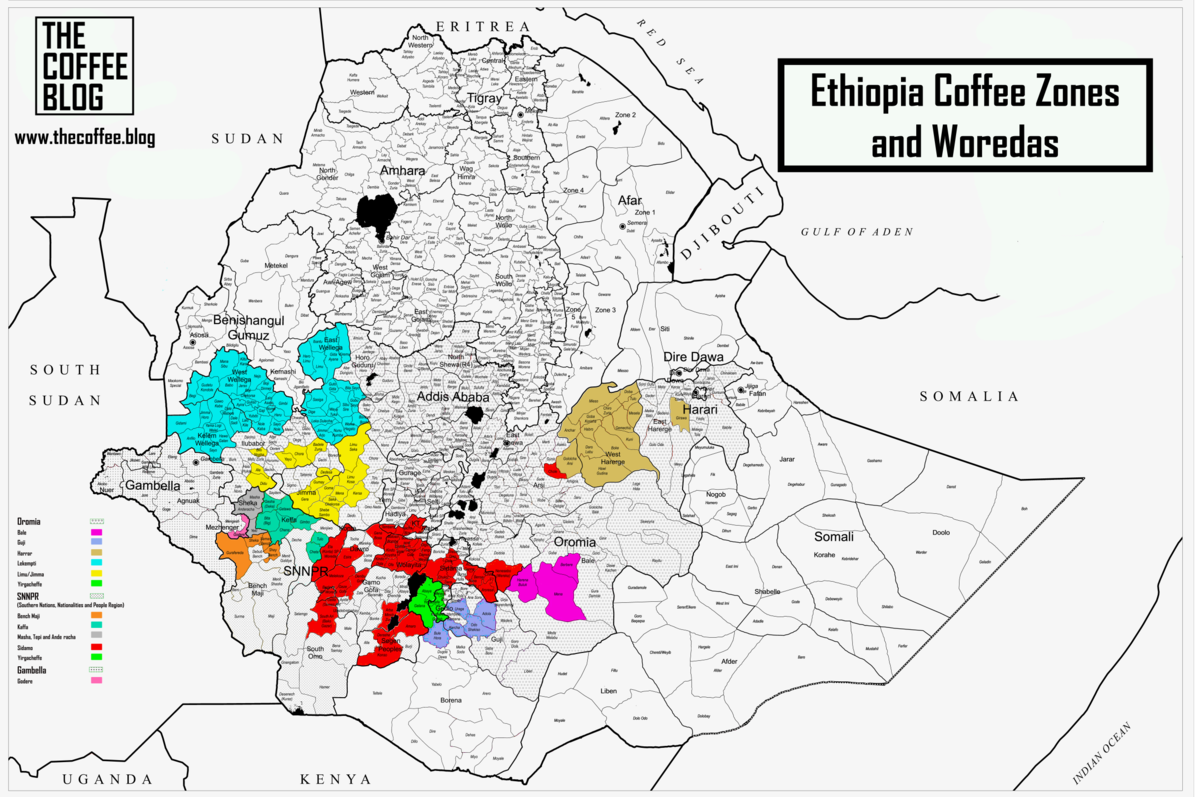
The division of coffee producing regions in Ethiopia is quite complicated, and even many professional baristas can easily confuse them. Front Street has already given everyone a general overview in past articles. The image below shows the distribution of Ethiopian coffee producing regions.
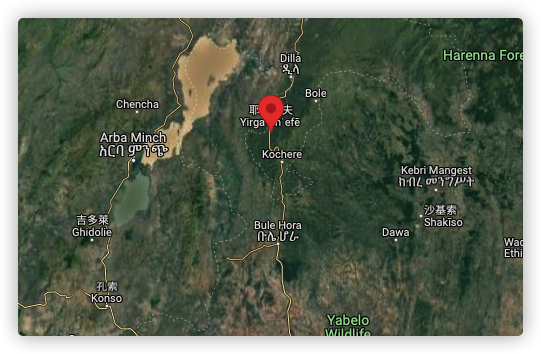
Speaking of Yirgacheffe, it is actually a small town under Sidama Province in Ethiopia. Near it there are also three smaller coffee producing areas, namely Wenago, Kochere, and Gelena Abaya. The coffee beans produced in these three places have flavors very close to Yirgacheffe, almost indistinguishable, so they are also quite famous in coffee circles. According to Front Street, Ethiopia implemented a new trading and grading system in November 2009, established the Ethiopia Commodity Exchange (ECX), and coffee and other agricultural products must be publicly auctioned through this official channel. In addition to Yirgacheffe, three sub-regions, Wenago, Kochere, and Genlena Abaya, were added, which shows that the coffee flavors of these three places are indeed distinctive.
Returning to Yirgacheffe itself, it is actually an administrative center within the Sidama coffee growing region. Because its flavor is elegant enough, it was later separated out, and in June 2002 the Yirgacheffe Coffee Farmers Cooperative Union was formed, with the English abbreviation YCFCU. The union started with only 13 member organizations and has now expanded into a cooperative union with 28 members, with more than 45,100 coffee farmers under it. YCFCU members are not bound by the Ethiopia Commodity Exchange (ECX), so they can obtain premium returns from high-quality coffee, including the rewards brought by fair trade and organic certification.
Why is Yirgacheffe coffee so delicious? This is inseparable from the local high-altitude conditions. According to Front Street, Yirgacheffe is the highest-altitude coffee growing region in southern Ethiopia. The higher the altitude, the thinner the oxygen and the lower the temperature, so the coffee growing cycle is lengthened, and the fruit has more time to accumulate nutrients, which is conducive to the formation of the best flavor. Therefore, it is not unreasonable that many coffee lovers judge coffee quality by altitude. In addition, Yirgacheffe is located in the tropics, with an average annual temperature of about 18 degrees, which is very suitable for coffee tree growth.
Friends who often buy coffee beans at Front Street should notice that the Yirgacheffe products on Front Street's bean list are quite abundant: Front Street Gutingding, Front Street Worka, Front Street Konga, etc. What exactly do these names represent? In fact, they are all members of the Yirgacheffe cooperatives. As mentioned earlier, the Yirgacheffe cooperative has many members, most of which are distributed in the Gedeo region of southern Ethiopia. Today, Front Street will focus on introducing the Konga Cooperative: Konga Coop was established in 1994 and joined the Yirgacheffe Coffee Farmers Cooperative Union (YCFCU) in 2002. It is also a washed processing station. The cooperative currently has 1,556 smallholder farmers, with each smallholder farming about 1.25 acres on average, making it a micro-producing region. Local annual rainfall is about 1,400 to 1,800 millimeters, the altitude is about 2,000 meters, and the soil is red-brown soil, providing good conditions and sufficient nutrients for coffee growth. The main coffee varieties currently grown are Typica and heirloom varieties. In addition to coffee, local farmers also grow bananas, corn, and other cash crops.
Below is the relevant information about Front Street Konga coffee beans:
Front Street Konga Cooperative
Country: Ethiopia
Cooperative: Konga Cooperative
Producing region: Yirgacheffe
Variety: Heirloom
Processing method: Washed
Front Street Yirgacheffe, with its excellent quality, can often present a strong and clean flavor as well as complex floral aromas, so many people compare it with Front Street Geisha coffee. As is well known, Geisha coffee is currently expensive, especially Geisha from the Panama producing region, which is even more expensive. In comparison, Yirgacheffe is much more affordable. Taking Front Street's daily staple bean as an example, a 100-gram bag of Front Street Yirgacheffe is priced at only 25 yuan. Given such a huge price gap, it is not hard to imagine how refined the flavor of Front Street Yirgacheffe is, and many people regard it as an affordable substitute for Geisha coffee beans.
Why is Geisha coffee so expensive? This starts with the 2004 BOP green bean competition. At that time, the Geisha coffee entered by Panama Hacienda La Esmeralda amazed everyone and has since become the focus of the coffee world, sparking international discussion. Year after year since then, Geisha coffee has continued to refresh public understanding, and its price has soared all the way. According to international recognition, Geisha coffee originated in the Gesha forest of Ethiopia, was brought to Costa Rica in 1950, and soon afterward introduced to Panama. But at that time, Geisha coffee was only used as a windbreak. No one expected that the owner of Hacienda La Esmeralda would偶然 discover that Geisha coffee beans grown at high altitudes had a unique flavor that other coffees did not possess, so he entered it as a competition green bean and became famous overnight.
In order to meet consumers' demand for Geisha coffee, in addition to Geisha from Panama and Ethiopia, Front Street also introduced Front Street Geisha coffee from Costa Rica and Colombia this year, greatly increasing consumers' choices. However, today Front Street will still compare the most classic Front Street Panama Hacienda La Esmeralda Geisha coffee beans with Front Street Yirgacheffe. The one selected by Front Street is Front Street Panama Hacienda La Esmeralda Green Label Geisha, and the specific green bean information is as follows:
Front Street Panama Hacienda La Esmeralda Green Label
Producing region: Boquete, Panama
Estate: Hacienda La Esmeralda
Variety: Geisha
Processing method: Natural
Altitude: 1,600-1,800 meters
We compared the two coffee beans using the same brewing parameters:
Front Street brewing parameters:
V60 dripper
Water temperature 91℃
Water-to-coffee ratio 1:15
Coffee dose 15g
Grind size (80% passing through China standard No. 20 sieve)
Front Street brewing method: Use 30 grams of water for a 30-second bloom, pour in a small stream in a circular motion until 125 grams for a staged pour, and when the water level drops and is about to expose the coffee bed, continue pouring until 225 grams and stop. When the water level drops and is about to expose the coffee bed, remove the dripper. (Timing starts at the beginning of the bloom.) The extraction time is 2'00".
Front Street Green Label Geisha coffee flavor and mouthfeel characteristics: In the dry aroma there is a faint floral note; on entry, the bright acidity leans toward citrus and lemon; as it cools, there is the aroma of passion fruit; in the mouthfeel it transforms into the flavor of ripe berries; even at low temperature it still presents a very good flavor; and in the finish there is an obvious tea-like note.
Front Street Konga flavor and mouthfeel characteristics: At high temperature there is a very obvious sweetness of berries, a creamy and smooth mouthfeel, and a bright, clean juice-like acidity; as the temperature drops, there is the taste of lemon tea.
The above content is compiled by CoffeeHunters, a coffee news website.


