







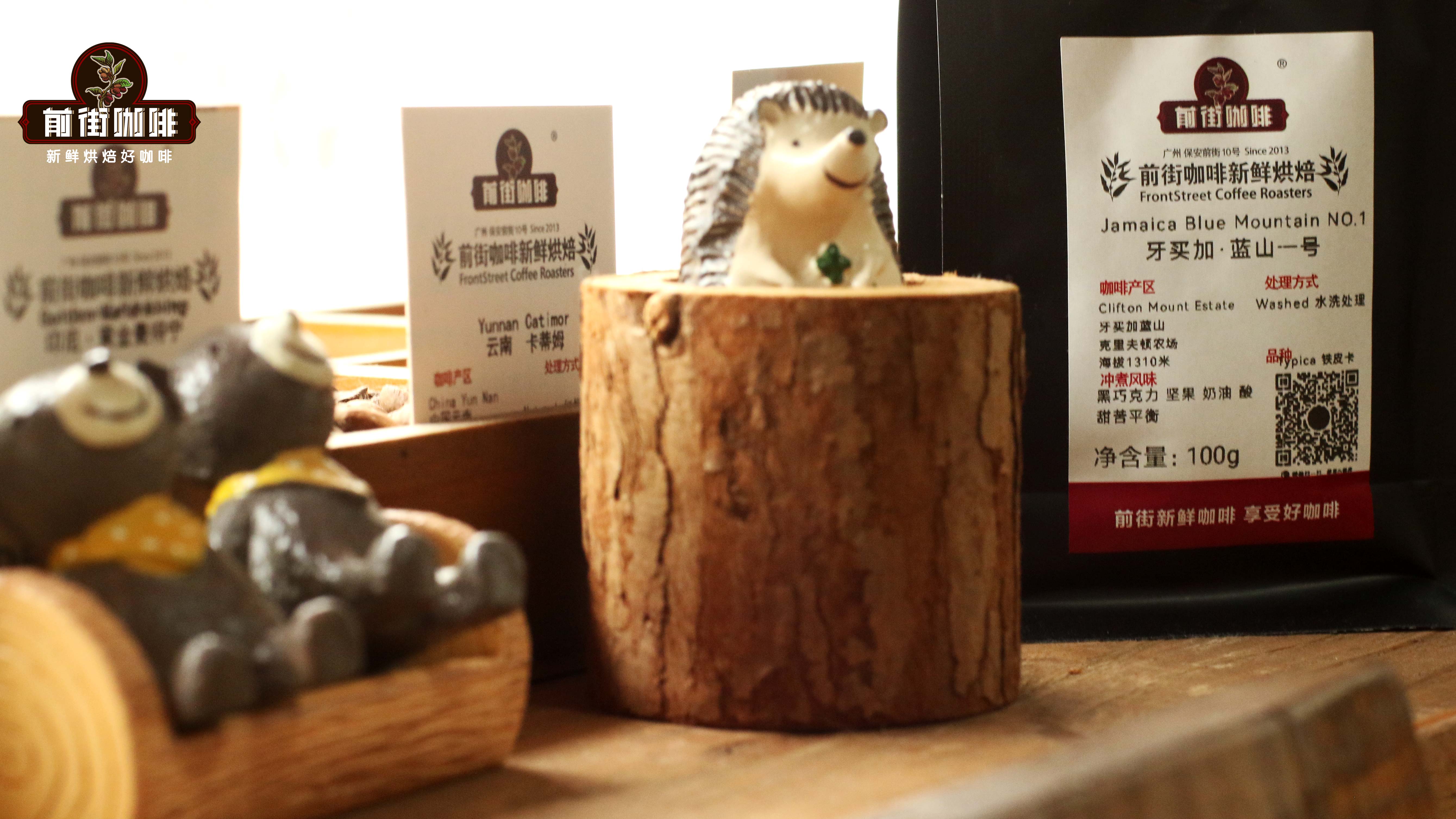
Blue Mountain coffee is a renowned specialty representative in the coffee world, but the market is flooded with both genuine and fake products, leaving many consumers full of questions about its authenticity, price, grading, and whether it can be made into black coffee. This article starts from Front Street's own roasted Blue Mountain No. 1, sorts out the real import situation of Blue Mountain coffee in China, the terroir and grading logic behind its high price, explains the origin of the "Blue Mountain No. 1" grade, and records in detail the parameters and technique Front Street uses to brew Blue Mountain No. 1 with a KONO dripper. Finally, it describes the chocolate, nutty, and creamy sweet aroma this bean presents when made into pour-over black coffee, helping coffee lovers gain a comprehensive understanding of genuine Jamaican Blue Mountain.
In coffee enthusiast circles, Blue Mountain is almost a name that needs no explanation. It has been repeatedly praised by countless connoisseurs, and even elders who normally do not drink coffee have heard of the term. At Front Street's shop, the question customers ask baristas most frequently is: "Is the Blue Mountain you sell genuine?"
Can you buy genuine Blue Mountain coffee in China?
As soon as you type "Blue Mountain" into the search bar, a large number of posts teaching people how to tell genuine from fake pop up on the screen. This is hardly surprising. Blue Mountain's international fame is so high that some merchants take the opportunity to pass off lower-quality commercial beans as the real thing, so the market is filled with all kinds of fake Blue Mountain. The phrases we often see, such as "Blue Mountain flavor," "Blue Mountain blend," and "Blue Mountain instant coffee," actually have nothing to do with authentic Blue Mountain.
Although there is a lot of counterfeit product in China, genuine Blue Mountain is not impossible to find. As early as April 2011, the media reported news of Blue Mountain coffee imported directly from Jamaica. At that time, Zhejiang DUNN'S RIVER Import and Export Trading Co. represented the Hangzhou Coffee and Western Food Association in purchasing 1000*70kg from Jamaica, with a total value of two million US dollars. Today Jamaica attaches considerable importance to the Chinese market, and a list of several authorized domestic exporters can be found on CIB's official website.
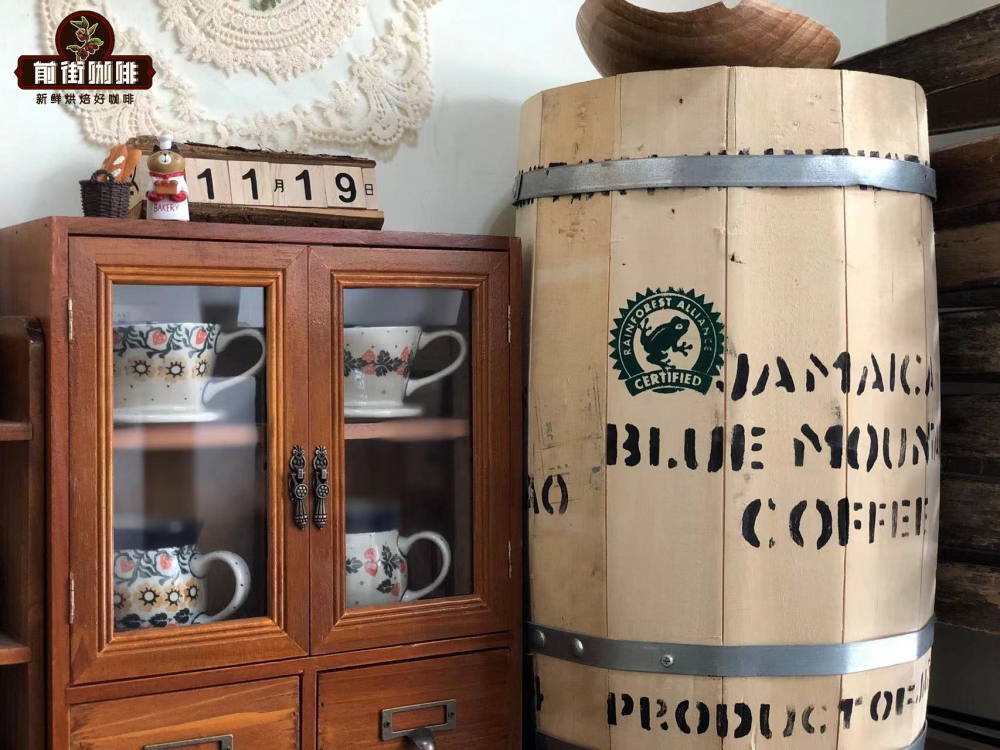
Front Street's own roasted Blue Mountain No. 1 uses green beans from Jamaica's Clifton estate and comes with a quality certificate issued by the Jamaica Coffee Board, an authorized sales certificate granted by the Blue Mountain coffee producer, and a certificate of origin for Jamaican Blue Mountain coffee. At the Dongshankou shop, there is also an oak barrel used to hold Blue Mountain green beans. When the shop is full of customers, this barrel is even used as a small table for coffee cups, adding a bit of fun.
Why is genuine Blue Mountain so expensive?
Blue Mountain coffee was once called the Hermès of the coffee world. After authentic Blue Mountain enters the mouth, you can perceive a rich, dense, and lasting aroma of chocolate and roasted hazelnut, with the five sensations of acidity, sweetness, bitterness, aroma, and body achieving an excellent balance. Front Street believes that Blue Mountain's reputation today is inseparable from the meticulous management and strict grading of Jamaican growers.
The terroir conditions of the Blue Mountain region can be described as uniquely favorable, with various beneficial factors combining to create an ideal environment for growing coffee. But coffee is ultimately a crop, and variety, altitude, picking method, and post-processing method all affect the final aroma.
According to the official area defined by the Jamaica Coffee Industry Board (CIB), only Typica grown in forest areas at an altitude of about 910 to 1700 meters is eligible to be called true "Jamaican Blue Mountain coffee." Typica needs to grow in a high-altitude environment for its flavor to be more prominent, and this variety has weak disease resistance, is easily infected by disease, and has a low yield per plant, so it requires more manpower and careful care. In addition, the high-altitude Blue Mountain terrain is uneven, making management and harvesting very difficult and placing extremely high demands on the skill of pickers, which further limits production. In recent years, less than 15% of the coffee beans produced in Jamaica can bear the Blue Mountain label, only about 900 tons.
Many friends may have heard a saying: "All genuine Blue Mountain coffee has been monopolized by Japan." This claim is not entirely unfounded. UCC is a Japanese coffee company whose predecessor was Ueshima Coffee Co., Ltd. In 1981 it opened a farm in Jamaica to operate a Blue Mountain coffee project, and Jamaica promised to sell 90% of the Blue Mountain coffee quota to Japan. Combined with Japan's vigorous promotion of Blue Mountain, Blue Mountain was once hard to obtain even at a high price. Today, with coffee culture flourishing, drinking a cup of Blue Mountain is no longer difficult. At Front Street, for 60 yuan you can drink a cup of the highest-grade Blue Mountain No. 1 pour-over black coffee.
Why is it called "Blue Mountain No. 1"?
Compared with other coffee origins, Jamaica was the earliest country to realize that coffee has a "taste of place." The local standards for evaluating the quality of Blue Mountain green beans cover multiple aspects: green bean size, defect rate, color, uniformity, and post-roast cupping performance, including dry aroma, wet aroma, acidity, flavor, body, and cleanliness.
Bean size is measured using screens with different hole diameters, and coffee beans that do not pass through the holes meet the corresponding standard. Color evaluation combines visual observation with colorimeter readings, with blue-green being the highest grade. Based on the above standards, Blue Mountain coffee is divided into 4 grades, from highest to lowest: NO.1, NO.2, NO.3, PB, and mixed. NO.1 is the highest-grade top Blue Mountain, commonly called "Blue Mountain No. 1" in China. Blue Mountain No. 1 must meet a size of 17 mesh or above, a defect rate below 3%, and a moisture content of about 13%. In cupping, it must present rich coffee aroma, a smooth and balanced mouthfeel, low mild acidity, and a lasting sweet aftertaste.
In terms of roasting, CIB also gives roast degree recommendations for Blue Mountain's classic flavor. Front Street's roaster follows this recommendation and uses a medium roast, allowing Blue Mountain No. 1 to retain both its rich chocolate sweetness and an appropriate soft fruit acidity.
Can Blue Mountain No. 1 be made into black coffee?
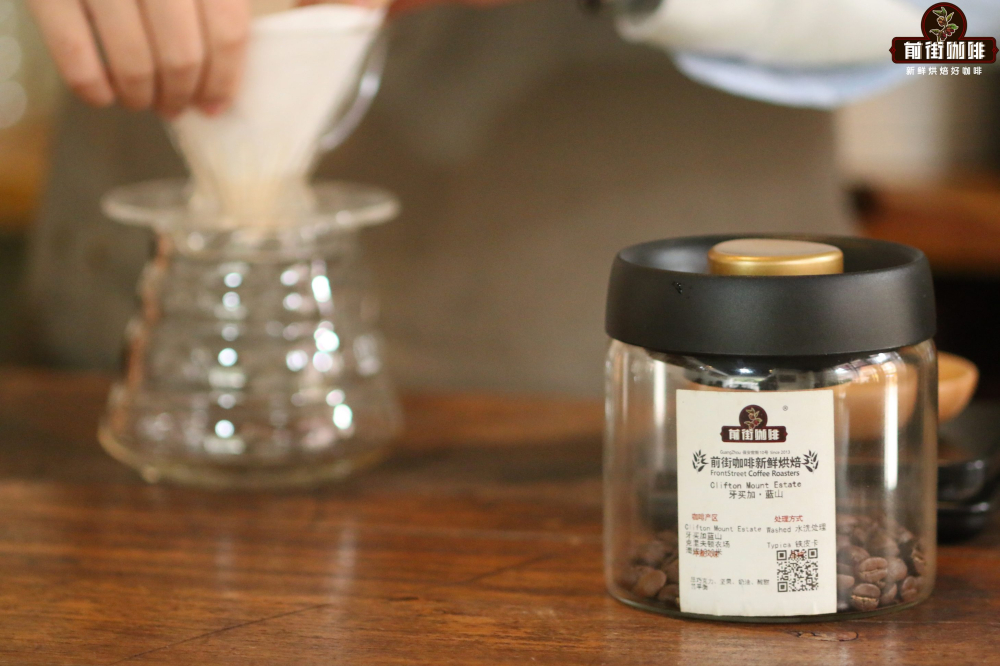
In order to highlight the rich, round mouthfeel of Blue Mountain No. 1, Front Street chooses a KONO coffee dripper for extraction. KONO's ribs are less than half the height of the dripper. This design is intended to make the filter paper cling tightly to the dripper wall after wetting, restricting airflow and thereby extending the water absorption time of the coffee grounds, making the extracted coffee more uniform overall.
Brewing parameters: 15 grams of coffee, coffee-to-water ratio 1:15, grind size EK43s setting 10.5 (75% passing rate on China No. 20 standard sieve), water temperature 87~88°C, brewing method is staged extraction.
First place the filter paper into the KONO dripper, pour water to wet the filter paper, and at the same time make the filter paper fit more closely to the dripper wall. Add the coffee grounds and tap lightly to distribute the coffee bed evenly. In the first stage, gently pour 30 grams of water for blooming, with a blooming time of 30 seconds; in the second stage, pour water to about 125 grams, circling outward evenly and steadily. When the coffee liquid drops to half, pour the final stage of water to 225 grams. After all the coffee liquid has dripped through, the total extraction time is generally about 2 minutes.
The pour-over Blue Mountain No. 1 presents notes of dark chocolate and nuts, with a very rich mouthfeel and an obvious almond-like sweet aftertaste. As the temperature drops, the creamy, silky sweetness of roasted hazelnut gradually emerges, mixed with a hint of soft acidity and caramel sweetness, and the aroma lingers in the mouth for a long time.
The above content is compiled by CoffeeHunters, a coffee news website.


