







Costa Rican coffee has always been renowned for its combination of sweetness and strength, and honey processing takes this sweetness to the extreme. This article takes you into Finca Canet in the Tarrazu region to learn the story behind the Baha coffee beans—from the history of Costa Rican coffee and the terroir of the Tarrazu region, to the micro-lot management of Finca Canet, and the varietal characteristics of the Bourbon variant Caturra and Yellow Catuai. You will see how the raisin honey process retains 100% mucilage with zero-water processing, and how Front Street Coffee designs the roast profile for this double-fermentation bean, and uses cupping and V60 brewing to bring out the rice wine fermentation aroma, tropical fruit, berries, and caramel aftertaste.
For more specialty coffee knowledge, please follow our WeChat public account: Front Street Coffee (FrontStreet Coffee)
Coffee produced in Costa Rica always has an irresistible charm—sweetness with tension hidden within, and one sip makes you involuntarily want to understand everything about it. Among the many processing methods, honey processing is undoubtedly the most famous in Costa Rica; it is precisely this that allows local coffee to release its high sweetness to the fullest, leaving an unforgettable impression after drinking.
Costa Rican Coffee History
Costa Rican coffee comes from the Republic of Costa Rica in southern Central America, and its flavor profile is quite similar to Colombian coffee. Coffee is an important economic pillar of the country. Since it was introduced in 1808, it has a history of more than two centuries. About one-third of the country's population is engaged in coffee cultivation-related work; although its land area ranks third from the bottom in Central America, its economic performance is better than that of more than half of its neighbors.
In 1729, coffee was introduced to Costa Rica from Cuba. This country, with a population of about 3.5 million, has as many as 400 million coffee trees, and coffee exports account for 25% of the country's total exports. Costa Rica has fertile volcanic soil with excellent drainage, especially in the Central Plateau area, where the soil layers are stacked with multiple layers of volcanic ash and volcanic dust.
Tarrazu Region
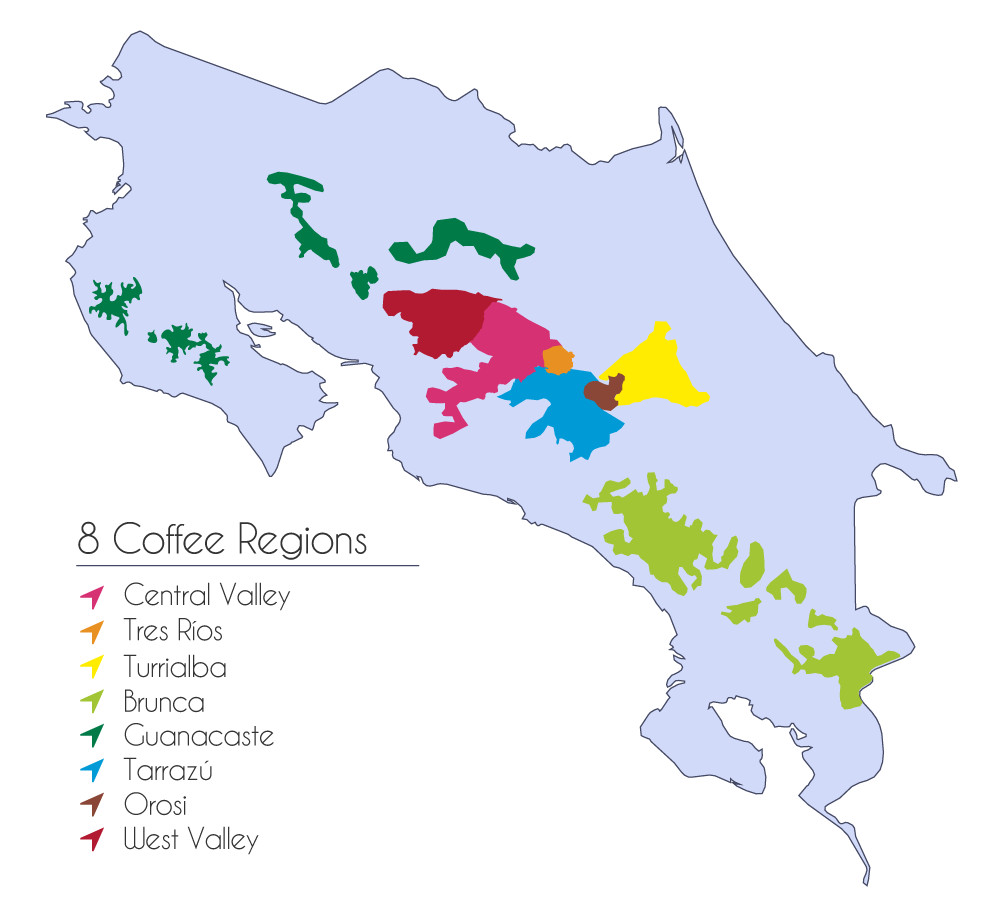
Tarrazu is located south of the capital San Jose and is the core coffee-producing area of Costa Rica, as well as one of the world's important coffee-producing regions. The coffee-growing soil here is extremely fertile and well-drained. Although production is not large, the estate has been held by the British McAlpine family for nearly three generations. The Tarrazu region has the highest average latitude, and both its climate and soil conditions are quite outstanding, making Tarrazu the most well-known and widely recognized as the finest major coffee-producing region in Costa Rica.
The Tarrazu region is the most concentrated area for fruit cultivation in Costa Rica. The estates mainly cultivate passion fruit, while the amount of coffee planted is quite limited. However, most of the coffee beans in this area use red honey, black honey, yellow honey, and other processing methods. The sweetness and berry aroma are stunning, with good sweetness, body, and thickness, and they carry a ripe fruit flavor similar to dried bananas.
Finca Canet
Finca Canet is a small estate covering only 5 hectares, located in the town of San Marcos in the Tarrazu region, and owned by the Robles brothers Leo, Elian, and Melvin and their family. They have worked together in cultivation and production for more than ten years and share a small processing plant (Beneficio).
Finca Canet is located in the highest-altitude coffee-growing area of Tarrazu, Costa Rica. This place is the most densely fruit-planted area in Costa Rica. The estate owner mainly grows passion fruit, while the amount of coffee is quite scarce, with coffee planted only in one specific plot and given special care, harvesting only ripe red cherries.
Variety: Bourbon variant Caturra
Caturra is a single-gene variant of Bourbon, discovered in Brazil in 1937. Its yield capacity and disease resistance are both superior to Bourbon, and the tree is shorter, making harvesting easier; unfortunately, it also has the same problem as Bourbon of "bearing fruit one year and resting the next." Its flavor is comparable to, or slightly inferior to, Bourbon beans, but what stands out more is its extremely strong adaptability. It does not need shade trees and can grow vigorously even when directly exposed to the scorching sun, commonly known as Sun Coffee. It can adapt to high-density planting, but fertilization must be increased, which raises costs, so early coffee farmers did not readily accept it.
Caturra is suitable for planting from low altitudes of 700 meters to high altitudes of 1,700 meters. The higher the altitude, the better the flavor, though bean yield decreases accordingly. There is also a yellow Caturra variant in Central and South America, but it is not as highly regarded as Yellow Bourbon.
Costa Rica is classified by altitude grade
SHB: Strictly Hard Bean, grown at 1,500 meters
GHB: Good Hard Bean, grown at 1,100-1,200 meters
HB: Hard Bean, grown at 1,000 meters
High-quality Costa Rican coffee is called "Strictly Hard Bean," and this type of coffee can grow above 1,500 meters. Generally, the higher the altitude, the better the coffee bean quality. This is not only because higher altitude can increase the acidity of coffee beans and thereby enrich the flavor, but also because nighttime temperatures in high-altitude areas are lower, causing trees to grow slowly, which makes the flavor of the coffee beans more intense.
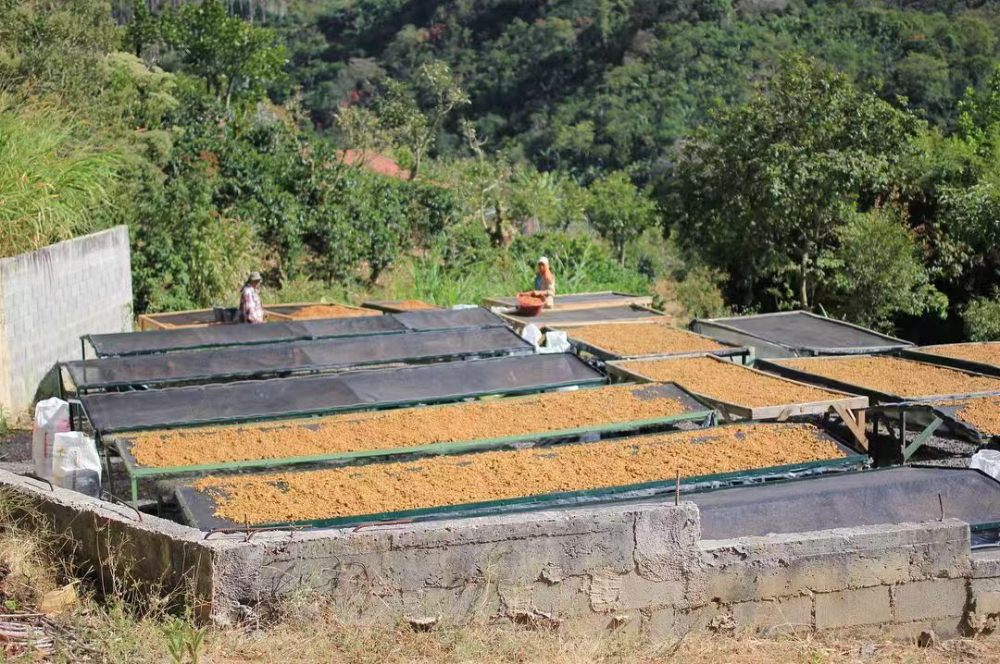
Raisin honey processing method: retaining 100% mucilage and zero-water processing method.
This processing method increases the difficulty of honey processing, so the requirements for timing control are extremely strict. On the day the coffee cherries are harvested, the harvested fruit is poured into a large water tank. Fully ripe and plump fruits sink to the bottom, while underdeveloped or overripe fruits float to the surface, and these floating beans need to be removed. The selected coffee fruits are placed on raised beds to dry for at least three days, then the cherry skin is removed, the mucilage is retained, and drying continues. At this stage, climate factors become the key to the success or failure of honey processing.
During the drying process, these coffee cherries need to be constantly turned to ensure even drying, but the frequency of turning must be well controlled. Drying must proceed slowly to ensure that the coffee achieves a fermented effect, but not so slowly that over-fermentation occurs.
Yellow Catuai (Catuai Amarillo) comes from a cross between Mundo Novo and Caturra, and was first successfully bred by Brazil's Instituto Agronomico de Campinas in 1949. Like Red Catuai (Catuai Rojo), Yellow Catuai has extremely high disease resistance and is suitable for planting in high-altitude and windy areas.
Both Catuai varieties also have a delicate and clean acidity. Through machine adjustment, red honey, yellow honey, and black honey processed coffees can be produced (depending on the degree of honey processing). Canet is located in the highest-altitude coffee-growing area of Tarrazu, Costa Rica. This area is the most densely fruit-planted area in Costa Rica. The estate owner mainly grows passion fruit, while the amount of coffee is quite scarce, with coffee planted only in one specific area and given special care, harvesting only ripe red cherries.
Roast Profile
The roaster is a Yang Chia Feima 800N from Taiwan, a semi-direct-fire type, with maximum damper setting of 5, and a charge weight of 300 grams.
Charge temperature 180, turning point at 1'43'' at 94.2; yellowing point at 6'15" at 151.5; first crack at 9'40" at 183.3, development time after first crack 1'45", drop temperature 196.
Agtron bean color value is 67.7 (upper image), Agtron ground color value is 78 (lower image), Roast Delta value is 10.3.
Roasting Approach
This Front Street Costa Rica Baha coffee bean consists of the two most common varieties in Central and South America: Caturra and Catuai. The green beans smell of fermented fruit aroma. Observing the green beans, they appear dark green, at an altitude of about 1,950M, with relatively hard bean density, and being from the 2019 crop year, the beans' moisture content is relatively higher. In the roasting approach, a gradual reduction of heat and extended dehydration time are used to climb this curve. Considering that this "Front Street Costa Rica Musician Baha" uses double-fermentation raisin honey processing, the roast level is designed as a medium roast, mainly to highlight the bean's fermentation aroma and fruit aroma, while also preserving the balanced and full-bodied mouthfeel of honey-processed beans.
Using Front Street Costa Rica Baha coffee beans as an example
Front Street Costa Rica Baha coffee beans Cupping Flavor
It smells like the fermentation aroma of rice wine. When drunk, it has the sweet-and-sour sensation of ripe tropical fruits and berries, along with nut and cream flavors. The sweetness in the finish carries caramel, and the aftertaste has a faint floral aroma.
Front Street Costa Rica Baha coffee beans brewing method
Brewing equipment: Hario V60
Water temperature: 90℃
Coffee-to-water ratio: 1:15
Grind size: medium-fine grind
Brewing method: Pulse pouring. Use 30 grams of water for a 30-second bloom, then pour in a slow circular stream to 125 grams and pause. When the water level drops and is about to expose the coffee bed, continue pouring to 225 grams and stop. When the water level drops and is about to expose the coffee bed again, remove the dripper (timing starts at the beginning of the bloom). Extraction time is 1.56 seconds.
The above content is compiled by CoffeeHunters, a coffee news website.


