







What makes Fazenda Rainha a benchmark for specialty coffee?
Fazenda Rainha sits in the Alta Mogiana region of São Paulo state, where coffee grows between 1,100 and 2,000 meters. The estate plants mainly Yellow Bourbon, including trees more than 110 years old, and has performed well repeatedly in Cup of Excellence competitions. Its beans show nutty and chocolate notes with smooth acidity.
Cooler average temperatures near 19°C slow fruit ripening and produce denser beans, so yields stay low while aroma and flavor run above ordinary Brazilian highland lots. Fazenda Rainha covers 280 hectares, 200 of them planted with Yellow Bourbon, a Bourbon mutation whose fruit ripens orange-yellow rather than red.
Fazenda Rainha is located in the Alta Mogiana region of São Paulo state and is one of the benchmark estates for Brazilian specialty coffee. The estate focuses on the Yellow Bourbon variety, including century-old Bourbon trees, and has repeatedly performed well in COE competitions. This article systematically reviews the flavor characteristics of Fazenda Rainha coffee beans, from the terroir of the producing region and variety characteristics to the evolution of processing methods and brewing parameters, and shares Front Street Coffee’s roasting and brewing recommendations, giving you a comprehensive understanding of this Brazilian specialty coffee that combines nutty and chocolate notes with a smooth acidity.
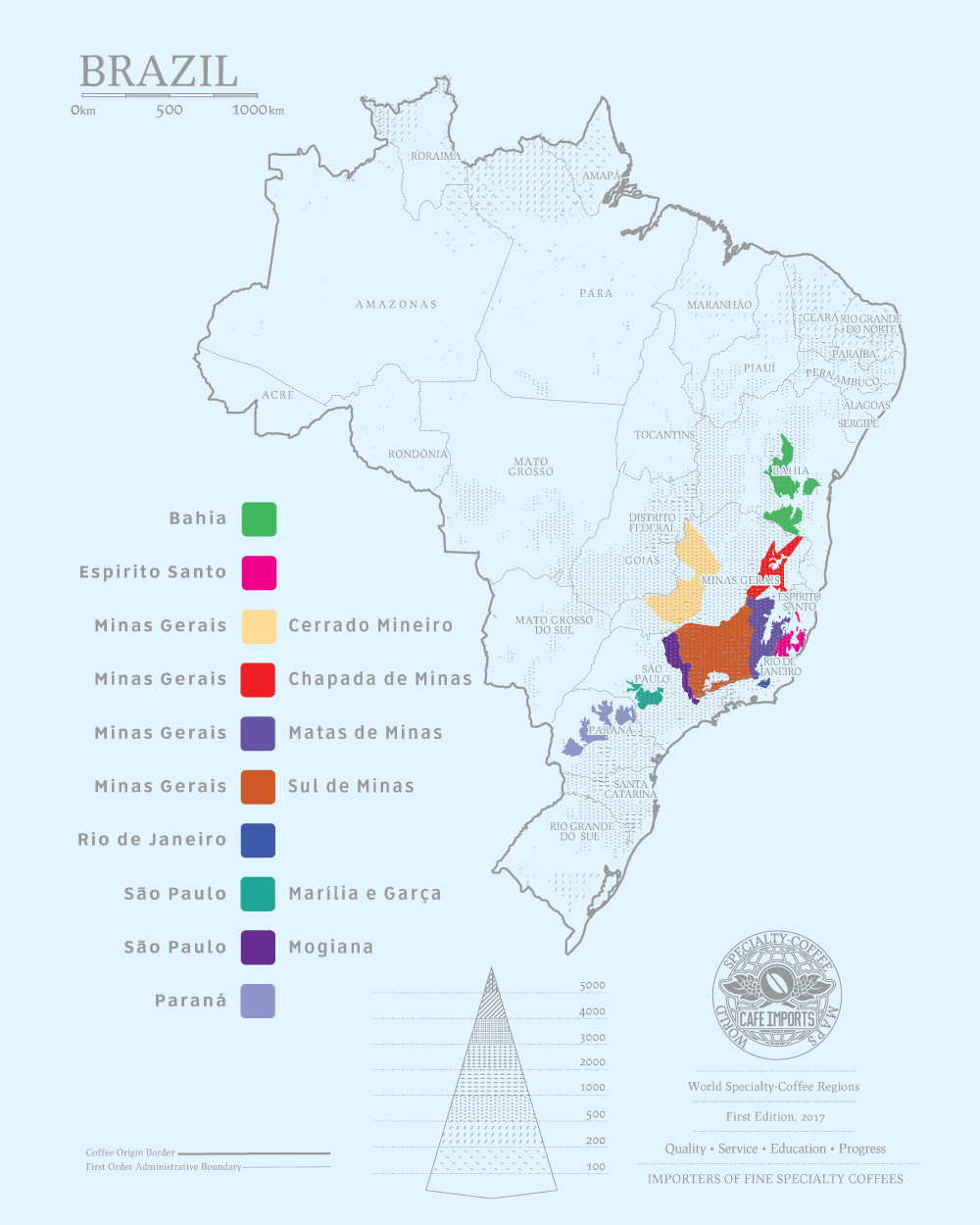
Fazenda Rainha (Queen Farm) is located in the Alta Mogiana region of São Paulo state, north of São Paulo city and not far from Minas Gerais (MINAS GERAIS), another Brazilian specialty coffee-producing region.
Brazilian Specialty Coffee Producing Region - Alta Mogiana, São Paulo State
In Alta Mogiana, coffee trees are scattered among shrubs, grasslands and other vegetation at altitudes between 1,100 and 2,000 meters. The area has both large farms that continue traditional practices and small growers pursuing modernization. Modern technology and mountain coffee-growing culture merge with each other, giving rise to green coffee beans of outstanding quality.
The average annual temperature in this area is only 19°C, so the fruit ripens relatively slowly, but what is gained in return is a denser bean structure. Although yields are relatively low, the aroma and flavor are far beyond those of ordinary Brazilian highland beans. This estate is mainly planted with Bourbon, including some old Bourbon trees over 110 years old.
Introduction to Fazenda Rainha, Brazil
Fazenda Rainha coffee in Brazil is located in the Alta Mogiana region at an altitude of 1,400 to 1,950 meters, with a total area of 280 hectares, of which 200 hectares are planted with Yellow Bourbon. The superior geographical conditions and pleasant climate make this an ideal origin for specialty coffee.
Yellow Bourbon is a Bourbon mutation unique to São Paulo state in Brazil. It gets its name because the fruit does not turn red when ripe but instead becomes orange-yellow. If planted at high altitudes, Yellow Bourbon can often display extremely outstanding flavor. Its acidity is balanced and gentle, its bitterness is faint and clean, and the overall profile is bright and refreshing.
Yellow Bourbon green beans are naturally sweet and clean. Using the natural method (or semi-natural method) slightly reduces the acidity, but it combines perfectly with the sweetness and carries tropical fruit aromas.
The Brazilian semi-washed Yellow Bourbon coffee beans currently offered by Front Street Coffee (FrontStreet Coffee) come from this estate. In order to showcase the rich nutty notes and full body characteristic of Brazilian coffee-producing regions, Front Street’s roaster, after fully understanding this bean, roasted it to a medium-dark roast.
According to cupping by Front Street Coffee (FrontStreet Coffee) baristas, this bean shows obvious nutty flavors, balanced and smooth acidity, faint and clean bitterness, rich chocolate aroma and nutty flavors, and a bright, refreshing, smooth and delicate mouthfeel.
At Fazenda Rainha, all workers live on the farm, there is no temporary employment, and they receive proper benefits such as health plans and unlimited hospital care. Recently, the workers also completed the second unit of the Pedro Roza IT school and a small chapel designed by Oscar Niemeyer. Fazenda Rainha’s environmental policy is based on coordinating production with environmental protection. The estate has obtained BSCA certification and adopts the UTZ-certified social and environmental management system, and has consistently been shortlisted in Cup of Excellence competitions for many years.
This estate is extremely well known in Brazil and is owned by the Carvalho Dias family. The family owns four major estates and has won awards every year since the first Brazilian COE competition in 1999, with more than 12 awards in 7 years.
In 2004, the family even swept places including champion, 9th place and 11th place. Countless estates large and small in Brazil have dreamed for years of being shortlisted and winning awards, yet the four major estates under this family have repeatedly taken home awards year after year. Fazenda Rainha has a brilliant record: runner-up in 2000, third place in 2001, 29th place in 2005, and so far it has won awards 3 times.
Fazenda Rainha, Brazil Semi-Washed Processing Method
Before 1990, almost all coffee in Brazil used a rough natural processing method, which made the beans prone to picking up notes of rotten wood or soil - the coffee fruit had to be sun-dried for two to three weeks, and once it encountered rain and moisture, it was likely to develop a musty smell.
To reverse this disadvantage, in 1990 Brazil developed the Pulped Natural method based on the country’s relatively dry climate in order to shorten processing time. The two methods are similar in practice; the difference lies in whether water is used to assist during processing. The Pulped Natural method greatly reduced the difficulty of quality control, successfully reduced defects, produced a neat and attractive appearance, and also increased sweetness.
Semi-washed processing is divided into two stages: first, sunlight drying is used to reduce the moisture content to 20% to 25%, and then the coffee is sent to a dryer to reduce the moisture content to 10% to 14%, completing drying.
After harvest at Fazenda Rainha in Brazil, the coffee fruit is pulped and spread out in the yard to dry. The coffee dries slowly in the sunlight until the moisture content reaches 11%. After drying is completed, the coffee is stored in wooden granaries, which is why the Brazilian coffee beans produced by this estate are more stable in quality.
How to brew Fazenda Rainha coffee beans from Brazil so they taste good?
In order to allow Fazenda Rainha coffee beans from Brazil to show a balanced body, Front Street Coffee (FrontStreet Coffee) uses a KONO dripper, paired with a medium-coarse grind (coarse sugar size / 70% passing rate on the Chinese No. 20 standard sieve) and water at 88 to 89°C for extraction.
The extraction method is as follows: pour 30 grams of water in the first stage for blooming, with a blooming time of 30 seconds; in the second stage, pour water until about 125 grams and wait for the coffee liquid to drop; when it has dropped by half, pour the final stage of water until 225 grams, and finish extraction after all the coffee has dripped through. The total extraction time is generally about 2 minutes 10 seconds.
Front Street - Fazenda Rainha, Brazil coffee brewing flavor: fresh sweetness like sugarcane juice, black tea, smooth fruit sweetness, obvious nutty flavors, balanced and gentle acidity, faint and clean bitterness, rich chocolate aroma and nutty flavors, and a bright, refreshing, smooth and delicate mouthfeel.
The above content is compiled by CoffeeHunters, a coffee news website.


