







How Do Arabica Bean and Robusta Differ in the Cup?
Arabica and Robusta dominate global coffee production, and they differ in appearance, flavor, growing conditions, and use. Arabica accounts for roughly 65 to 75 percent of world output and is known for delicate aroma and layered acidity, which is why most cafe coffee comes from it. Robusta makes up about 20 to 25 percent, tastes stronger and more stimulating, and appears widely in instant coffee.
A third species, Liberica, covers only about 3 percent of production and grows mainly in the Asia-Pacific region. Green Arabica beans such as Yirgacheffe look slender and blue-green, while washed Robusta beans are yellow-brown, short, and round; after roasting, Robusta turns rounder and fuller. Some countries, including Indonesia and India, now grow Robusta at higher altitudes with refined management to lift quality, and it plays a key role in Italian-style espresso blends.
When we hold a cup of coffee, have we ever wondered where the flavor in the cup actually comes from? In global coffee production, the two major varieties, Arabica and Robusta, occupy the vast majority of the share, and they differ significantly in appearance, flavor, growing conditions, and uses. Arabica is known for its delicate aroma and rich layers, while Robusta, with its full-bodied taste and high caffeine content, holds a place in blending and instant coffee. This article will deeply analyze the essential differences between the two, explore Robusta's pros and cons and the truth behind the so-called "harm," and reveal its key role in the northern and southern Italian blending schools. At the same time, two classic blended products from Front Street Coffee will also serve as cases to show how Robusta and Arabica complement each other to create a rich and full-bodied Espresso.
Arabica: About 65% of global coffee production belongs to this variety, and usually the better-flavored coffee we drink in cafes comes from Arabica.
Robusta: The taste is stronger and more stimulating, and it is most common in instant coffee products.
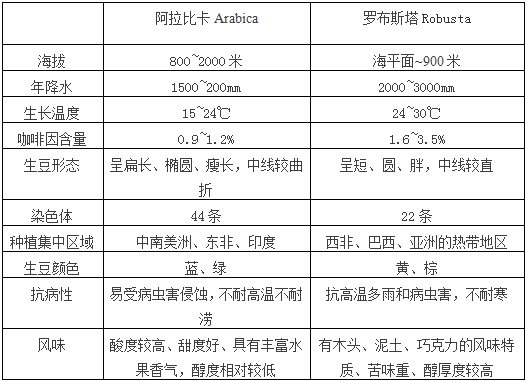
The three major native species of coffee are Arabica, Robusta, and Liberica (Liberica). Among them, Arabica has the highest production, accounting for about 70%~75% of the world's total coffee production, and includes sub-varieties such as Bourbon and Typica. Robusta accounts for about 20%~25% of the world's total coffee production. Liberica accounts for only 3% of the total and is mainly grown in the Asia-Pacific region. Below we will use charts to specifically analyze the differences between Arabica and Robusta.
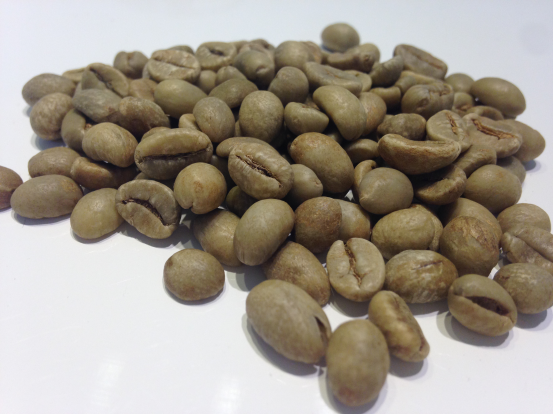
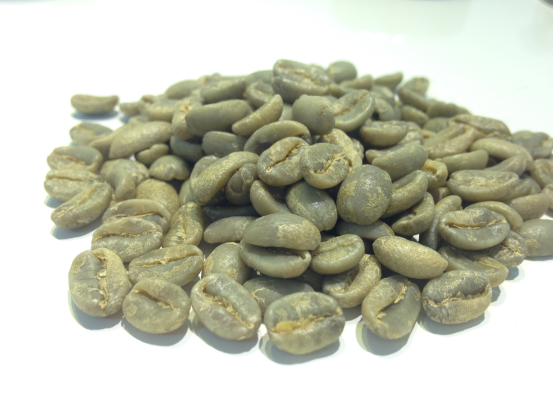
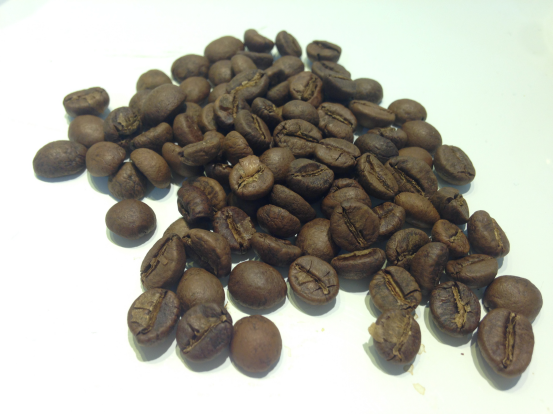
From the following three images, it can be observed that compared with Arabica Yirgacheffe (Figure 2), the green beans of high-quality washed Robusta (Figure 1) are yellow-brown and short, round, and plump; the latter appears more slender and elegant, with a beautiful blue-green color. Figure 3 shows roasted Robusta beans. After roasting, the appearance of Robusta beans is rounder and fuller.
The Royal Washed Robusta in the image above comes from high-altitude regions in Indonesia and India. It is worth mentioning that in recent years a few countries (such as Indonesia and India) have been working to improve the quality of Robusta coffee, growing Robusta at high altitudes and adopting refined management in order to obtain higher-quality green beans.
At the same time, the washed processing method can, to a certain extent, remove as much of the off-flavors in Robusta beans as possible, making the taste cleaner. However, even relatively high-quality Robusta that has undergone refined processing still cannot fully make up for its inherent flavor deficiencies. If extracted by pour-over, it will show obvious characteristics of barley tea, peanut, and genmaicha, with prominent bitterness and almost no acidity. When we teach, we usually prepare Robusta beans for students to taste as part of the flavor experience.
The image below is a comparison of the leaves of Arabica and Robusta. The former's leaves are slender and oval, while the latter's leaves are wider and thicker. The difference in leaf size is already very obvious, not to mention the difference in plant size. Arabica coffee trees are usually 2~3 meters tall, while Robusta can generally grow to more than 10 meters.
However, Robusta's value is not only as a negative example to set off Arabica's superiority; it has an irreplaceable place in Italian espresso blends. Italy's blending schools are divided into southern and northern Italian styles. Northern Italian roasting is lighter than southern Italian roasting and uses 100% Arabica beans. Southern Italian style, which is roasted darker and pursues a thick mouthfeel, adds a small amount of Robusta to the blend to enhance the coffee's body and produce an Espresso with richer crema. After southern Italian-style Espresso is combined with milk, it presents a rich and full-bodied mouthfeel. Because Robusta and Arabica bring out the best in each other, milk coffee becomes even richer and more aromatic. Robusta makes up for Arabica's lack of body, while Arabica enhances Robusta's aroma. At this moment, blending is elevated to an art.
The design concept of Front Street's classic blend is precisely based on the above idea. It uses a 100% Arabica Mamba combination and, on the basis of Brazilian Red Bourbon and Indonesian Mandheling, adds a small amount of Robusta. Because it uses a medium-dark roast, it gives off obvious aromas of butter, toasted bread, and caramel biscuits during extraction, with a strong flavor, a solid mouthfeel, and delicate crema. Extraction is very stable, making it an essential home coffee for beginners.
If you want to make the same taste as a coffee shop, or want to become a shop owner, then Front Street Commercial Blend is the first choice. Compared with other espresso coffees, Front Street Commercial Blend uses the typical combination of Brazil and Colombia and also adds a small amount of Robusta, adding further brilliance to the original flavor layers. The coffee shows complex nutty aromas such as almonds, apricot kernels, and walnuts, with good crema fluidity, low acidity, and a full-bodied taste. Combined with its price advantage, it is undoubtedly the best choice for opening a shop.
Robusta has also made a certain contribution to the development of new coffee varieties. Although Arabica has a rich aroma and a delicate, varied taste, it is not tolerant of drought or waterlogging, has weak disease resistance, and also has relatively lower production than Robusta. In order to improve a certain variety's disease resistance and increase production, Arabica and Robusta are first crossed and then backcrossed, with genetic selection carried out, in pursuit of new varieties that have both high-quality flavor and strong disease resistance and high yield.
The above content is compiled by CoffeeHunters, a coffee news website.


