







Which grades and defect rates does the coffee grading system use?
Yirgacheffe coffee is graded by defect count and cup quality, which explains the wide gap in price between lots that look similar on the shelf. Washed beans are sorted into grades such as G1 and G2, and natural lots follow their own scale, while Q1 and Q2 scores describe cup quality in the specialty market.
The town sits between 1,700 and 2,100 meters, and the surrounding rift valley keeps the area cool and misty. Natural and washed processing shape the flavor differently: washed lots show cleaner floral and citrus notes, natural lots push berry sweetness. For a V60, use a medium grind and water near 92C.
Also from Ethiopia's Yirgacheffe, why is the quality and price of commercially available beans so vastly different? The key lies in the grading system. This article systematically lays out the grading logic of Yirgacheffe: how the Ethiopian Ministry of Agriculture's CLU body and the ECX system operate, what washed and natural beans are graded on respectively, where G1 and G2 differ in defect rate and cup score, and what Q1 and Q2 mean. The article also compares how the two processing methods—natural and washed—shape flavor, and includes Front Street's V60 brewing parameters and cupping flavor descriptions, so you have a basis for both bean selection and brewing.
When shopping at the supermarket, it's easy to notice that the same kind of fruit is often placed in two or three different spots, with different price tags. If you observe carefully, you'll find that these separately placed fruits really do have clear differences—either uneven in size or varying in freshness. This way of displaying them is essentially meant to help consumers more quickly buy what they want.
Front Street has mentioned before: coffee beans are essentially an agricultural product, and they too are divided into different categories, with the aim of making it easier for traders to purchase them, and naturally there are price gaps between different grades. There are many types of coffee beans worldwide, and given the vastly different actual conditions in each producing country, each country has developed its own classification criteria based on its own circumstances—some look at bean size, some at growing altitude, and some use the proportion of defective beans as the benchmark.
So, by what standard exactly are Yirgacheffe coffees graded? Before revealing the answer, let's first get a basic understanding of this producing region.
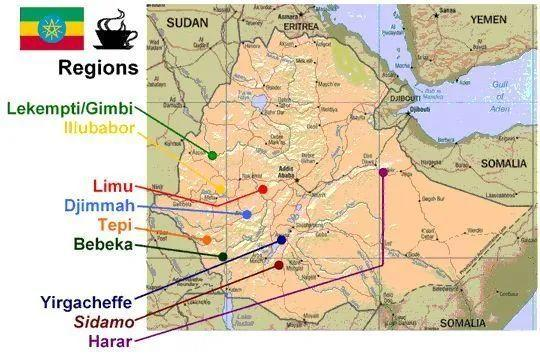
Yirgacheffe is a small town in Ethiopia, at an altitude between 1,700 and 2,100 meters, making it one of the highest coffee-producing regions in the world and a calling card of Ethiopia's specialty coffee. Lake Abaya, Lake Turkana, and Lake Chamo supply abundant moisture to this land; the rift valley area, represented by the Misty Valley, is shrouded in clouds and mist year-round, with a mild and pleasant climate, cool breezes, and a moist, refreshing atmosphere, where thousands of coffee trees thrive. Front Street believes it is precisely such exceptional climate conditions that give rise to Yirgacheffe's unique terroir, where floral and fruity aromas intertwine, layered and ever-changing, and hard to pin down.
As the birthplace and "gene bank" of coffee, Ethiopia has an extremely rich variety of cultivars, including a large number of native varieties that have not yet been developed. For this reason, the green coffee beans produced locally vary greatly in size and appearance, and cannot be graded by size or shape, so they can only be graded by the proportion of defective beans.
How Yirgacheffe's grades are divided
First, you need to know that under the Ethiopian Ministry of Agriculture there is an institution called CLU (Cupping and Liquoring Unit), dedicated to overseeing the quality of export beans, one of whose core functions is to set grading standards. This department had already been operating for many years before the birth of ECX.
Before the ECX system was implemented, washed coffees were classified into two grades, G1 and G2, for export based on the number of defective beans; natural coffees corresponded to G3, G4, and G5, meaning the highest grade for natural beans was only G3. After ECX appeared, the grading system was reorganized: the grade names for washed beans remained the same, while natural beans had a G1 grade for the first time. This also explains why today you can see Ethiopian natural G1 and G2 on the market, while G3 is increasingly rare.
Ethiopia's earlier old grading system simply used the number of defective beans as the sole measure—washed beans capped at Grade 1 (G1), and natural beans capped at Grade 3 (G3). The grading scheme in use today was formulated by ECX, combining physical attributes and cup flavor performance into a score, and determining the grade accordingly.
According to processing method, all coffees are first classified into three major categories:
a. Speciality (washed & unwashed): very few defects, excellent cup flavor performance;
b. Commerical (washed & unwashed): though not reaching the specialty threshold, better than the domestic consumption grade;
c. Local / Domestic (washed & unwashed): coffees with relatively many defects (including unripe beans), or those that are past their harvest season, improperly stored, and weakened in flavor.
Among the above categories, Specialty and Commerical are exported to the international market, while Local is specifically supplied to Ethiopia's domestic market.
ECX's specific grading and scoring rules are as follows:
A. Scoring composition for the washed processing method
1. Physical characteristics weighted 40%: defects account for 20%, bean size 10%, color 5%, odor 5%
2. Cupping quality weighted 60%: cleanliness 15%, acidity 15%, mouthfeel 15%, flavor characteristics 15%
B. Scoring composition for the natural processing method
1. Physical characteristics weighted 40%: defects account for 30%, odor 10%
2. Cupping quality weighted 60%: cleanliness 15%, acidity 15%, mouthfeel 15%, flavor characteristics 15%
C. Comprehensive summary:
1. All coffees are first divided into two major categories, natural and washed, according to processing method;
2. Then, based on physical characteristics and basic cup quality scores, they are divided into nine grades from G1 to G9;
3. For G1 to G3, additional cupping is conducted according to SCAA standards to more finely assess their flavor attributes; any G1 or G2 scoring 85 or above is classified as Q1;
4. G1, G2, and G3 scoring between 80 and 85 are designated Q2, while G1, G2, and G3 scoring below 80 are all grouped into G3;
5. Q1 and Q2 are classified as Specialty Grade for export; G4 to G9 retain their original grades and, together with G3, are classified as Commercial Grade for export.
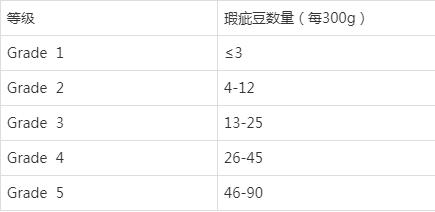
Taking washed beans as an example, Grade 1 means no more than 0 to 3 defective beans per 300 grams of green beans; Grade 2 allows 4 to 12 defective beans per 300 grams. Of course, in actual practice buyers and sellers inevitably differ in their identification of defective beans (otherwise how would we always manage to pick out so many defective beans?), but the gap in defect rate between the two is still obvious at a glance. G1 contains clearly fewer defective beans than G2—in other words, setting aside specific flavor and roast level, Ethiopian G1 coffee beans are overall superior to G2 in both quality and score, and at least in terms of the off-flavors caused by defects, the two can be distinguished in a single sip.
At present, the core differences between G1 and G2 come down to two points: the level of defect rate and the gap in cup score. G1 has a lower defect rate and correspondingly a higher cup score. However, another situation has now emerged: some beans, although their defect rate already meets the G1 threshold, fail to reach the G1 cupping requirement (i.e., below 91 points), and such beans are likewise downgraded to G2.
Yirgacheffe coffee's processing methods
In terms of processing methods, Yirgacheffe originally always used the oldest natural method. Since the introduction of washing technology in 1972, after decades of development, the popularity of the washed method now far exceeds that of the natural method. Front Street feels that washed processing can reduce the negative effects of defective beans, making the flavor present more cleanly and transparently. Front Street's daily staple bean—washed Yirgacheffe—has a bright citric acidity and alluring floral aroma that linger in memory, and it is also the best-selling bean in the shop.
The natural processing method is one of the oldest and most traditional processing methods: after the coffee cherries are picked, they are immediately spread out and dried in the sun. This method is common in areas with abundant sunlight or scarce water resources—in Ethiopia, for example, about 70% of the country's coffee cherries follow the natural route. Front Street believes that compared with washed coffee, natural coffee has lower acidity, more prominent sweetness, and a clear tactile feel, but slightly inferior cleanliness, and its flavor shows richer berry notes while being overall more complex. For example, Yirgacheffe Red Cherry, with its flavor interwoven with berries and flowers, captivates you in one sip.
Front Street's brewing suggestions:
Some may ask: how should you brew to bring out the utmost deliciousness? Front Street believes that the freshness of the beans is one of the most crucial elements; only sufficiently fresh coffee beans can fully display their rich flavors. Every batch of beans sent out by FrontStreet Coffee is no more than 5 days past roasting, because Front Street deeply understands how much freshness affects flavor. Front Street's roasting philosophy is "freshly roasted good coffee," striving to ensure that every friend who places an order receives beans in the freshest possible state. Since coffee's resting period is about 4 to 7 days, by the time customers receive it, it happens to be at its flavor peak.
Of course, some customers need Front Street to grind the beans for them, and that's no problem either, but Front Street must especially remind you: once the beans are ground into powder in advance, there's no need to rest them anymore—during transport, the pressure from accumulated carbon dioxide inside the packaging bag actually makes the flavor rounder, so the ground coffee can be brewed and enjoyed immediately upon arrival. However, ground coffee must be finished as soon as possible, because once ground and exposed to air, the oxidation rate greatly accelerates, the flavor dissipates faster, and the taste naturally suffers. So Front Street more strongly recommends buying whole beans and grinding fresh right before brewing, to firmly lock in the coffee's flavor.
Front Street's Yirgacheffe brewing parameter reference:
Water temperature 90°C, V60 dripper, 1:15 coffee-to-water ratio, 15 grams of coffee, grind size (No. 20 standard sieve, 80% pass rate)
The brewing rhythm is staged extraction: first use an amount of water equal to twice the coffee dose for blooming, that is, pour in 30 grams of hot water and let it sit for 30 seconds. The reason for arranging the blooming stage is to encourage the coffee grounds to release the carbon dioxide gas trapped inside, thereby making the subsequent extraction more stable. Then reduce the flow, pour in a circular motion until 125 grams, pause, then continue pouring until 225 grams; after the water in the dripper has completely dripped through, remove the dripper. Starting the timer from the formal pouring, the entire extraction takes 2 minutes 00 seconds. Finally, pick up the whole cup of coffee and gently swirl it to even it out, then pour it into a cup and savor it slowly.
[Washed Yirgacheffe flavor]: Bright and lively acidity, bringing out citric and citrus aromas, crisp on the palate, with a hint of black tea in the finish.
[Natural Red Cherry flavor]: The taste of strawberry, berries, and lemon, layered with the vinous aroma produced by fermentation.
The flavor differences among Ethiopia's various producing regions are very pronounced. To let more friends appreciate the character of Ethiopia's different producing regions, Front Street alone stocks more than a dozen single-origin beans from this one producing country, Ethiopia; in addition, there are dozens of beans from producing regions in other countries, rich in variety and diverse in flavor. We warmly invite everyone to visit FrontStreet Coffee and experience it for yourself!
To get more professional coffee knowledge and coffee bean information, welcome to follow Coffee Workshop (WeChat public account cafe_style)
If you'd like to purchase more specialty coffee beans, welcome to add FrontStreet Coffee's personal WeChat, WeChat ID: qjcoffeex
The above content is compiled by CoffeeHunters, a coffee news website.


