







What Is Blue Mountain Coffee and How Does It Taste?
Blue Mountain coffee is a washed Typica coffee grown above 1,000 meters in Jamaica's Blue Mountains, and its cup shows balanced acidity, sweetness, and bitterness with a full body. Only coffee from that certified zone may carry the name; lower-altitude lots are sold as High Mountain coffee.
For brewing, Front Street Coffee uses 88C water, a Kono Meimon dripper, 15g of medium-dark roasted Blue Mountain No. 1, and a 1:15 ratio, pouring in three stages after blooming. Authentic lots carry a Jamaican government certificate, wooden barrels, and a Rainforest Alliance frog logo.
Blue Mountain coffee is renowned for its balanced acidity, sweetness, and bitterness along with a full body, but to truly brew its classic flavor, water temperature, dripper, and pouring rhythm are all indispensable. This article begins with the origin certification and varietal background of Blue Mountain coffee, and combines Front Street Coffee's roasting and brewing experience to break down in detail the pour-over parameters for medium-dark roasted Blue Mountain No. 1: 88°C water temperature, Kono Meimon dripper, 15g dose, 1:15 ratio, and the specific technique of three-stage pouring after blooming. It also compares the performance of Blue Mountain Geisha to help coffee lovers understand the flavor boundaries and brewing key points of this legendary bean.
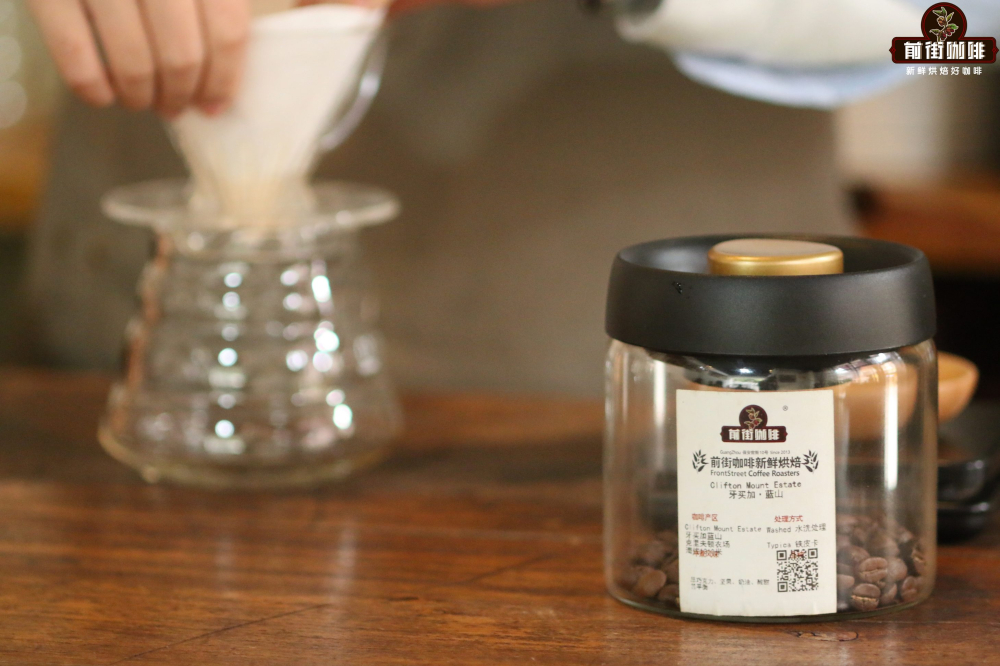
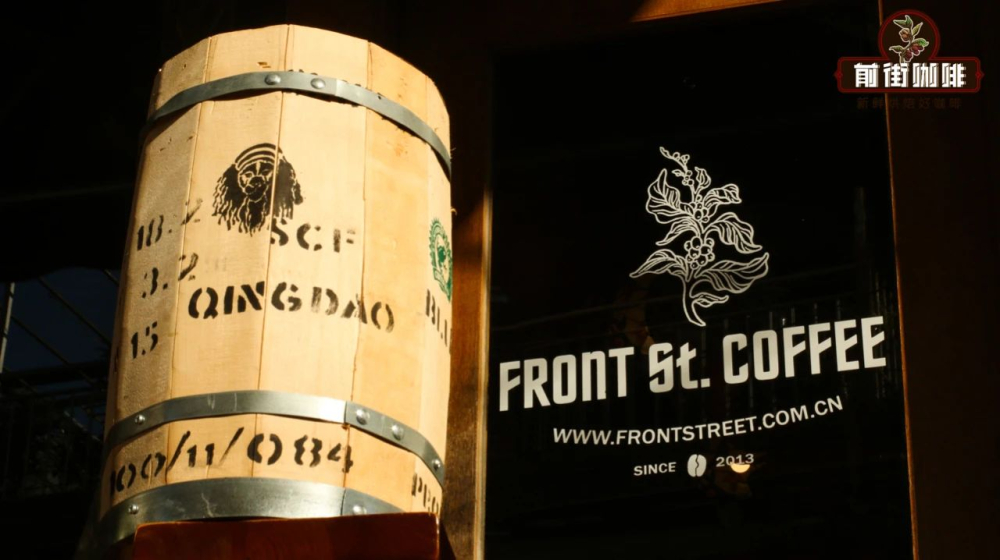
To enjoy a cup of genuine Blue Mountain No. 1 coffee is actually not as difficult as one might imagine, and Front Street Coffee can provide it. As for how to determine whether Blue Mountain No. 1 is authentic, the method is quite straightforward: a Blue Mountain coffee certification certificate issued by the Jamaican government, green beans imported in wooden barrels, and the green frog logo of Rainforest Certification on the exterior of the barrel. All three of these can be seen with your own eyes at Front Street Coffee.
|Does Jamaican Blue Mountain coffee count as authentic as long as it is grown in the Blue Mountain region?
Not exactly. According to CIB (Certified International Barista) standards, only coffee grown at altitudes above 1,000 meters qualifies to be called Jamaican Blue Mountain coffee; conversely, coffee produced below 1,000 meters in the Blue Mountain area is classified as High Mountain coffee, second only to Blue Mountain coffee in quality, and is often called the sibling variety of Blue Mountain coffee in the industry. It must be emphasized here: only coffee grown within the Blue Mountain region can bear the name Blue Mountain coffee. Coffee grown outside the Blue Mountain region, even if still within Jamaica, cannot use the name Blue Mountain coffee.
CIB has delineated a range of approximately 6,000 hectares in the Blue Mountains and strictly stipulates that only Typica coffee produced within this area can be named "Blue Mountain Coffee." Products from other areas are called High Mountain Coffee or Jamaica Select Coffee. According to CIB's classification, the Blue Mountain coffee growing region has an altitude of about 910 to 1,700 meters, mainly distributed across St. Thomas, St. Mary, St. Andrew, and Portland, accounting for about one-third of the entire Blue Mountain growing area.
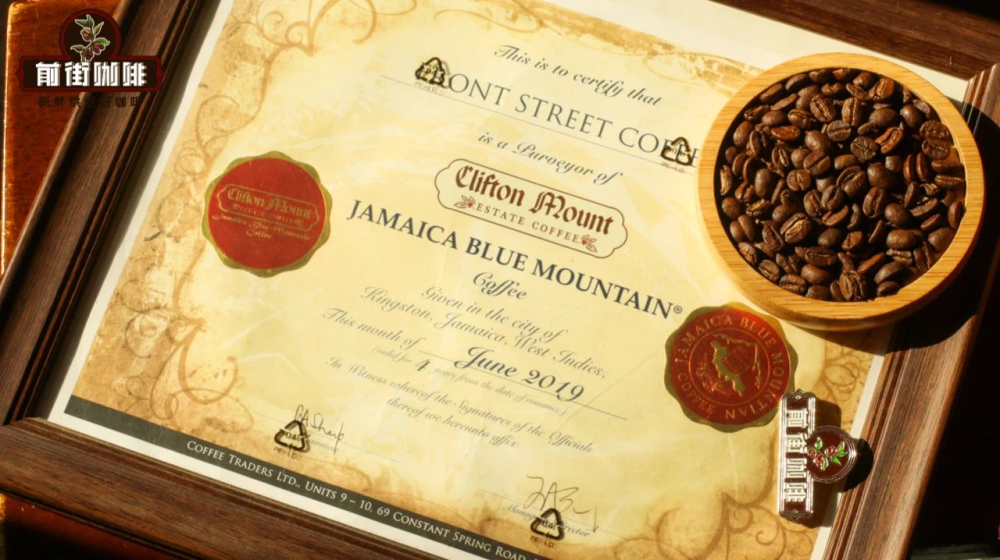
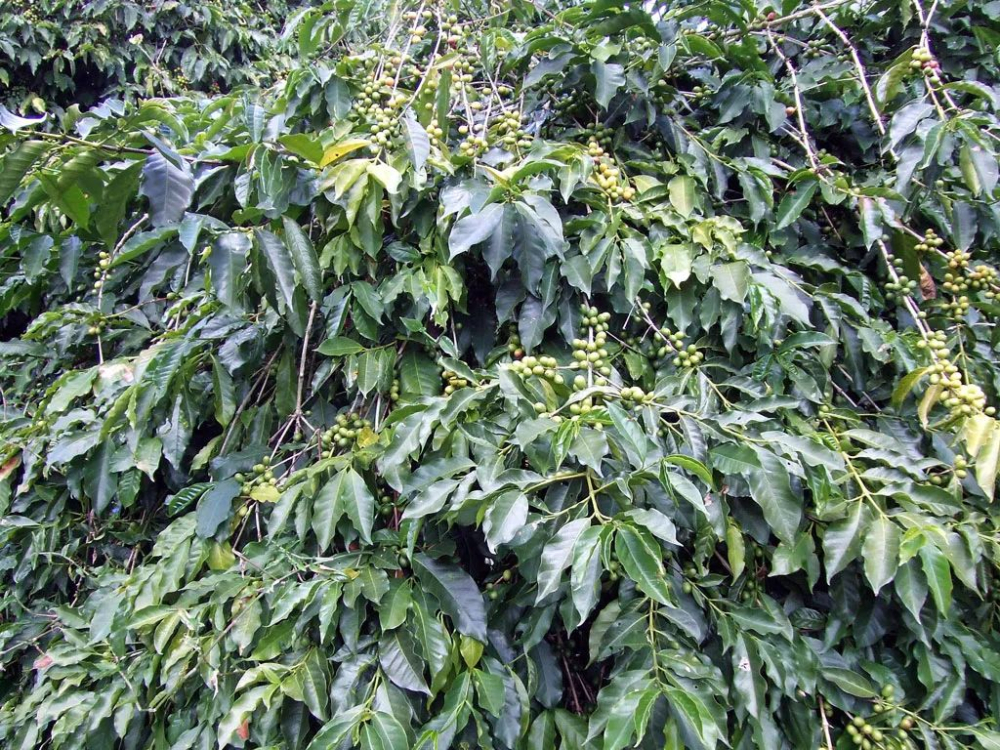
Front Street Coffee's Blue Mountain No. 1 comes from Clifton Farm at an altitude of 1,310 meters in the Blue Mountain region. This farm is the largest estate in the area, though by international standards it still counts as small-scale cultivation. Many estate owners are actually small landholders whose families have worked this land for two centuries. This place is recognized as a world-famous source of high-quality Blue Mountain coffee. Clifton Farm is also the only coffee estate in the Blue Mountain coffee region to obtain Rainforest Certification, so the Blue Mountain No. 1 coffee exported by this estate bears the green frog logo of Rainforest Certification on its shipping barrels.
|Blue Mountain coffee bean variety
The traditional Blue Mountain coffee variety is Typica: Blue Mountain Typica was transplanted from Martinique to the Jamaica Blue Mountains in the 1720s. After more than 200 years, Blue Mountain Typica has evolved better disease resistance, especially resistance to coffee berry disease, superior to ordinary Typica. However, once Blue Mountain Typica leaves Jamaica, it cannot reproduce its characteristic delicate sweetness and subtle aroma.
In 2020, Clifton Farm introduced Geisha variety coffee beans. Based on Front Street's understanding and deduction, it is believed that these Geisha varieties came from Panama's Elida Estate, but this is only speculation and has not been officially confirmed. Geisha coffee beans need to be grown at high altitudes to develop rich and captivating floral aromas. For example, the average altitude of Geisha grown at Hacienda La Esmeralda is above 1,500 meters, while the Blue Mountain coffee producing area is only 1,310 meters. Through cupping Blue Mountain Geisha coffee beans, Front Street found that the floral aroma of Blue Mountain Geisha is not obvious; only when tasting carefully can one detect a faint hint of jasmine. | Does Blue Mountain coffee taste good? What does Blue Mountain coffee taste like?
If asked whether Blue Mountain No. 1 coffee tastes good, Front Street's baristas would answer: "It is the taste that defines a good cup of coffee." Why say that? Because Blue Mountain coffee is famous for its balanced acidity, sweetness, and bitterness, along with good body.
In terms of flavor, it is not as captivating as Geisha; in terms of acidity, it is not as rich as beans from Ethiopia; in terms of sweetness, it is not as pronounced as beans from Brazil; in terms of body, it is not as full as Mandheling coffee. So why has such seemingly ordinary coffee flavor been remembered and savored by so many for so many years? Perhaps what we drink is sentiment, and what we drink is also history. Undeniably, in people's memories, hearing the word "coffee" all began with Blue Mountain. Even if its status is one day replaced by other regions, its name will certainly always be remembered.
For such a classic cup of Blue Mountain coffee, how should we brew it to maximize the characteristics of this bean?
|First, let's look at Front Street's roasting approach for the most classic washed Blue Mountain coffee
To express the balanced acidity, sweetness, and bitterness of Blue Mountain coffee, Front Street Coffee's roaster adopted a level between medium-light and medium-dark roast. Charged at 165°C drum temperature, heat 130, damper set to 3; turning point at 1'32", at 95.8°C drum temperature the heat remained unchanged; at 3 minutes the damper was adjusted to 4, at 4 minutes the heat was increased to 140. At 153.3°C drum temperature the bean surface turned yellow, the grassy smell completely disappeared, entering the dehydration stage. At 8'36", ugly wrinkles and dark patches appeared on the bean surface, and the toast aroma clearly turned into coffee aroma, which can be defined as the prelude to first crack. At this point, one must listen carefully for the sound of first crack. First crack began at 10'06", developed for 3 minutes after first crack, and the beans were dropped at 198.5°C.
We know that Blue Mountain coffee beans are roasted to a medium-dark level, so we can roughly tell that this coffee bean will have a certain body. But as mentioned above, Blue Mountain coffee is a coffee with balanced acidity, sweetness, and bitterness, so this coffee still has a certain soft acidity. To enhance the body, Front Street Coffee's baristas use the Kono Meimon dripper for brewing. |Why can the Kono dripper enhance the body of coffee?
Front Street Coffee chose the Kono dripper because they like its rib design. Unlike the spiral ribs of the V60, the Kono dripper's divergent rib design and small outlet hole make its filtration speed slower, tending overall toward immersion-style extraction, giving the coffee a full taste.
|Blue Mountain coffee brewing water temperature
Because a near medium-dark roast is used, Front Street sets the water temperature at 88°C when brewing Blue Mountain coffee. This ensures that during the "immersion" in the brewing process, it is less likely that the flavors have already been extracted while brewing is not yet complete. |Blue Mountain coffee brewing parameters
Dripper: Kono Meimon
Dose: 15g
Ratio: 1:15
Grind size: medium-coarse (75% passing through No. 20 standard sieve)
Water temperature: 88°C
|Front Street Coffee brewing notes
First, bloom with 30g of water for 30 seconds, then slowly pour 95g of water in a circular motion from the center outward with a small stream, until the scale reads 125g. Next, wait for the coffee bed to drop to the halfway point, then pour 100g of water with a larger stream, reaching a total water amount of 225g. After all the coffee liquid in the dripper has flowed into the server, remove the dripper to end extraction. Total brewing time is 1 minute 59 seconds. Because it is a staged extraction, the coffee concentration in the server is not uniform, so remember to shake it well before tasting after extraction is complete.
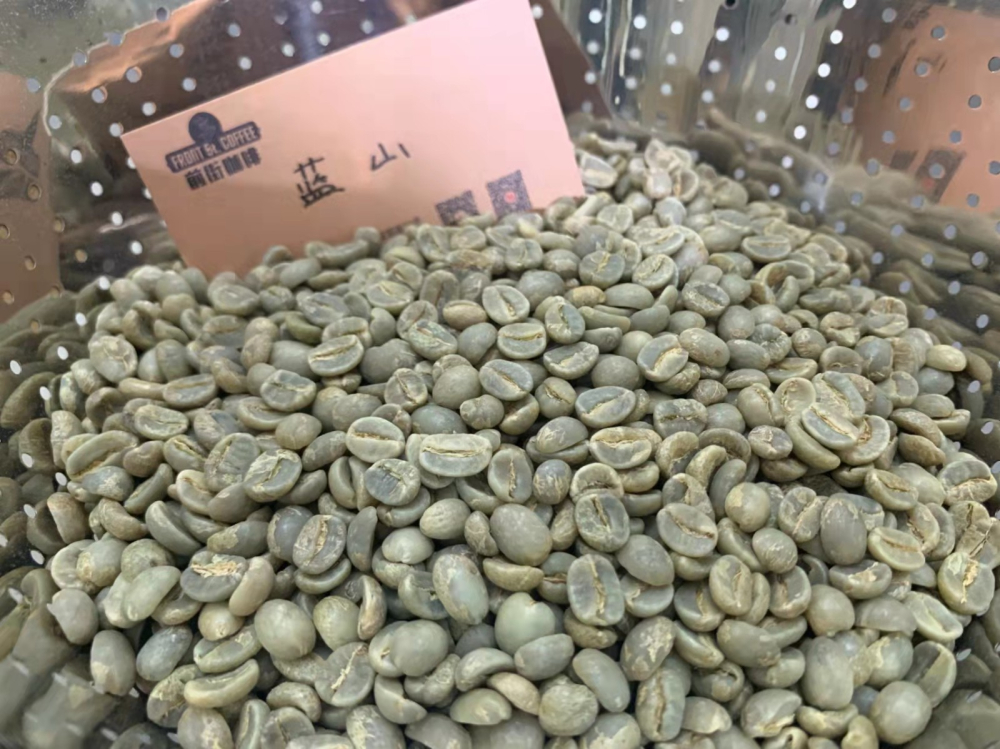
Blue Mountain coffee brewing flavor: dark chocolate and nutty notes on the entry, high cleanliness, very bright, good body, balanced acidity, sweetness, and bitterness.
For more specialty coffee beans, please add the private WeChat of Front Street Coffee, WeChat ID: kaixinguoguo0925
The above content is compiled by CoffeeHunters, a coffee news website.


