







In the world of specialty coffee, Ethiopia's Yirgacheffe is undoubtedly one of the most recognizable names. Compared to the pricey Panama Geisha, Yirgacheffe has won the favor of many coffee lovers with its rich floral and fruity acidity and its delicate, bright mouthfeel. This article will systematically examine the unique charm of Yirgacheffe coffee beans from multiple angles—including the geography of the producing region, its historical evolution, processing methods, and flavor profile—and introduce several representative Ethiopian coffees on Front Street Coffee's bean shelf, helping readers gain a comprehensive understanding of the terroir and flavor spectrum of this African star region.
Compared to the pricey Panama Geisha, coffee produced in Ethiopia, Africa, also possesses abundant floral and fruity acidity. Currently, Africa's coffee production accounts for only about 12% of the global total, far lower than that of Latin America. Yet as the birthplace of coffee, Africa boasts rich coffee genetics, prominent floral and fruity notes, and vivid sweetness and acidity, and is thus pushed to the pinnacle of the world coffee map. Ethiopia in particular has become a holy land that countless coffee lovers long for.
Within Ethiopia, the divisions between producing regions are not very clearly defined and change or are updated almost every few years. Examples include the Guji and Bale regions, which have appeared frequently in competitions such as COE and TOH in recent years. This may be related to Ethiopian authorities' active efforts to develop new producing regions and explore coffee terroir, forms, and flavor profiles.
The same is true of the Yirgacheffe region. The region's growing elevation is close to 2,000 meters, making it one of the highest coffee-producing regions in the world, and it was once part of the Sidamo region. The lakes around the region bring abundant moisture to coffee cultivation. In the rift valleys represented by the Misty Valley, mist coils year-round, the climate is springlike throughout the four seasons, gentle breezes blow, and the air is cool and humid. Thousands of coffee trees grow luxuriantly here, nurturing Yirgacheffe's unique terroir, in which floral and fruity aromas interweave and shift unpredictably.
In the 1970s, the most advanced washed processing method of Central and South America at the time was introduced locally, thereby improving the quality of green coffee beans and bringing growers more substantial returns. At the same time, the washed processing method processes the coffee fruit until only parchment beans remain for drying. With no excess sugars or esters participating in reactions, Yirgacheffe's truest coffee terroir could be clearly presented to the world.
The fresh, elegant white jasmine aroma in Yirgacheffe coffee beans' flavor, along with their delicate and bright mouthfeel, allowed Yirgacheffe to stand out from among many Sidamo coffee beans. Many coffee growers in the Sidamo region even take pride in having their products labeled as Yirgacheffe coffee. Yirgacheffe coffee beans are outstanding in quality and have long built up a group of loyal fans. On Front Street's bean shelf, a number of African coffee beans are displayed, and Yirgacheffe coffee beans have always drawn inquiries from their loyal fans.
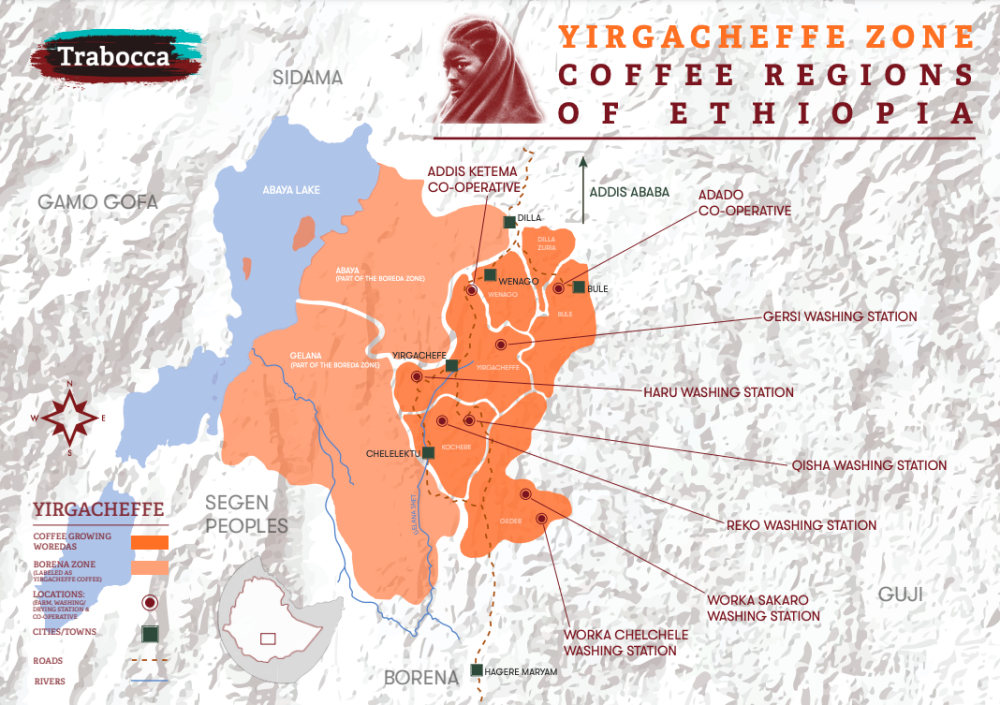
For a long time before Yirgacheffe truly became famous, it was consistently sold under the label Sidamo. It was not until 1995, when Ethiopia abolished provinces and adopted a federal system, and with four revisions and adjustments to the ECX coffee classification table in 2010, 2015, 2018, and 2022, that Yirgacheffe had long since become an independent origin. Today, the Yirgacheffe producing region covers the Gedeo Zone in the Southern Nations, Nationalities, and Peoples' Region as well as West Guji in Oromia.
Among these, the Gedeo Zone governs five coffee woredas: Yirgacheffe, Dilla Zuria, Wenago, Kochere, and Gelana Abaya. It is worth noting that although Gedeb, the southernmost coffee woreda in the Gedeo Zone, is not listed as a Yirgacheffe origin in the ECX classification table, the coffee industry has already regarded it as a Yirgacheffe origin.
Yirgacheffe exudes an extremely complex aroma and displays an exceptionally outstanding mouthfeel that is difficult to describe. On Front Street's bean shelf, seven everyday beans from different producing regions are displayed. This series mostly uses the washed processing method, allowing newcomers to specialty coffee to quickly become familiar with the terroir of various producing regions at an affordable price. Among them, Front Street Coffee chooses to use Yirgacheffe coffee beans, using their bright citrus notes to represent the terroir of the African producing region.
In addition to the everyday bean series, Front Street Coffee sells multiple Ethiopian coffee beans. Even if they are all from southern producing regions, different processing methods and different growing areas produce different flavor and mouthfeel expressions. Gutingding, Red Cherry, Kafa Forest, Huakui, Gesha Village Red Label, Grana Geisha, and so on.
Gutingding and Kafa Forest are both washed-process coffee beans. Gutingding presents citrus, apricot, and green tea; Kafa Forest presents citrus, honey, and black tea.
Konga Red Cherry is a naturally processed Yirgacheffe coffee bean. Red Cherry leans more noticeably toward berries, strawberries, and fermented wine aromas, along with lemony acidity, a lingering creamy finish, and strong honey sweetness.
The above content is compiled by CoffeeHunters, a coffee news website.


