







Why does Central American coffee from Costa Rica taste so sweet?
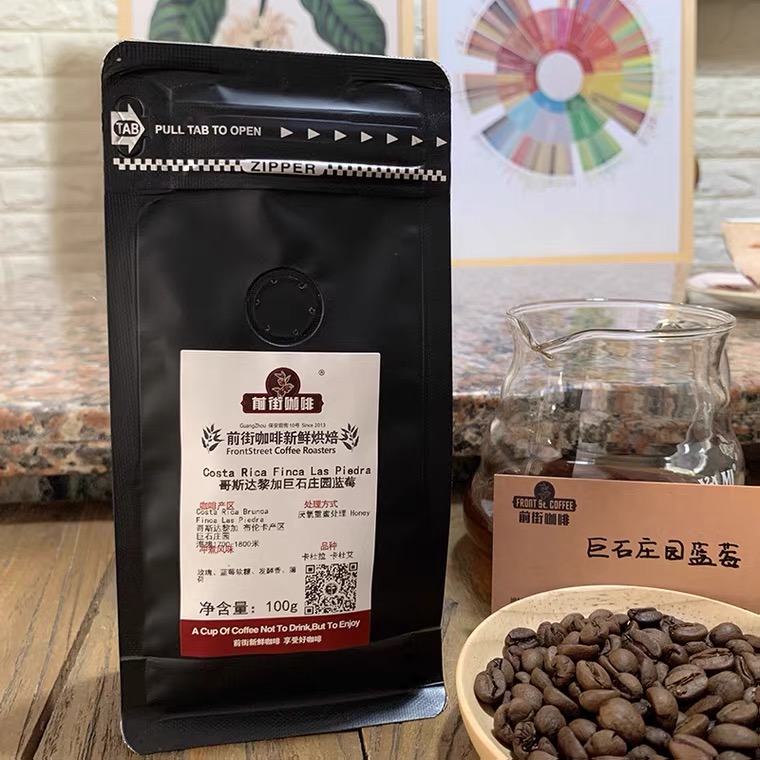
Costa Rica sits on the Central American coffee map as a source of honey-sweet cups, and the Tarrazú region is central to that reputation. Piedra Grande Estate's Blueberry bean comes from Bruncas at 1,700 to 1,800 meters, processed as anaerobic heavy honey from Caturra and Catuai varieties, giving rose in the dry aroma, a blueberry gummy body, and a cooling mint finish.
The country's sweetness comes from variety, altitude, and processing rather than one single factor. Geisha also performs in Costa Rica, though Caturra and Catuai remain the workhorses of Tarrazú. Where are arabica beans grown matters here: high-elevation sites across Costa Rica slow cherry ripening, concentrate sugars, and support the honey-like tonality the estate beans are known for.
Costa Rica is a coffee origin that cannot be overlooked on the Central American coffee map, and Front Street Coffee's Costa Rica series has always been known for being "sweet as honey." This article starts with the Blueberry coffee from Piedra Grande Estate, guiding you through the terroir characteristics of the Bruncas region, the refined process of anaerobic heavy honey processing, and an in-depth analysis of the main varieties in the Tarrazú region—the differences between Caturra and Catuai, as well as how Geisha performs in Costa Rica. Whether you are looking for a daily drinker with outstanding sweetness or want to clarify the flavor differences between varieties, this article will give you clear answers. Finally, Front Street's standard brewing parameters are included so you can replicate a great cup of coffee at home.
For more specialty coffee knowledge, please follow our WeChat official account: Front Street Coffee (FrontStreet Coffee)
Costa Rica is one of the most charming countries in Central America. In the eyes of ordinary tourists, it is a vacation paradise, but for coffee lovers, its thriving coffee industry is the real attraction. The Costa Rican coffees produced by Front Street overall present a "sweet as honey" tonality. Whether it is a daily drinker, Mirazu Estate, the Musician Series, or the recently launched Blueberry, whenever a picky customer wants a pour-over with outstanding sweetness, Front Street always turns to Costa Rican coffee as the go-to. Today we will focus on the Blueberry bean—fans of it should not miss this.
Front Street Coffee (FrontStreet Coffee): Costa Rica · Piedra Grande Estate Blueberry
Region: Bruncas, Costa Rica
Estate: Piedra Grande Estate
Altitude: 1,700-1,800 meters
Processing method: Anaerobic heavy honey processing
Varieties: Caturra, Catuai
Anyone who has tried Blueberry should know that this is a coffee with a very distinct personality. In the dry aroma stage, you can catch subtle notes of rose, elegant and delicate. On the first sip, a blueberry gummy-like texture bursts in the mouth. After the juicy sensation fades, the cooling freshness of mint delivers a second wave of impact. It really is addictive!
Using this bean as a starting point, Front Street wants to quiz you: do you know what other coffee regions Costa Rica has besides Bruncas? Although Costa Rica is not a large country in terms of land area, it has eight coffee regions: Central Valley, West Valley, Tres Ríos, Tarrazú, Turrialba, Orosi, Guanacaste, and Bruncas. Today, setting aside the other seven, we will focus specifically on the Bruncas region. Coffee production in this region accounts for about one-fifth of the country's total. Bruncas is a mid-altitude area, with coffee cultivation at roughly 800 to 1,200 meters. Most coffee crops in this region reach HB grade or above.
According to Front Street's understanding, Piedra Grande Estate is located in southern Costa Rica, bordering Panama, and has diverse microclimates that are very suitable for coffee cultivation. Because the area is relatively low in altitude, coffee is basically grown on hillside farms, at elevations between 800 and 1,700 meters, with an average temperature of 22°C. Local conditions can meet the requirements for growing demanding specialty coffee. The total coffee planting area is about 12,000 hectares, distributed across 4,200 farms, and coffee production accounts for about 20% of the national total.
So where does the name Piedra Grande Estate come from? A large number of carvings made by indigenous people between 200 BC and 1500 AD were unearthed near the estate, and the estate was therefore named "Piedra Grande" ("Big Stone").
Many customers are confused about Blueberry's processing method. If Costa Rican honey processing is mentioned, everyone should have some understanding. Honey processing is essentially a method between natural and washed processing, aimed at allowing coffee farmers to produce sweeter coffee in a shorter time while effectively reducing the risk of over-fermentation. After removing the skin, the mucilage on the fruit is retained and dried naturally until the moisture content drops to 11%.
The processing of anaerobic heavy honey is slightly more complex than ordinary honey processing. Pickers first select ripe, perfect coffee cherries and soak them in plastic tanks to remove leaves, impurities, and coffee cherries that are not dense enough.
Before the first fermentation stage, cultures need to be prepared: yeast, lactic acid, sucrose, blueberry fructose, orange juice, mint juice, etc. The first fermentation stage lasts 30 hours, with the goal of stimulating the coffee's sweetness and fruity tonality. After removing the skin, the beans are placed into round plastic tanks, the prepared culture liquid is added, carbon dioxide is injected, and the pH value inside the tank is controlled. Cold nights can extend the fermentation time of the coffee beans without worrying about the risk of over-fermentation. In the end, the coffee tastes clean, has high body, and carries a rich cherry-like sweet-and-tartness and the typical Costa Rican sweet fruity aroma. After anaerobic fermentation ends, the second stage of honey processing fermentation begins. During the day, the beans with mucilage are placed on African beds and sun-dried at a temperature controlled below 40°C. After 8 hours of sun drying, the fruit is moved into a greenhouse to rest for 12 hours, repeating this cycle for 20 to 25 days. After the green coffee beans reach a moisture content of 15%, they enter a stabilization period. The green beans are put into an inner bag with an outer cloth bag and left to rest for one month.
Besides Blueberry, what other Costa Rican coffees are worth trying? Front Street strongly recommends Costa Rica's daily drinker—Tarrazú. Using the region name directly as the bean name, one bean can represent the flavor of the entire region—this is exactly the original intention behind Front Street's daily drinker series. The Front Street daily drinker series is a group of high-value regional beans. In some respects they may not be as good as beans from famous estates, but through this series, you can taste the main flavors of major regions in an affordable way, helping coffee beginners determine their preferred regions at a lower cost.
Let's take Front Street's daily drinker as an example to look at this region! Costa Rica's Tarrazú growing area is locally called "Los Santos" because its canton (similar to a town) is named after various saints. Tarrazú is about a two-hour drive from San José, with roads winding around mountainsides and coffee plantations along the way. Tarrazú is an ideal place for growing Arabica coffee beans. The region is known for producing coffee with distinctly acidic qualities, which is largely related to the diamine content in this area. Moreover, an altitude of 1,200-1,900 meters gives coffee cultivation here diverse small-scale climatic variations.
The main varieties grown in this region are Caturra and Catuai. Caturra is a natural mutation of the Bourbon line, discovered in Brazil in 1937. Its tree shape is shorter than Bourbon. Although it inherits Bourbon's weaker resistance, its yield is higher than Bourbon's. Caturra's flavor is mainly fruity, with berry-like acidity. Catuai is a cross between Mundo Novo and Caturra. It also inherits Caturra's short tree shape, but has stronger resistance, and its fruit set is firm and not easily dropped. In terms of flavor, Catuai is more monotonous than Caturra, mainly with nutty tonality, lacking Caturra's rich layering. The blend of the two varieties makes Tarrazú coffee more balanced and gentle.
So how should Costa Rican coffee beans be brewed? Front Street believes it is better to start with the standard brewing method:
Front Street brewing parameters:
V60 dripper
Water temperature 91°C
Water-to-coffee ratio 1:15
Coffee dose 15g
Grind size (80% passing through China No. 20 standard sieve)
Front Street brewing method: bloom with 30 grams of water for 30 seconds, then pour in a small stream in circles until 125 grams for a staged pour. When the water level is about to expose the coffee bed, continue pouring until 225 grams and stop. When the water level is about to expose the coffee bed again, remove the dripper. (Start timing from the beginning of the bloom.) Total extraction time is 2'00".
By comparing with the coffee bean information and flavor descriptions on Front Street Coffee (FrontStreet Coffee) packaging, everyone can also try to identify the various flavor and mouthfeel characteristics in coffee at home.
The above content is compiled by CoffeeHunters, a coffee news website.


