







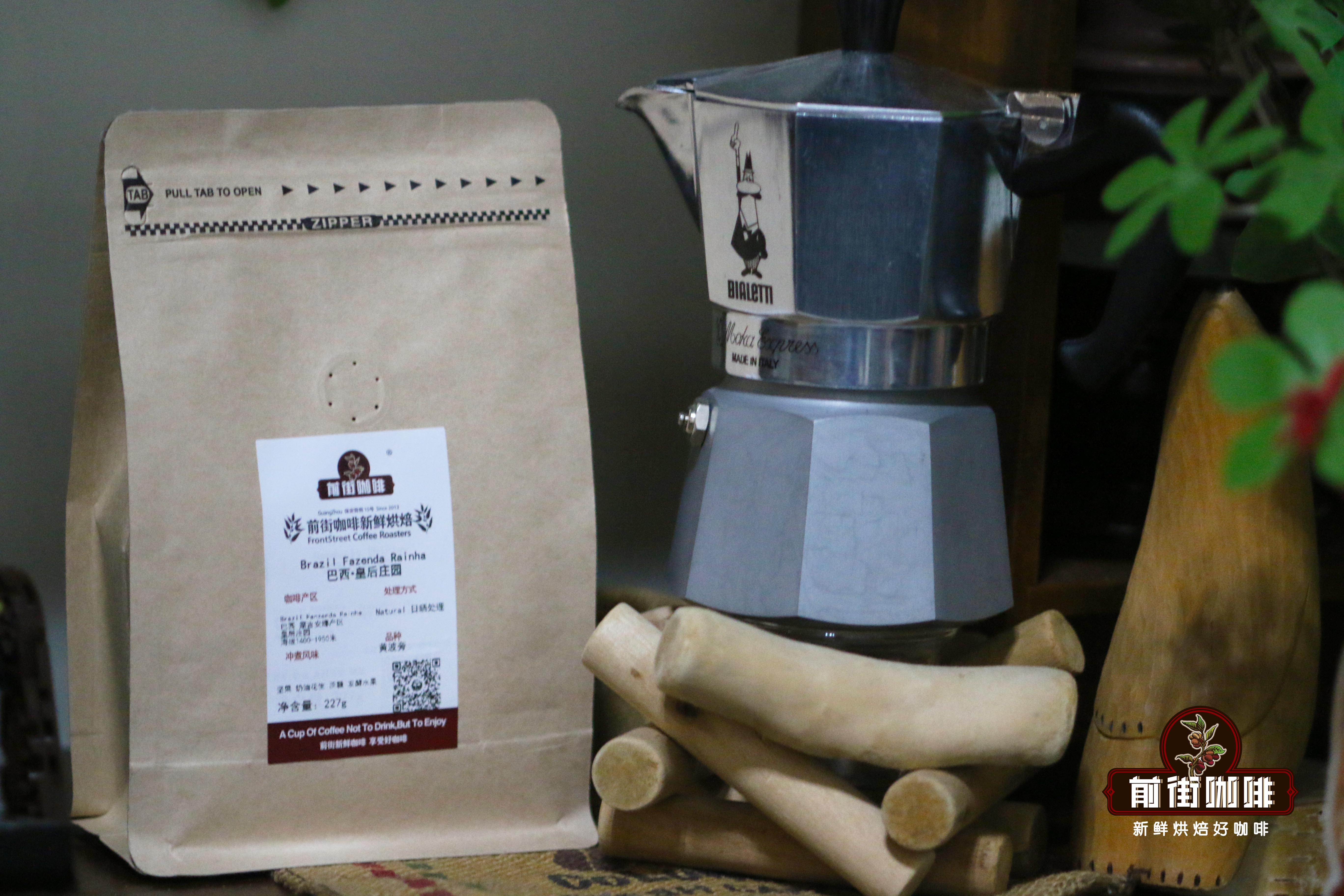
Brazilian coffee often appears in the international market as a base for blends, yet this South American giant also produces single-origin coffees of outstanding quality. Located in the Mogiana region of São Paulo state, Fazenda Rainha (Queen Farm), with its Yellow Bourbon variety and meticulous natural processing, stands as a benchmark in Brazil's specialty coffee scene. This article takes a deep dive into Queen Farm's geographical environment, variety characteristics, processing methods, and flavor profile, while also sharing Front Street Coffee's brewing suggestions and parameters. From the Carvalho Dias family's illustrious award records to the rigorous hand-picking process, from Yellow Bourbon's sweetness to the technical details of natural processing, we bring you a comprehensive understanding of this Brazilian specialty coffee that combines sugarcane sweetness with almond and cocoa notes.
When Brazilian coffee is mentioned, most people first think of blend beans, but in reality Brazil also produces excellent single-origin coffees, and Fazenda Rainha is a prime example. At Front Street, if someone wants a cup of coffee that isn't acidic, Front Street will recommend Brazilian coffee first, as its flavor is balanced and distinctive, making it a model of American beans.
Brazil's growing environment and climate conditions shape the unique flavor of Brazilian coffee—low acidity, prominent nutty notes, excellent chocolate sweetness and body, but with slight woody and earthy notes, and no obvious floral or citrus aromas. In short, Brazilian coffee has a relatively light, balanced taste and does not easily exhibit the wild, soaring acidity and citrus notes of African beans. For this reason, it is often used as the base for espresso.
Although coffee is an agricultural crop, it has demanding growing requirements, such as needing shade trees and plenty of sunlight, and the higher the altitude, the better the flavor tends to be—Panama Geisha being a case in point. However, not all coffees follow this rule; some low-altitude growing environments can still produce quality flavors, and Brazilian coffee is one of them. Brazil is located in the tropical zone, with a tropical rainforest climate in the north, hot and humid year-round, suitable for tropical crops. Compared to the producing countries of Central and South America, Brazilian coffee's altitude is noticeably lower. The terrain here is flat and monotonous, lacking microclimates, and the shade-free (sun-dried) cultivation method is customary, thus developing Brazil's unique soft bean flavor—low acidity, heavy nutty notes, and good chocolate sweetness and body.
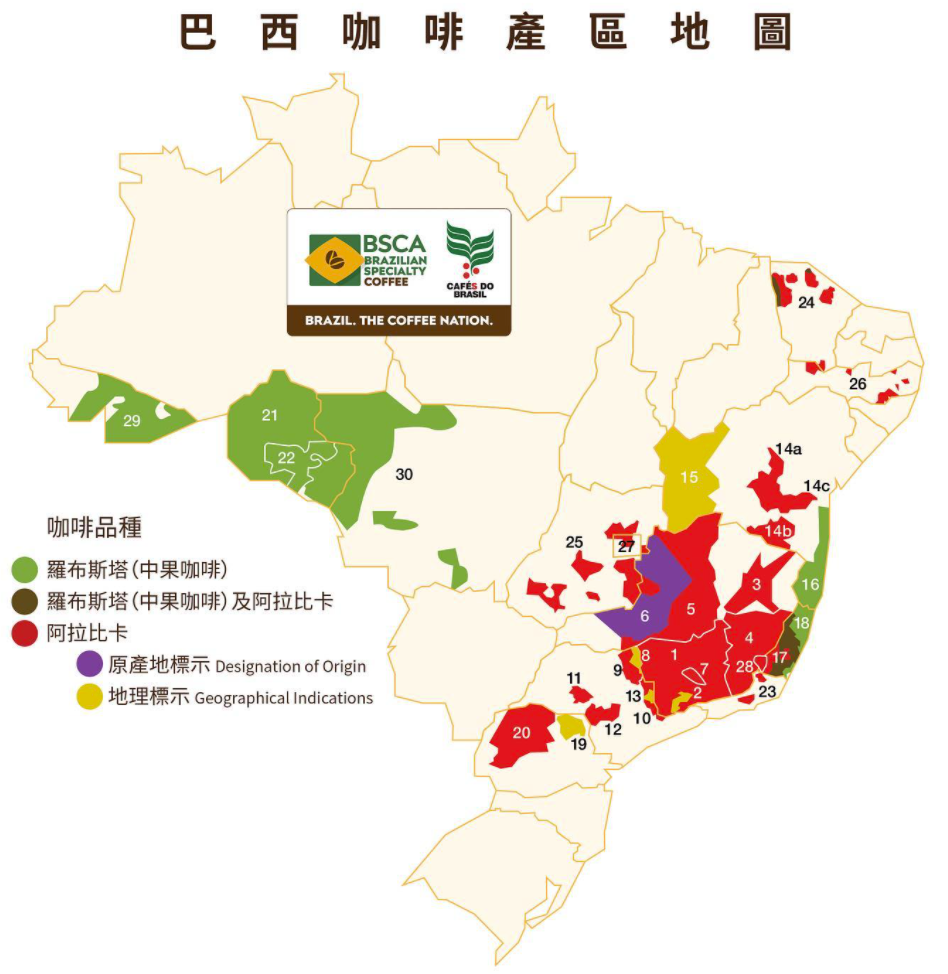
Brazilian coffee beans are concentrated in the central and southern regions, distributed across 7 states, with approximately 14 coffee-producing regions: Sul de Minas, Minas Mountains, Chapada de Minas, Matas de Minas, Mogiana, Centro-Oeste de São Paulo, Montanhas do Espírito Santo, Conilon Capixaba, Cerrado, Planalto da Bahia, Atlantic Bahia, Paraná, Rondônia, and Cerrado. Among these, the most representative is undoubtedly the Cerrado region. It can be said that the Sul de Minas and Cerrado regions have contributed enormously to the rise of Brazilian coffee, and are also the core areas of Brazil's specialty coffee.
Mogiana
The renowned Fazenda Rainha is located in the Mogiana region. Mogiana is close to southern Minas, and the coffee beans from this area are equally outstanding, with coffee grown among shrubs, grasses, and other plants. Fazenda Rainha has higher elevation and good environmental protection, with all Brazilian Queen coffee cherries hand-picked and low-yield, high-quality Bourbon planted, making it a representative estate of Brazil's finest coffee, and the quality of Fazenda Rainha's coffee beans is widely praised. Front Street believes that in addition to terrain and climate, it may also be related to its business model—adopting both the traditional large-farm management model and small-scale modern operational methods. High-tech planting equipment gives the coffee beans in this region higher sweetness, a clear sugarcane-like sweetness.
Introduction to Fazenda Rainha
Fazenda Rainha (Queen Farm) is located in the Alta Mogiana region of São Paulo state, north of São Paulo city. This estate is very well known in Brazil and is owned by the Carvalho Dias family. Carvalho Dias owns 4 major estates, and since the first Brazil COE competition in 1999, they have won awards every year, winning more than 12 times over 7 years, and in 2004 even taking champion, 9th place, and 11th place.
Countless estates large and small in Brazil have hoped over the years to place and win awards, but have found it difficult to achieve. Yet this family's 4 major estates have carried off multiple awards year after year, and Fazenda Rainha enjoys a brilliant record: 2000 runner-up, 2001 third place, 2005 29th place—to date, Fazenda Rainha has won awards 3 times. Yellow Bourbon beans are naturally sweet and clean, and using the natural method (or semi-natural) makes their acidity slightly lower, yet combines well with sweetness, with tropical fruit aromas.
Fazenda Rainha is a member of a medium-scale farm organization in the local Grama Valley, mainly exporting specialty coffee of the Bourbon variety. The organization's office is located nearby in Pocos de Caldas, and they also have a national-level cupping laboratory equipped with a large warehouse. The organization also collaborates with local universities and other institutions on research, including Lavras University—the famous Dr. Flavio Borem comes from that university's agricultural research center.
Brazilian Queen Coffee Bean Variety
Bourbon and Typica are both relatively ancient varieties. Brazil's main coffee varieties are primarily Bourbon, Mundo Novo, and Catuai. Yellow Bourbon, for instance, is generally grown only in Brazil, and the coffee beans from Fazenda Rainha carried by Front Street are of the Yellow Bourbon variety. Brazil's Bourbon has higher yield, rounder beans, berry-like acidity and body, with a very pronounced creamy aroma, but Bourbon also has relatively poor disease resistance.
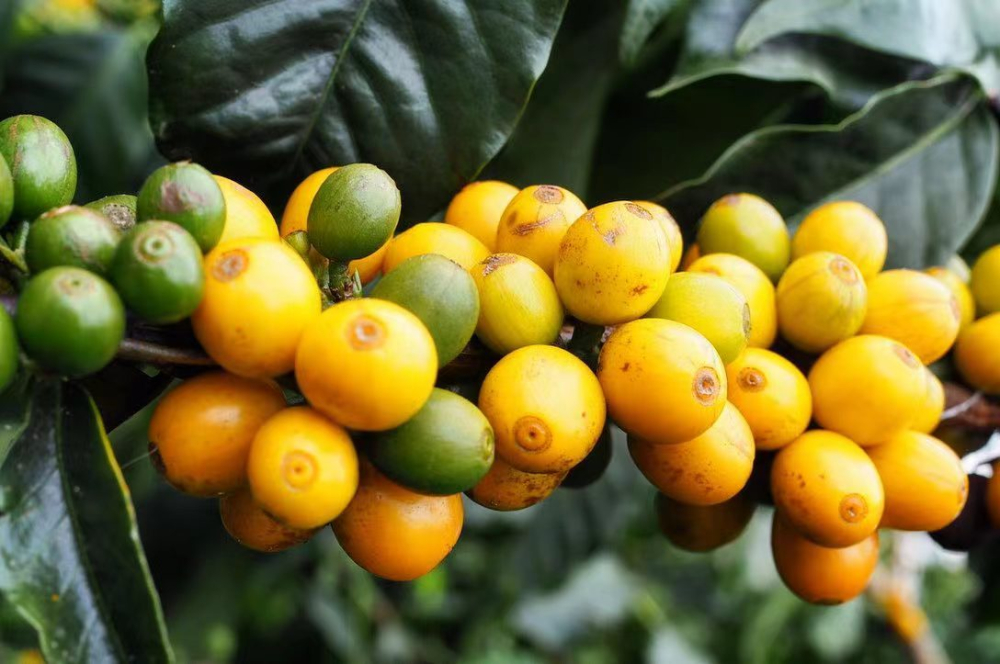
Yellow Bourbon is a Bourbon variant grown in Brazil, and due to the influence of a recessive gene, its cherries turn yellow. Bourbon has long been considered among the finest coffees due to its high yield and good quality. Yellow Bourbon is a Bourbon variant unique to São Paulo state, Brazil; when the coffee cherries ripen, unlike Red Bourbon they do not turn red but instead turn orange-yellow, hence the name Yellow Bourbon. Yellow Bourbon coffee beans are naturally sweet and clean, and using the natural method makes their acidity slightly lower, yet combines well with sweetness, with good balance and tropical fruit aromas. Yellow Bourbon's flavor typically features nuts and chocolate, with balanced, smooth acidity, and a faint, clean bitterness, overall very bright and refreshing.
Fazenda Rainha's Exquisite Natural Processing Method
Because of Brazil's climate, the Brazilian semi-natural processing method came into being. The most important reason Brazil uses semi-natural processing instead of traditional natural processing is that traditional natural processing cannot guarantee the quality of large batches of coffee beans. Of course, not all Brazilian coffee beans use semi-natural processing; Fazenda Rainha uses small-scale exquisite natural processing, employing African-style raised beds for sun-drying, and during the drying process dedicated workers turn the beans and check their moisture content, thereby improving the quality of the coffee beans.
Fazenda Rainha's Coffee processing system:
Ripe cherries are hand-picked into cloth bags to avoid contact with the ground. The coffee cherries harvested on any given day are certainly sent that same day to the estate's processing facility for Pulped Natural processing. Hand-picking and using cloth bags to collect the harvested coffee cherries is to avoid earthy flavors and any improper fermentation flavors. When these harvested coffee cherries arrive at the processing facility, they are immediately "washed": the coffee cherries are washed clean, and substandard or dried-out fruits (bóia beans) are sorted out and removed based on bean size. The qualified beans that pass through the screen continue to the pulping step (using a pulper machine).
Front Street Coffee Brewing Suggestions
Whether it's pour-over coffee or espresso, to brew well you must use good coffee beans, and also rest them well. Front Street has always believed that the freshness of coffee beans is a very important part of brewing. Front Street Coffee (FrontStreet Coffee) ships coffee beans within 5 days of the roast date, because Front Street knows well the great impact of coffee bean freshness on flavor. Front Street's roasting philosophy is "Freshly Roasted Good Coffee," so that every customer who places an order receives the freshest coffee. Coffee's resting period is about 4-7 days, so when the customer receives it, it is at its optimal flavor.
Of course, some customers need Front Street to help grind the beans, and that's fine too, but Front Street must remind you: once coffee beans are pre-ground, they no longer need resting, because during transport the pressure from carbon dioxide inside the packaging also rounds out the coffee's flavor, so once you receive the ground coffee you can immediately brew a cup and drink it. However, ground coffee needs to be brewed promptly, because ground coffee oxidizes relatively quickly upon contact with air—that is, the coffee's flavor dissipates relatively quickly and the coffee won't taste as good. Therefore, Front Street recommends buying whole beans and grinding fresh for each brew, so you can better taste the coffee's flavor.
Front Street's parameters for brewing Brazilian coffee:
Front Street chose: KONO dripper, 88°C water temperature, 1:15 coffee-to-water ratio, 15g of coffee, grind size (75% passing through a Chinese No. 20 standard sieve).
Using staged extraction, bloom with 2 times the coffee dose in water, i.e., 30g of water for a 30-second bloom, then pour in a slow circular stream until 125g and pause, continue pouring until 225g and stop. Once the water in the dripper has drained, remove the dripper. Timing starts from the beginning of pouring, with an extraction time of 2'00". Next, pick up the entire cup of coffee and swirl it to mix evenly, then pour it into a cup for tasting.
Natural-processed Fazenda Rainha coffee flavor: balanced mouthfeel, with almond and cocoa as the main notes, highlighting sugarcane sweetness—a coffee with good body and abundant sweetness.
Although Brazilian coffee is often used as the base for espresso, Fazenda Rainha's flavor will make you realize that Brazilian coffee can be this delicious too. In fact, Brazilian coffee has always had good flavor—that's why it's used in blend beans. Of course, everyone's taste is different, so you could try Ethiopia's floral and fruity acidity, or Colombia's nutty dark chocolate with soft fruity acidity.
For professional coffee knowledge exchange and more coffee bean information, please follow Coffee Workshop (WeChat public account: cafe_style)
For more specialty coffee beans, please add the private WeChat of Front Street Coffee (FrontStreet Coffee), WeChat ID: qjcoffeex
The above content is compiled by CoffeeHunters, a coffee news website.


