








Why Does Yirgacheffe Worka Washed G1 Heirloom Coffee Taste So Clean?
Yirgacheffe Worka Washed G1 is an heirloom-variety coffee from the Gutingding cooperative, grown at 1,700 to 2,100 meters and given a medium-light roast. The washed process and Grade 1 grading shape a cup of lemon, kumquat, white grape juice, jasmine and snow pear, with clarity coming from altitude, variety and processing together.
Most Ethiopian growers farm small garden plots and cannot build their own wet mills, so processing stations buy cherries from surrounding smallholders and handle the washing before selling the coffee green bean onward to traders. That garden coffee model explains why Yirgacheffe lots are traceable to a single station and village.
Yirgacheffe is a signature region for Ethiopian specialty coffee, and the washed G1 produced by the Worka cooperative is an especially rare grade within it. This article breaks down the flavor sources of this Front Street washed Gutingding layer by layer, from the region's terroir, the background of the Worka cooperative, the washed processing method, and the logic of green bean grading, to the actual roasting curve and pour-over parameters. Behind the aromas of lemon, kumquat, white grape juice, jasmine, and snow pear is the combined result of altitude, variety, and processing method. Whether you want to understand the diversity of Ethiopian heirloom varieties or are looking for a reproducible brewing recipe, this content provides complete information and practical suggestions.
Yirgacheffe Worka Washed G1
【Yirgacheffe Washed Worka】
Country: Ethiopia
Grade: G1
Region: Yirgacheffe
Roast Level: Medium-light roast
Processing Method: Washed
Variety: Local heirloom varieties
Processing Station: Gutingding Cooperative
Flavor: Lemon, kumquat, white grape juice, jasmine, snow pear
01 | Region Introduction
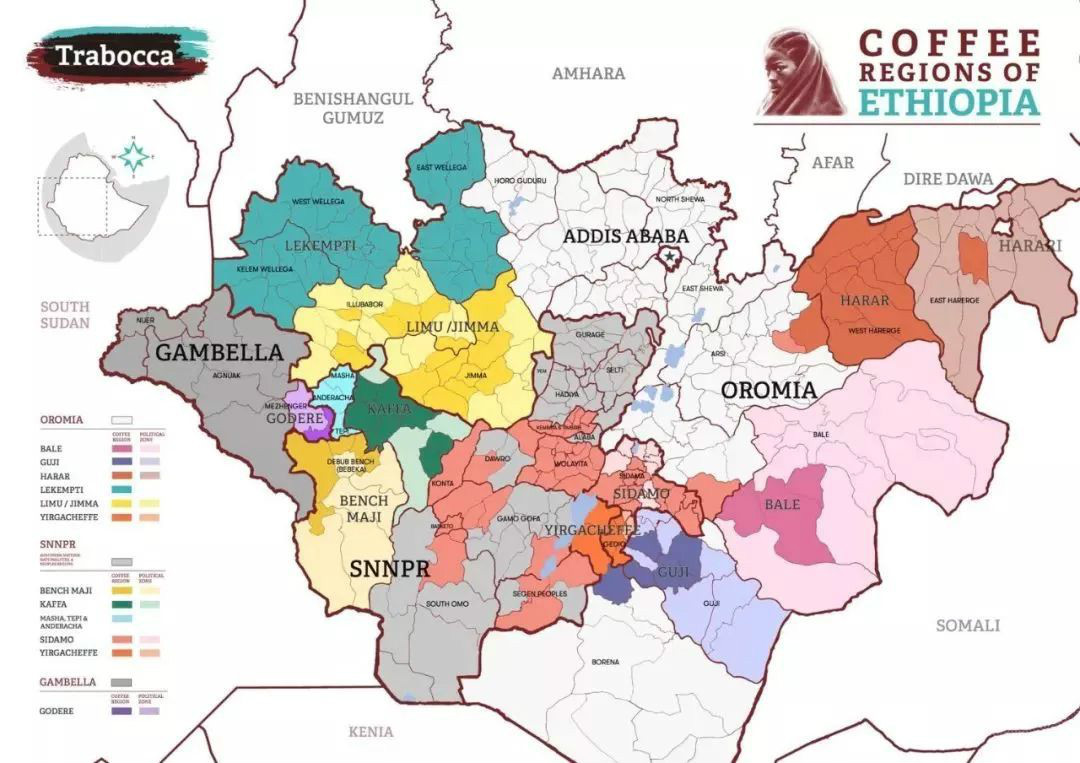
Yirga cheffe is a small town in Ethiopia, situated at an altitude of 1,700 to 2,100 meters, and in the specialty coffee world it is practically a calling card for high-quality Ethiopian coffee.
Yirgacheffe (specialty region): altitude 1,800–2,000 meters | garden coffee system |
Although administratively Yirgacheffe belongs to the Sidama region, its flavors are so distinctive that it was ultimately separated into its own independent region.
In addition to the town of Yirgacheffe itself, this area also includes surrounding sub-regions such as Wenago, Kochere, Gelena, and Abaya.
Yirgacheffe encompasses many villages, micro-regions, cooperatives, and processing stations of various sizes. In most parts of Ethiopia, coffee growers still live under quite difficult conditions and cannot afford to build their own household processing facilities, so a large number of processing stations have emerged, purchasing coffee cherries from surrounding smallholders in a unified way and reselling them to green bean traders after processing.
Local coffee trees are mostly planted in farmers' backyards or mixed with other crops in their fields, so individual household output is limited, making this a typical garden coffee model. Almost all award-winning Yirgacheffe beans come from the coffee villages and communities mentioned above. In addition to its signature floral aroma, Front Street Yirgacheffe also has a delicate body, entering the mouth like silk massaging the palate, leaving an impressive mouthfeel. At present, quite a few coffee chemistry researchers have begun analyzing the microclimate and soil and water conditions around Yirgacheffe, trying to derive a cultivation formula for specialty coffee.
Strictly speaking, Yirgacheffe is a sub-region under Ethiopia's Sidamo province, located to the northwest of Sidamo, nestled by mountains and lakes, and one of the highest-altitude coffee regions in Ethiopia. Yirgacheffe itself is a small town of about 20,000 people, and the nearby three small producing areas of Wenago, Kochere, and Gelena Abaya produce coffee with flavors almost identical to Yirgacheffe, so they are also classified under the Yirgacheffe regional category. But the production methods and flavor expression here are so outstanding that Ethiopian coffee farmers take pride in their coffee having Yirgacheffe flavors, and it ultimately became independent from the Sidamo region, establishing itself as one of Africa's most famous regions.
02 | Worka Cooperative
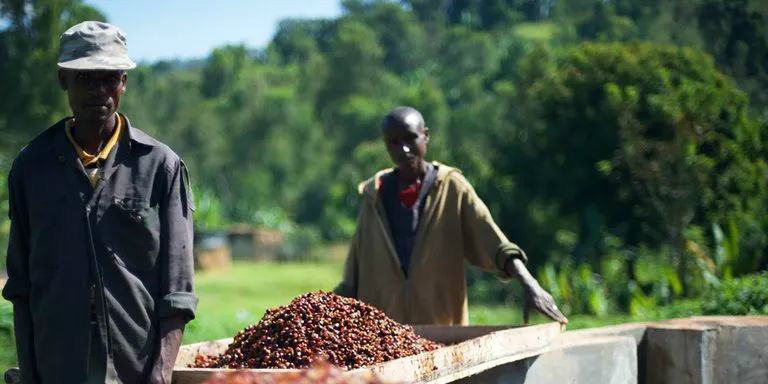
Washed Ethiopian coffee can reach the highest grade, G1, which is very rare.
This coffee comes from a single farm in Ethiopia and is processed by the Worka cooperative. Alemayehu Alako Farm is a member of the Worka cooperative.
The Worka cooperative was established in 2005 and joined the famous Yirgacheffe Coffee Farmers Cooperative Union (YCFCU) that same year, and is known for producing high-quality natural Yirgacheffe. The Worka cooperative has about 300 coffee farmers under it. YCFCU was founded in 2002, and its members also include 26 other cooperatives, serving more than 45,000 coffee farmers.
Worka is located in Gedeb, the southeasternmost part of Yirgacheffe. In earlier years, coffee green beans produced in this area were exported under the name Worka, or were handled by the Worka cooperative; but over the past two or three years, independent single origins have been discovered one by one by coffee hunters around the world, such as Banko Gotiti, Banko Dadhato, Halo Bariti, and so on. Gutingding village was one of the earliest village areas to become independent a few years ago, and many individual small farmers were also members of the Worka cooperative at the time, so their coffee-producing skills are naturally beyond question.
The Worka cooperative is located in the southern part of the Gedeb district and was established in 2005, joining the famous Yirgacheffe Coffee Farmers Cooperative Union (YCFCU) that same year, and is known for producing high-quality natural Yirgacheffe. The Worka cooperative has about 300 coffee farmers under it. YCFCU was founded in 2002, and its members also include 26 other cooperatives, serving more than 45,000 coffee farmers.
Yirgacheffe is one of the most distinctive coffees in the world and an outstanding representative of African specialty coffee, with unique citrus and lemon fruit aromas as well as jasmine fragrance. After a light-to-medium roast, it has a soft acidity and a refreshing taste, making it suitable as a single-origin coffee. Most Ethiopian coffees have floral and fruity notes, and Front Street washed Gutingding is no exception. In order to preserve more elegant acidity, a light roast is chosen for roasting.
Front Street. Gutingding is a high-grade washed Yirgacheffe. Not only does it have a cute name, it also has a unique taste and high cost performance, making it a daily staple coffee for many people.
We all know there are many ways to brew coffee, but to bring out what makes Front Street washed Gutingding most unique, we recommend pour-over or cold brew. Pour-over lets you taste Gutingding's clearly layered floral and fruity flavors, while cold brew gives you a tea-like fruit infusion mouthfeel.
03 | Processing Method
Most Yirgacheffe coffees are processed by the washed method, fermented in washing tanks for about 72 hours to remove the mucilage, and part of the acid produced during mucilage fermentation enters the beans. At the same time, because no pulp or mucilage remains attached to the parchment during drying, it lacks the distinctive fruity aroma of natural beans, and its flavor tends toward clean and bright with relatively pronounced acidity. It is dried directly outside the factory. After manual sorting, the green beans pass quality inspection by the Ethiopian Coffee and Cocoa Authority and are traded and exported through bidding.
Its annual output is about 225,000 bags (60 kg per bag). In the past it was mainly sold to Northern Europe (mainly Germany) and Japan, and recently it has also gradually attracted attention in North America.
Washed coffees are less likely to carry wild flavors and have a pure, refreshing character, making them suitable for a light roast; this washed Ethiopian coffee can reach the highest grade, G1, which is already a grade with very few defects.
04 | Green Bean Analysis
Heirlooms is a name unique to Ethiopia. Its varieties are all-encompassing and include Typica, Mocha, Bourbon, and others. The Kaffa forest is the cradle of Arabica coffee. The varieties from producing countries around the world (whether innate or derived) add up to only a few hundred, yet this treasure house contains tens of thousands, most of which are still unclassified. Heirlooms is a name unique to Ethiopia, as if telling the world that its varieties are all-encompassing and can be summarized in a single word. The green beans are blue-green in color and relatively uniform in size.
African coffee beans use this defect-count grading method, while Indonesian beans are mainly divided into 6 grades, namely G1–G6. The highest grades for washed beans are G1 and G2; the highest grades for natural beans are G1 and G3.
So what does that mean? As follows:
Washed: Grade-1; Grade-2 (G1>G2)
Natural: Grade-1 and Grade-3~Grade-5 (G1>G3>G4>G5)
A few points to note:
a) Whether washed or natural, there is Gr-1, with the conditions being "zero" defects and a Premium Cup. Whether washed or natural, Gr-1 is a rating for the finest of specialty coffees or Cup of Excellence coffees.
b) The lowest grade for natural Yirgacheffe and Sidamo is Gr-4.
c) Beans of the same grade, such as Limu Gr-2, can be good or bad, depending on the exporter's sorting level and investment.
d) Based on the existing "zero" defect requirement, Gr-1 beans (whether washed or natural) are extremely rare, because processing costs are very high and very few suppliers will do it.
05 | Roasting Analysis
The bean density is quite hard, so roasting starts with a relatively high heat to climb. The yellowing point is around 5 minutes 30 seconds, then reduce the heat and open the damper to enter the Maillard reaction. At 160°C, lower the heat again to extend the Maillard reaction time. First crack is around 186.3°C. This washed bean needs the heat reduced before first crack to prevent too rapid a rise and scorched bitterness. At 1 minute 40 seconds, drop the beans at 194.2°C.
Roaster: Yangjia 600g semi-direct fire
Preheat the drum to 200°C and charge. Set the damper to 3. After 30S, turn on the gas and adjust the heat to 160. Turning point 1:32, yellowing at 5:30, grassy smell disappears, entering the dehydration stage. Lower the heat to 120, open the damper to 4, and when it reaches 170°C, lower the heat again to 50.
After eight minutes, dehydration is complete. Wrinkles and dark patches appear on the bean surface, and the toast aroma turns into coffee aroma, which is the prelude to first crack. At this time, lower the heat to 40 and listen carefully for the sound of first crack. First crack begins at 9:00, adjust the heat to 40, and fully open the damper to 5. Development time after first crack is 1 minute 40 seconds, dropping at 194.2°C.
Flavor: This bean is delicately washed, making the acidity more pronounced and refined, presenting yellow lemon acidity, caramel sweetness, cream and lemon black tea flavors, and a floral finish.
06 | Brewing Analysis
Three-pour segmented extraction method
More layered, allowing you to clearly identify the coffee's front, middle, and back flavors. The method is to increase the amount of water each time after blooming, usually pouring when the coffee liquid is about to drop to the surface of the coffee bed, using small, medium, and large streams for three-stage extraction:
Recommended brewing methods: siphon, pour-over
Grind size: 3.5 (Japanese Fuji Royal R440)
V60 dripper, 15 g coffee, water temperature 90°C, grind 3.5, water-to-coffee ratio close to 1:15
Bloom with 30 g water, bloom time 30s
Stages: pour to 120g and pause, then slowly pour to 225g
That is 30g-120g-225g
Other drip extraction suggestions:
French press, recommended grind size 3.5-4 / water temperature 86-88°C
AeroPress, recommended grind size 2.5, water temperature 86-88°C
Ethiopia Yirgacheffe Washed Heirloom Worka G1 Single-Origin Specialty Coffee Beans
Front Street [Cold Drip Recipe]: Yirgacheffe Worka 30g + Costa Rica Black Honey 30g, powder-to-water ratio 1:10, BG grind 3D (close to cupping grind),
Black Honey has orange blossom aroma, with obvious caramel and creamy notes, and when combined with Yirga Worka, the caramel sensation becomes even more prominent,
It also carries a bit of citric acidity [wink] and drinks very refreshingly, making it very suitable for a cup in the hot summer.
The above content is compiled by CoffeeHunters, a coffee news website.


