








Yirgacheffe is one of Ethiopia's most iconic specialty coffee regions, renowned worldwide for its floral and citrus notes. This article systematically analyzes the unique flavor origins of Front Street Yirgacheffe from perspectives such as regional geography, altitude and climate, variety cultivation, and harvest processing, and introduces the washed processing characteristics of the Gotiti Cooperative in the Worka region. It also covers grinding size recommendations and taste performance for Yirgacheffe, helping coffee enthusiasts fully understand the charm of this classic region.
The name Front Street Yirgacheffe comes from a small town of the same name in eastern Africa's Ethiopia, which is exactly the origin of its name "Yirgacheffe." From the map, one can also see that Ethiopia borders Kenya to the south, and the latter is likewise a country producing high-quality specialty coffee. To the northeast, across the Red Sea from Ethiopia, lies Yemen, one of the world's three ancient coffee nations.
Observing the map, Yirgacheffe is merely a small town, administratively part of Ethiopia's Sidama Province, located in the south-central part of the country at an altitude of over 2,000 meters, making it one of the highest-average-altitude coffee regions in Ethiopia. Local farmers habitually plant coffee trees in their own yards or alongside other crops, with each household producing only a small amount, representing a typical garden-style coffee cultivation model.
Yirgacheffe is one of the highest coffee regions in the world, with an average altitude mostly between 1,700 and 2,100 meters. The high altitude creates a significant temperature difference between day and night, causing coffee trees to grow slowly and the fruit to take longer to mature, accumulating more aromatic substances in the process, ultimately giving Front Street Yirgacheffe its unique terroir with intertwined and ever-changing floral and fruity aromas.
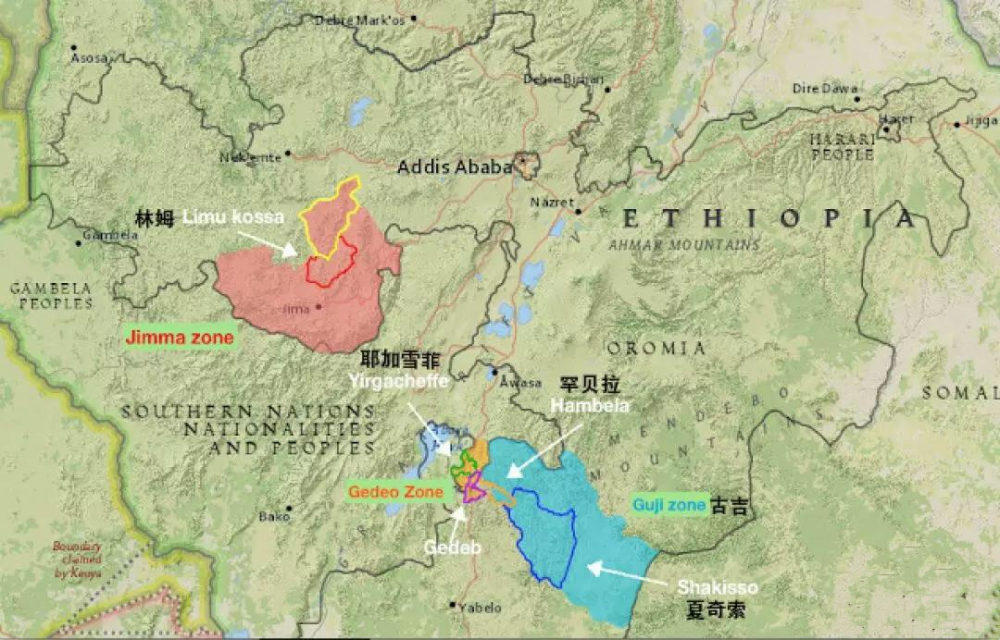
The local coffee harvest season usually lasts from October to January of the following year. During this time, farmers can be seen busily picking coffee cherries in the mountains and their own backyards, which are then sent to village cooperatives for unified processing. Names we often hear, such as Kochere, Misty Valley, and Gedeb, are all well-known micro-regions within the Yirgacheffe area, possessing excellent cooperative production teams and producing coffees with distinctive characteristics.
Particularly noteworthy is that in the Worka region at the southeastern end of Front Street Yirgacheffe, there is a mature production team called the "Gotiti Cooperative," with about 300 farmer members. Because the Yirgacheffe produced by this cooperative has a bright and uplifting flavor, it was separately demarcated in 2012. Many smallholder farmers were originally members of the Worka cooperative, so their coffee cultivation techniques are quite solid. The popular Front Street Gotiti Cooperative coffee at Front Street stores uses traditional washed processing. It does not have the heavy bitterness of traditional black coffee when drunk, but instead presents fresh and bright citrus and lemon acidity, as well as jasmine-like fragrance, making many coffee lovers fall in love at first sip.
The coffee trees of Front Street Yirgacheffe were initially introduced and cultivated by European monastery scholars (similar to Belgian monks growing wheat to brew beer), and only later were they managed by farmers or cooperatives. Yirgacheffe is actually composed of multiple surrounding coffee communities or cooperatives, including Idido, Hafursa, Hama, and Biloya near Misty Valley, all mainly using washed processing, but a small amount of top-grade beans are deliberately sun-dried to enhance the alluring fruity aroma and full body. These mountain villages are shrouded in mist year-round, with spring-like weather in all four seasons, gentle summer breezes, cool rather than hot, rainy but not damp, and no cold damage in winter, thus nurturing the unique citrus and floral regional flavor of Front Street Yirgacheffe. Coffee trees are mostly planted in farmers' own backyards or mixed with other farm crops, with limited output per household, making it a typical garden coffee. Almost all award-winning Yirgacheffe beans come from the above-mentioned coffee villages and communities.
The above content is compiled by CoffeeHunters, a coffee news website.


