







How Much Does the Cup Differ Between These Two Coffee Brewing Methods?
The French press and the siphon are both immersion brewers, but they produce clearly different cups. The French press is simple and fast: grounds steep in hot water, then a metal mesh filter separates them, much like brewing tea. The siphon demands more steps and careful cleanup, using constant-temperature extraction and a more ritualized process.
Because both rely on soaking rather than pressure, the main variables are grind size, contact time and water temperature rather than coffee boiling. Choosing beans matters too: floral and fruity lots suit one device, while nutty and chocolatey profiles suit the other. Parameter control and the right grind decide how much of that character reaches the cup.
The French press and the siphon are two coffee brewing devices with markedly different styles—the former is known for being simple and quick, while the latter is famous for its elaborate ritual and unique constant-temperature extraction. This article will systematically compare the differences in the cup between these two immersion-style devices from the perspectives of extraction principles, operating steps, parameter control, and flavor performance, helping coffee lovers make a choice based on their own taste preferences. The article also compiles Front Street Coffee's recommended coffee bean lists for the French press and the siphon respectively, covering floral-fruity, nutty, chocolatey, and other flavor directions for readers' reference when purchasing.
In the world of coffee brewing, Front Street Coffee has introduced more than a hundred preparation methods, including popular mainstream approaches, easy lazy-person solutions, obscure niche devices, and classic schools full of ritual—a true hundred flowers blooming.
Judging purely by the operational process, Front Street Coffee thinks the French press should count as the least troublesome—as long as you pick the right beans and grind size, it's much like brewing tea, and in just a few minutes you get a rich cup of black coffee. By contrast, every time Front Street Coffee uses the siphon to make coffee, it feels considerably more troublesome than other methods—not only are the steps complicated, but the preparation and cleanup before and after brewing are also quite time-consuming, which is why many people who want to try it are often put off. So here's the question: how big is the taste difference between coffees made with these two extraction methods? Below, Front Street Coffee will conduct an actual comparison.
What is a French press and how do you use it?
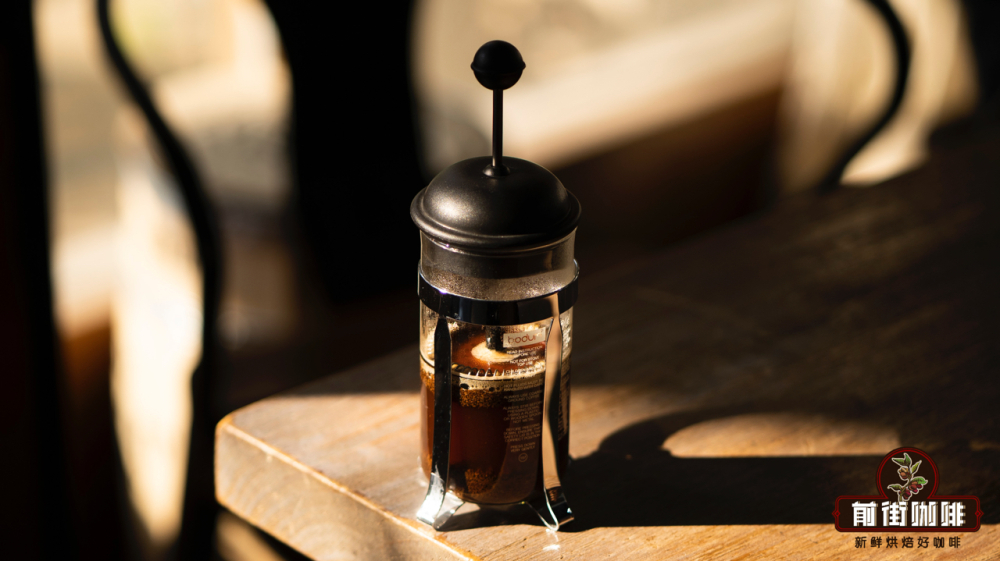
This device originated in France and has a simple structure: a cylindrical container plus a lid, with a metal filter mesh in the center of the lid that can be pushed up and down to separate the coffee grounds from the coffee liquid, thereby controlling the degree of extraction.
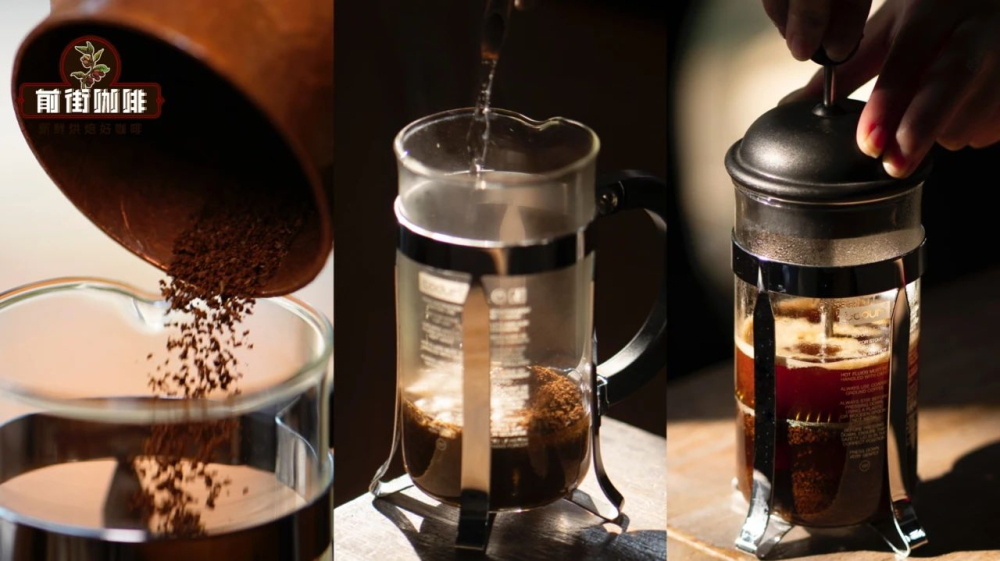
The working logic of the French press is exactly the same as brewing tea—soak the coffee grounds in hot water for a period, then press the plunger down, and after filtering you get the coffee liquid. The specific operation is to pour all the hot water at once into the ground coffee, let the water fully penetrate the coffee bed, wait for the flavor substances to dissolve out, and finally separate the grounds from the liquid to obtain a cup of black coffee. The biggest advantage of immersion devices is that they have a low threshold for pouring technique and require no extra accessories, making them much easier to master than pour-over devices that require technique control—hence they are also called "lazy-person coffee devices." Because the entire process remains in a soaking state, coffee made with a French press tends to have a fuller body, and its flavor expression is relatively balanced.
Unlike the complex pouring of pour-over coffee, the French press uses a "one-time water addition" method, which is more direct in operation. This means there are only four variables affecting the final taste: coffee-to-water ratio, grind size, water temperature, and steeping time. Similar to the cupping approach, the extraction process is relatively stable, and the coffee's own flavors can be presented more faithfully.
Because the French press completes its water addition all at once, the temperature gradually decreases over time during extraction, so the starting water temperature needs to be slightly higher than for pour-over. If brewing a light-to-medium roast acidic bean, you can use 92–94°C; for medium-dark roast beans with a bitter profile, it is recommended to keep it at 89–90°C. In autumn and winter when room temperature is low, you can first rinse the French press with boiling water to preheat it, reducing heat loss during extraction.
Time is the variable that the French press can adjust flexibly. Since there is no manual stirring involved, steeping time becomes one of the key factors determining the extraction yield. Under the same conditions, the longer the steep, the fuller the coffee usually tastes, but it is also more prone to over-extraction, producing bitterness, astringency, or even woody notes. Paired with a coarse grind, Front Street Coffee recommends steeping light-to-medium roast beans for about 4 minutes; medium-dark roast beans, because they release bitterness more easily, need only 3 minutes and 30 seconds. This time range both fully releases the positive flavors and avoids the bitter, muddy sensation caused by steeping too long.
As Front Street Coffee said earlier, the French press belongs to immersion extraction, so Front Street Coffee believes it is better suited to medium or medium-dark roast coffee beans. If you want French press coffee with floral and fruity aromas, Front Street Coffee recommends three single-origin beans: Front Street Coffee Strawberry Candy, Front Street Coffee Mozart, and Front Street Coffee Sidra; if you prefer rich nutty flavors, you can choose Front Street Coffee Queen's Estate, Front Street Coffee Golden Mandheling, and Front Street Coffee Huila, which can make the French press's cup even fuller in body. All the above coffee beans can be purchased at Front Street Coffee's Tmall flagship store or Front Street Coffee's Taobao store, and are shipped within 24 hours after ordering.
What is the principle behind brewing coffee with a siphon?
The English name of the siphon pot is "SIPHON," so it is also called a siphon. Its operating mechanism uses steam produced after water is heated, and with the physical effect of thermal expansion and contraction, presses the hot water in the lower chamber into the upper chamber to mix with the coffee grounds; when the temperature drops, the water flows back through the vacuum tube into the lower chamber, thus yielding the coffee liquid.
Many people may assume that the siphon's extraction method is simply "siphon-style," but this understanding is actually not accurate—the siphon merely uses the siphon principle to send hot water to the upper chamber, and this process itself does not involve coffee extraction.
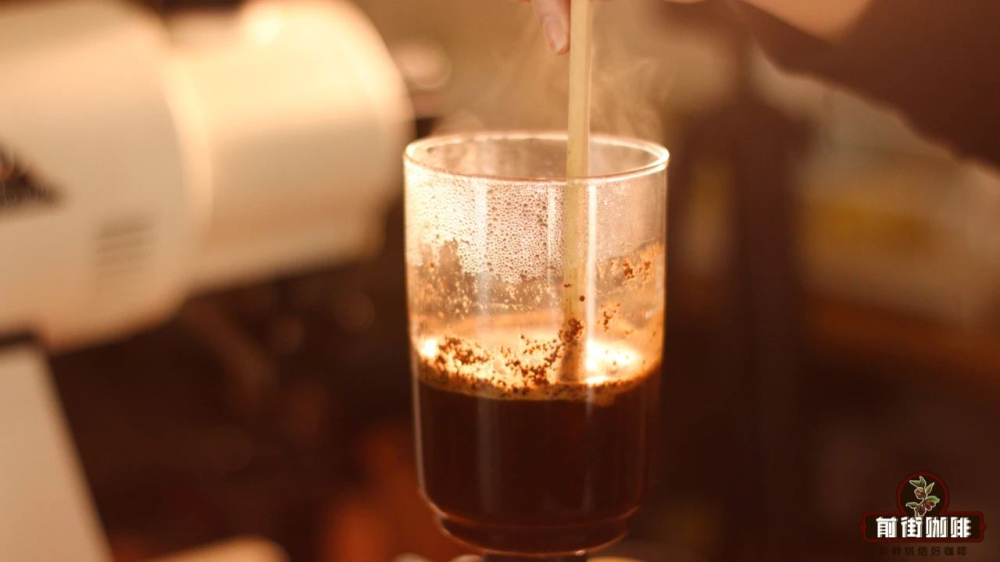
Extraction in the true sense only officially begins after the hot water has been drawn up to the upper chamber and the coffee grounds are added to start steeping. So strictly speaking, the siphon's extraction method should be classified as "immersion"—extracting the flavor substances from the grounds through contact and soaking between water and coffee grounds.
Since immersion extraction brings all the hot water into contact with the coffee grounds, once the dissolved substances in the water reach a certain concentration, the dissolution rate slows down and no longer continues to extract a large amount of flavor components from the coffee—that is, it reaches what we commonly call a saturation state. Therefore, siphon coffee tastes relatively balanced, with a round body and solid aroma, but compared with pour-over, its flavor layering is not especially prominent.
It is worth mentioning that the siphon's immersion extraction has one obvious difference from conventional immersion. Because of the siphon principle, the hot water is continuously heated during extraction, and the lower chamber has enough pressure to keep the hot water in the upper chamber, so the siphon's immersion extraction is at a constant temperature throughout. Conventional immersion or drip extraction, by contrast, is in a process of continuous cooling, with water temperature gradually dropping over time. This enables the siphon to achieve a higher extraction yield, and with stirring, extraction can be completed in a shorter time.
In addition, the siphon usually uses flannel cloth as its filter material. Although filter paper can also be used, because filter paper cannot fully cover it, it cannot form a "sealed" filtering space like pour-over. Fine particles and oils fall through the gaps into the lower chamber and mix into the coffee liquid, so siphon coffee looks relatively cloudy. However, although oils and fine particles reduce the clarity of the coffee liquid, they bring a fuller mouthfeel to the coffee—which is exactly why siphon coffee tastes thicker.
As for coffee beans suitable for the siphon, Front Street Coffee recommends prioritizing beans with flavor profiles such as caramel, chocolate, nuts, juicy texture, ripe fruit, and dried fruit. Recommended: Front Street Coffee Kenya Little Tomato, which has the sweet-and-sour taste of smoked plum and cherry tomatoes and a full juicy texture; for prominent nutty and caramel flavors, you can choose Front Street Coffee Queen's Estate and Front Street Coffee Bird of Paradise; for those mainly featuring ripe fruit and dried fruit notes, it is recommended to buy Front Street Coffee Mozart and Front Street Coffee Strawberry Candy.
The above content is compiled by CoffeeHunters, a coffee news website.


