







Among the many well-known producing regions in Ethiopia, Yirgacheffe and Sidamo are undoubtedly the two names most often discussed by coffee lovers. Although both are in the same country, they present截然不同的 flavor profiles due to differences in altitude, microclimate, and processing methods. Front Street Coffee often encounters customers hesitating between these two beans, but the key to choosing actually lies in which taste you prefer: if you seek bright acidity like lemon and citrus, washed Yirgacheffe is the classic choice; if you favor full berry-like sweet acidity reminiscent of berries and blackcurrant, sun-dried Sidamo is more to your taste. This article will systematically sort out the differences between the two from producing region background, processing method evolution, roasting and cupping to actual brewing, and attach Front Street Coffee's brewing suggestions and flavor comparison.
For more specialty coffee knowledge, please follow our WeChat official account: Front Street Coffee
When it comes to Ethiopian coffee beans, Yirgacheffe coffee and Sidamo coffee beans are surely familiar to everyone. Whenever a customer comes to Front Street Coffee and hesitates over whether to drink Yirgacheffe coffee or Sidamo coffee , Front Street's baristas will say that if you want bright acidity and fresh flavors like lemon and citrus, you can choose washed Yirgacheffe coffee; if you want berry-like sweet acidity and full flavors like berries and blackcurrant juice, you can choose sun-dried Sidamo coffee. Having read this, I believe everyone can roughly understand the flavor differences between the two producing regions. In this article, Front Street will talk about Yirgacheffe coffee and Sidamo coffee.
Yirgacheffe Yirgacheffe administratively belongs to the Sidamo producing region, but because its flavor performance is so unique, it was ultimately delineated separately and became one of the most famous coffee origins in Africa. This area is located on the eastern edge of the East African Rift, with terrain that is strongly dissected, at an altitude between 1,800 and 2,000 meters, making it one of the coffee-producing regions with the highest average altitude in Ethiopia. This is a wetland environment with abundant water resources. Initially, Yirgacheffe only used sun-dried processing; however, due to limited equipment conditions, the coffee cherries were directly spread on the ground to dry and easily picked up earthy odors. After Ethiopia introduced the washed processing method from Central and South America in 1972, people found that washed Yirgacheffe had a cleaner flavor and brighter acidity, and it was widely praised. Thereafter, washed processing became the mainstream processing method for Yirgacheffe.
Later, some green coffee bean traders believed that washed processing was almost burying the value of sun-dried processing, so in 2006 they launched the Idido specialty sun-dried bean, and Yirgacheffe's sun-dried coffee beans regained their status from then on. After Biloya and Aricha near Yirga were successively launched in 2007, these three beans interpreted the idea that Yirgacheffe beans could only be washed and that sun-dried processing was a waste of good things. Front Street believes that coffee beans from both processing methods have their own advantages. Washed Yirgacheffe gives people a fresh and clean feeling with bright acidity, while sun-dried processing gives people a juice-like mouthfeel and a relatively more obvious sweetness than washed processing, so whether washed Yirgacheffe tastes better or sun-dried Yirgacheffe tastes better depends on the drinker's preference~ Sidamo Sidamo The Sidamo region is located in southern Ethiopia, extending east to the Arsi and Bale administrative zones and west to the Gamogofa administrative zone. Sidamo coffee is cultivated at altitudes between 1,400 m and 2,000 m. Sidamo's coffee flavors are very diverse. Different soil types, microclimates, and countless native coffee varieties have created obvious differences and characteristics in the coffee produced by each town. Among them, the most famous coffee-growing towns are Guji and West Arsi. Most of the Sidamo region uses the sun-dried processing method for green coffee beans. Front Street believes that sun-dried processing gives Sidamo coffee beans a rich fruity aroma and a smooth mouthfeel.
The most famous coffee produced in Guji is none other than Huakui coffee beans. After Hambela from Guji won the championship in the 2017 Ethiopia National Taste of Harvest Competition, Chinese green bean importers named this bean Huakui. At that time, this bean had a strong strawberry and cream aroma. Later, the 2.0 and 3.0 of the new crop seasons did not have as obvious a Huakui flavor as the 2017 one. In 2020, as the fourth year of Huakui coffee beans, the producing area had expanded to several times its original size, and combined with more scientific cultivation and management, the flavor of Huakui 4.0 was even better, receiving praise from many coffee enthusiasts. Front Street also acquired and listed a batch of Huakui 4.0 coffee beans . Washed processing method Put the selected coffee cherries into a depulper to initially remove their skin and pulp; place the green coffee beans with residual pulp and mucilage into water and let them ferment for about 24 hours; after fermentation, put the green coffee beans with parchment into a flowing water tank to wash off the pulp and mucilage; after washing, dry the coffee beans in the sun or with a dryer to reduce the moisture content to about 12%. Finally, remove the parchment from the green coffee beans. Front Street Coffee believes that washed coffee has relatively obvious acidity, good cleanliness, medium mouthfeel, and the most consistent green bean quality.
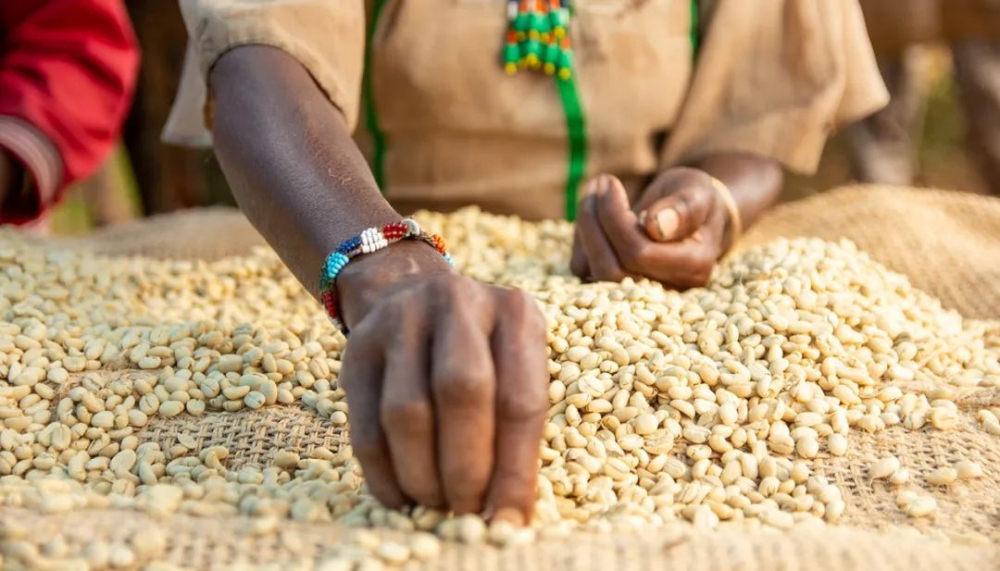
Sun-dried processing method Ethiopian sun-dried processing is, after selecting usable coffee cherries, placing the coffee cherries with the entire pulp and skin intact on raised beds for sun drying. It is precisely this raised-bed drying method, which requires high-intensity manual labor, that isolates the cherries from contact with the ground, prevents musty and earthy off-flavors during sun drying, and creates an exceptionally clean fruity flavor. After more than two weeks of sun drying, the dark brown coffee cherries are professionally stored, waiting for the entire flavor to mature. Only before shipment are the coffee beans taken out of the coffee cherries, so one can imagine the sweetness. Front Street believes that compared with washed coffee, sun-dried coffee has lower acidity, higher sweetness, clearer mouthfeel, but slightly lower cleanliness. In terms of flavor, it produces more berry-like tones and is also more complex.
Next, Front Street will compare Ethiopian washed and sun-dried coffee through a series of steps including roasting, cupping, and brewing to see the differences between Front Street Coffee's washed Yirgacheffe Gudingding and sun-dried Sidamo Huakui 4.0.
Front Street Coffee roasting suggestions Washed Gudingding uses Yangjia 800N, charge amount: 480g: charge when the drum temperature reaches 175°C, set the damper to 3, and the power to 120; the turning point is 1'32", when the drum temperature is 140°C keep the power unchanged and open the damper to 4; at this time the bean surface turns yellow, the grassy smell completely disappears, and it enters the dehydration stage. At 166°C reduce the power to 100, and at 176°C reduce the power to 80, keeping the damper unchanged. At 8'28", ugly wrinkles and dark spots appear on the bean surface, and the toast smell clearly turns into coffee aroma, which can be defined as the prelude to first crack. At this time, you need to listen clearly to the sound of the first crack point. At 9'38" first crack begins. Adjust the damper to 5 (adjust the power very carefully, not so low that there is no cracking sound). After first crack, develop for 1'30'', and drop at 193.5°C.
Sun-dried Sidamo Huakui 4.0 coffee beans use Yangjia 800N, charge amount 480g: charge when the drum temperature reaches 175°C, set the damper to 3, and the power to 120. When it rises to 140°C, open the damper to 4. Roast until 6'00'', temperature 151.7°C, the bean surface turns yellow, the grassy smell completely disappears, and dehydration is complete. When ugly wrinkles and dark spots appear on the bean surface, and the toast smell clearly turns into coffee aroma, it can be defined as the prelude to first crack. At this time, you need to listen clearly to the sound of the first crack point. At 9'50'' first crack begins, open the damper fully, reduce the power to 80 at 188°C, develop for 1'40'' after first crack, and drop at 196°C. Front Street roasted bean comparison Although from the green bean appearance, washed beans have less silver skin and sun-dried beans have more silver skin. However, during roasting, the silver skin at the center line of washed coffee beans is the hardest to fall off. The outer silver skin of sun-dried beans is connected in one piece, making it easier for it to fall off together with the silver skin at the center line, so after roasting, the silver skin of sun-dried roasted beans peels off very cleanly. Washed beans are the opposite, because there is almost no outer silver skin connection, and the silver skin in the center-line crack cannot easily peel off, instead remaining after roasting. This is why, from the appearance of roasted beans, washed beans have more silver skin while sun-dried beans have less.
Front Street cupping report Washed Gudingding Dry aroma: citrus, passion fruit Wet aroma: citrus, berries Palate: citrus acidity, berry sweetness, almond, tea-like, honey
Sun-dried Huakui 4.0
Dry aroma: citrus, berries
Wet aroma: blackcurrant, rose
Palate: almond, strawberry, blackcurrant, fermented note, long-lasting sweetness Front Street brewing suggestions & comparison Dripper: V60 #01
Water temperature: 90-91°C Dose: 15g Coffee-to-water ratio: 1:15 Grind size: fine granulated sugar size (sift to 80% with a No. 20 sieve)
Front Street brewing method: Pour 30g of water in the first stage for a 30-second bloom, then pour 95g (the electronic scale shows about 125g), finishing the pour in about 1 minute. When the water level drops to 2/3 of the coffee bed, pour the remaining 100g (the electronic scale shows about 225g), finishing the pour in about 1 minute 40 seconds to 1'45". The drip finishes in 2 minutes to 2'10". Remove the dripper and extraction is complete.
Washed Gudingding brewed flavor: On the palate there are citrus and black tea; as the temperature changes, there are cream, caramel, and almond, with an obvious sweet aftertaste and a clean, sweet mouthfeel.
Sun-dried Huakui 4.0 brewed flavor: At high temperature there is an almond aroma; after slowly cooling, there is the sweet acidity of berries, a blackcurrant juice-like quality, a honey aftertaste, and long-lasting sweetness.
The above content is compiled by CoffeeHunters, a coffee news website.


