







How fine should pour-over coffee grinding be?
There is no single setting, because beans from different regions, varieties, processing methods, and roast levels each need their own grind. As a rule, finer coffee grinding packs the bed, slows the flow, and raises extraction yield, while coarser grinding speeds the flow and lowers it. Store output standards and the No. 20 sieve pass-through rate give a useful reference point.
Front Street Coffee baristas answer the same question daily: how fine should this bean be ground? Medium-light roasts usually take a finer setting and dark roasts a coarser one. The Golden Cup concept is a guide, not a target, and the Colombia Rose Valley example shows staged pouring with set parameters. The coffee association's extraction charts offer the same general frame.
When brewing pour-over coffee, grind size is often the key variable that determines the flavor direction. Front Street Coffee frequently receives inquiries about how fine a certain bean should be ground, but in reality, beans from different regions, varieties, processing methods, and roast levels each have their own suitable grind standards. This article starts from the practical experience of Front Street Coffee's stores, explains the mechanism by which grind size affects extraction time and extraction yield, introduces the reference value of the No. 20 standard sieve pass-through rate, and explains the different approaches for medium-light and dark roasted beans. At the same time, the article will also discuss the concept of the Golden Cup and its true purpose, and finally, using Colombia Rose Valley as an example, provide complete brewing parameters and a staged extraction technique to help enthusiasts brew a good cup of coffee that suits their own taste.
Whenever a friend gets a bag of new coffee beans, the baristas at Front Street Coffee (FrontStreet Coffee) are always asked the same question: how fine should this bean be ground? If the beans were sold by Front Street Coffee (FrontStreet Coffee), we usually use the store's output grind standard as a reference. But Front Street Coffee (FrontStreet Coffee)'s bean list is quite long, covering different regions, varieties, processing methods, and roast levels, so it is really unrealistic to expect every friend to remember them all completely.
What is gratifying is that everyone has begun to pay attention to the issue of grind size. The grind level of pour-over coffee has a decisive impact on the extraction effect, and it can even be said that the coarseness or fineness of the grounds directly influences the flavor expression of a cup of coffee. Moreover, for different extraction methods, the suitable grind size will also adjust accordingly.
The coarseness or fineness of coffee grinding directly affects the length of extraction time and the level of extraction yield. The finer the coffee is ground, the denser the coffee bed becomes, with more coffee particles coming into contact with hot water, increasing extraction resistance, making it easier to prolong extraction time and raise extraction yield, and making over-extraction more likely.
Conversely, the coarser the grind, the larger the gaps between particles in the coffee bed, the fewer particles hot water can contact, the lower the extraction resistance, the easier it is for water to pass through, the shorter the extraction time, and the lower the extraction yield, making under-extraction more likely.
The most intuitive comparison is none other than espresso versus brewing whole coffee beans directly in water. The larger the contact area between coffee grounds and water, the more substances are dissolved out; the coarser the particles, the smaller the contact area, and those good flavors hidden deep inside the beans cannot meet the hot water, so the brewed coffee naturally lacks enough aroma.
How fine should the grind size for pour-over coffee be?
After seeing the experiment of brewing whole coffee beans in water, some people may think: for pour-over coffee, is finer grinding always better? Front Street must give a clear answer here — no.
Calculated by the weight of coffee beans, only about 30% of the substances can be extracted and dissolved into water, while the remaining 70% or so is insoluble fiber. Moreover, not all of that 30% of soluble matter is what we want. Unless you prefer the bitterness brought by over-extraction, or the sharp acidity caused by under-extraction.
Taking the EK43s grinder used in Front Street Coffee (FrontStreet Coffee)'s stores as an example, Front Street's pour-over coffee grind standard determines the pass-through rate on the China standard No. 20 sieve according to the roast level of the coffee beans.
Front Street's standard is that for medium-roasted and light-roasted coffee beans, the pass-through rate on the China standard No. 20 sieve is 80%; while for dark-roasted coffee beans, the pass-through rate on the China standard No. 20 sieve is 75%.
Why does Front Street set the sieve pass-through rate for dark-roasted beans at 75%? The reason is that when the baristas at Front Street Coffee (FrontStreet Coffee)'s stores brew darker-roasted beans such as Mandheling, the dripper they use is the KONO dripper. Everyone knows that the flow rate of the KONO dripper is considerably slower than that of the Hario V60, which can produce an immersion effect and also make the coffee liquid fuller to a certain extent, with a more substantial mouthfeel. If a grind degree with an 80% pass-through rate is still used at this time, it may cause over-extraction, and the final cup is prone to obvious bitterness.
[What is Golden Cup extraction?]
Here, regarding the bitterness of over-extraction or the sharp acidity of under-extraction mentioned earlier, Front Street Coffee (FrontStreet Coffee) must again bring up Golden Cup extraction for everyone. According to Front Street Coffee (FrontStreet Coffee)'s understanding, the Golden Cup standard originated in the 1950s when the National Coffee Association (NCA) of the United States commissioned MIT chemistry PhD Lockhart to conduct scientific research on coffee. Simply put, Golden Cup extraction means that in the process of making pour-over coffee, the "strength" is controlled between 1.15-1.45%, and the "extraction yield" reaches 18-22%, which is considered to be within the Golden Cup extraction range.
Does it have to fall within the Golden Cup extraction range? In fact, this range may not suit everyone's taste, but most people will find coffee within this range relatively good to drink. However, there is no fixed and unchanging extraction yield standard for brewing coffee; everyone's preferred strength and extraction yield are different. A major myth about Golden Cup extraction is that it misleads everyone into thinking that only coffee brewed into the Golden Cup extraction range is necessarily delicious.
The greatest value of Golden Cup extraction lies in using it to learn and adjust our brewing techniques, so as to brew the taste we want, rather than simply brewing coffee into the Golden Cup range. Always remember, there is no absolute good taste in coffee, and only coffee that suits you can be called good coffee.
How should pour-over coffee be brewed to taste good?
Friends who often read Front Street articles should be able to recite the complete process of pour-over coffee by heart. Front Street has also repeatedly emphasized that pour-over coffee has several key elements: grind size, water temperature, extraction time, and coffee-to-water ratio.
What Front Street particularly wants to remind everyone here is that some friends, after pouring 225 grams of water, find that the time has already passed 2 minutes, so regardless of whether there is still water in the dripper, they immediately remove the dripper and stop extraction. This practice is incorrect. If the water in the dripper has not completely dripped into the server, how can the coffee-to-water ratio be guaranteed to be 1:15? If this happens, it means more practice is needed.
In order to teach everyone how to brew a delicious cup of pour-over coffee, Front Street Coffee (FrontStreet Coffee) uses Front Street's Colombia Rose Valley as a demonstration.
Front Street Colombia Rose Valley
Region: Santander Department, Colombia
Estate: Big Tree Estate
Altitude: 1700m
Variety: Caturra
Processing method: Anaerobic enzyme washed
Front Street Coffee (FrontStreet Coffee) brewing recommendation
Coffee grounds: 15g
Coffee-to-water ratio: 1:15
Grind size: Medium-fine grind (80% pass-through rate on No. 20 standard sieve)
Water temperature: 91℃
Dripper: Hario V60
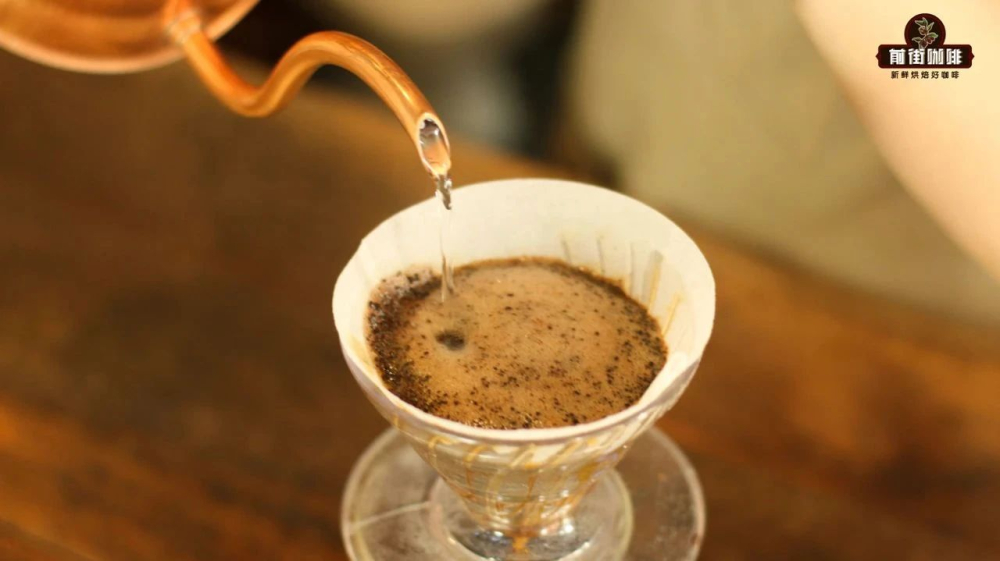
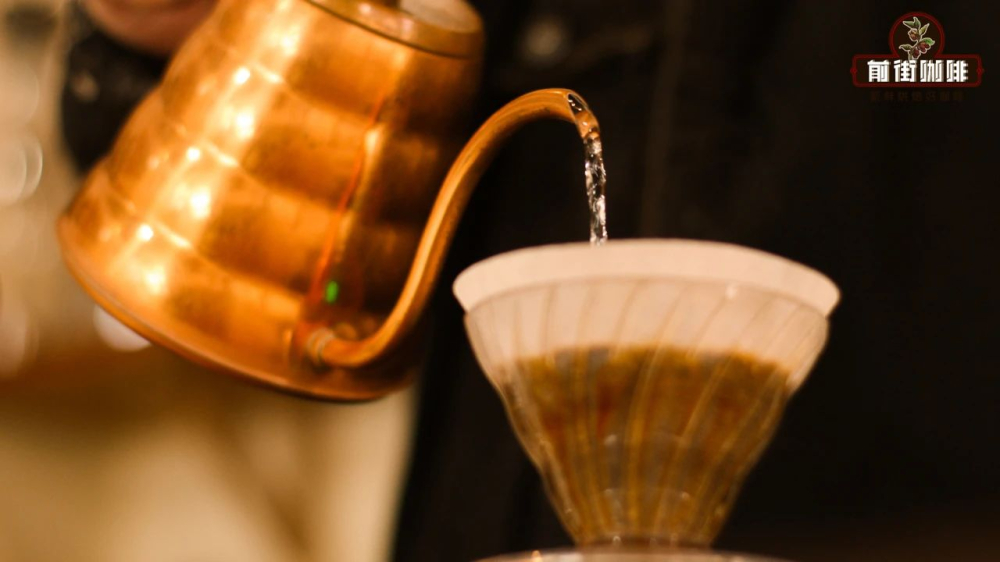
Front Street uses staged extraction. Use 30 grams of water for a 30-second bloom, pour in a small stream in a circular motion until 125 grams for the stage break, and when the water level drops and is about to expose the coffee bed, continue pouring until 225 grams and stop pouring. When the water level drops and is about to expose the coffee bed, remove the dripper. (Timing starts from the beginning of the bloom.) The extraction time is 1'53".
Brewed flavor: Stunning peach characteristics, accompanied by the aroma of roses and rum chocolate, fragrant and rich, and the first sip is like drinking peach juice. It has both the high-quality sweet-and-sour sensation of black grapes and the silky mouthfeel of creamy toffee.
For more coffee bean information, please follow: Front Street Coffee (FrontStreet Coffee)
The above content is compiled by CoffeeHunters, a coffee news website.


