







Mandheling coffee is synonymous with Sumatran Arabica beans, known for its low acidity, full body, and earthy, herbal notes. This article starts from the history of coffee's spread, tracing how the Indonesian coffee industry shifted from Java to Sumatra, and provides a detailed introduction to the terroir differences between the two major Mandheling producing regions, Aceh and Lintong. It focuses on analyzing how the unique local wet-hulling method shapes Mandheling's signature flavor, as well as the distinctive features of PWN's Golden Mandheling in terms of sorting standards, grade requirements, and cupping performance. The article also includes Front Street Coffee's roasting recommendations and KONO dripper brewing parameters, making it a useful reference for readers who enjoy full-bodied coffee.
For more specialty coffee knowledge, please follow the WeChat public account: Front Street Coffee (FrontStreet Coffee)
Coffee as a beverage has been recorded in Middle Eastern literature for only about seven hundred years. During these centuries, coffee's flavor has continuously evolved alongside growing conditions and human preferences. In the early days, people drank coffee either to display status or to refresh themselves and relieve fatigue. Today, picking up a cup of coffee is more about finding a distinctive aroma amid a busy daily routine.
Compared to the floral and fruity tea-like character championed by the third wave of specialty coffee, many seasoned coffee enthusiasts actually prefer types with low acidity and a steady, mellow aroma. You should know that behind every cup of rich, aromatic coffee lies a winding journey of development.
Coffee's place of origin is Ethiopia, which is already widely known. It was not until the late fifteenth century that coffee appeared as a beverage outside Ethiopia. Entering the seventeenth century, coffee set off a craze in Europe. Some European colonizers, in order to monopolize the market, launched planting competitions in their colonies, moving coffee seedlings to various places.
At the end of the seventeenth century, the Dutch brought coffee seedlings to the island of Java in Indonesia. In the suitable temperatures and fertile soil there, coffee trees grew well and gradually spread to the island of Sumatra. Java's coffee industry once flourished, and the word JAVA thus became synonymous with coffee.
However, the good times did not last. In the early twentieth century, coffee leaf rust struck Java on a large scale, and the coffee trees on the island suffered devastating damage. Indonesia's coffee planting center was forced to move north to the island of Sumatra, and Java subsequently lost its status as a major production region.
Today, Sumatra is Indonesia's largest producing region for both Arabica and Robusta beans, accounting for more than 60% of output. Among them, Aceh in northern Sumatra and North Sumatra Province have higher elevations and mainly produce Arabica beans.
People habitually refer to Arabica beans produced in Sumatra collectively as Mandheling coffee beans, with the core producing areas located in the Aceh Special Region in northwestern Sumatra and North Sumatra Province to the southeast of Aceh.
The Aceh producing region is near the Gayo Mountains by Lake Tawar, surrounded by thousands of hectares of vegetation. As this emerging Mandheling producing region gradually rises, more and more coffee enthusiasts are discovering that Aceh Mandheling has a delicate aroma and a bright mouthfeel.
The traditional Mandheling producing region is located in the Lintong area around Lake Toba in North Sumatra Province. There, plant varieties are abundant, the growing elevation is suitable, and together with the special wet-hulling method and the local microbial fermentation and aroma-generating mechanisms, they jointly create the mysterious and classic Mandheling flavor—rich aroma, full body, and intense taste.
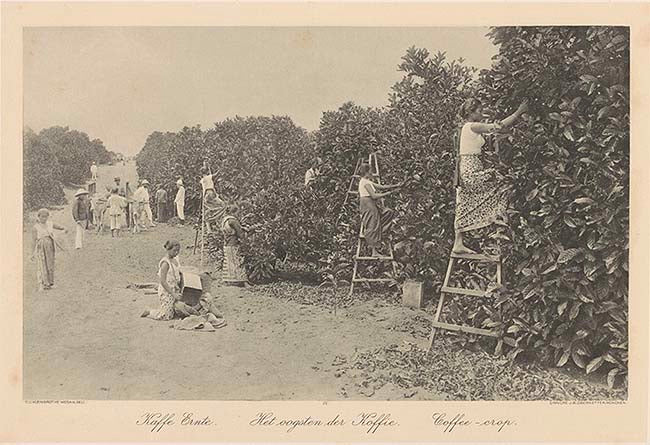
Indonesia's rainy season highly overlaps with the coffee cherry ripening period, making sun-dried coffee beans almost impossible to achieve, so a regionally distinctive Sumatran-style processing method—wet hulling—was developed. Since the 1970s, this processing method has shaped the unique flavor of Mandheling coffee.
Because rainfall is frequent in Sumatra, in order to dry the green coffee beans as quickly as possible, growers first remove the skin and pulp, then dry them after a brief wash; when the coffee fruit reaches a half-dry, half-wet state, the parchment layer is removed by machine, exposing the green beans directly to the air, thereby speeding up the overall drying process.
This distinctive wet-hulling method gives the coffee low acidity, a heavy body, and unique earthy and herbal flavors. It is precisely this taste, like Mother Nature herself, that intoxicates some veteran coffee lovers and makes it hard for them to pull away.
Some coffee enthusiasts think Mandheling coffee beans look rather ugly and even have a relatively high proportion of "defective beans." In fact, this is because during the hulling process the green beans have higher moisture content and lower hardness, making them prone to forming "goat hoof"-shaped bean forms. Every man has his hobbyhorse, and some coffee fans are precisely fond of Mandheling coffee beans with irregular appearances.
Among the many Mandheling coffee beans, Golden Mandheling best satisfies coffee lovers pursuing perfection. One Golden Mandheling that Front Street Coffee sourced comes from Indonesia's PWN company. When producing Golden Mandheling, this company implements extremely strict standards.
On the basis of selecting coffee beans of 18 mesh or above, it requires fewer than 3 defective beans per 300-gram green bean sample, thereby reaching the highest grade G1 standard. On top of that, it must also undergo three rounds of manual hand sorting to completely remove defective beans from the green beans, thus enhancing the cleanliness of Golden Mandheling's taste and the intensity of its sweetness.
From such strict production standards alone, one can see the high quality and limited output of Front Street PWN Golden Mandheling coffee beans, which also makes the price of Front Street PWN Golden Mandheling higher than many Mandheling coffee beans. Some merchants, seeing a business opportunity, use Golden Mandheling coffee beans that are also G1 grade, adopt three rounds of manual hand sorting, and ensure a high degree of similarity in appearance to Front Street PWN Golden Mandheling, hoping to sell them at a high price.
In order to compare the flavors of many Golden Mandheling coffees on the market, Front Street Coffee (FrontStreet Coffee) once purchased multiple Golden Mandheling coffees for blind testing. However, Front Street Coffee's (FrontStreet Coffee) baristas could all clearly identify Front Street PWN Golden Mandheling from among the many Mandheling coffees. This is because the cleanliness of Front Street PWN Golden Mandheling's taste is incomparable.
Of course, as an ordinary consumer, distinguishing Front Street PWN Golden Mandheling by taste alone is a bit difficult. Besides taste, consumers can also ask the merchant to provide the jute sack and origin certificate for the Golden Mandheling green coffee beans to prove whether their Golden Mandheling comes from PWN. These two kinds of proof can be seen at Front Street Coffee's (FrontStreet Coffee) store in Yuexiu District, Guangzhou.
In order to highlight Golden Mandheling's full body and rich, unique aroma, Front Street Coffee (FrontStreet Coffee) decided to use a medium-dark roast level when formulating the roasting curve. Therefore, when brewing, Front Street recommends the following brewing parameters:
Dripper: KONO
Water temperature: 88 degrees Celsius
Dose: 15 grams
Coffee-to-water ratio: 1:15
Grind size: 70% passing through a Chinese standard No. 20 sieve
In choosing the dripper, Front Street recommends using a dripper with an immersion function, such as the KONO dripper, to enhance the thickness of the final brewed cup.
First pour 30 grams of hot water and bloom for 30 seconds, then pour from the center point in a fine stream and slowly spiral outward to 125 grams. When the water level in the dripper drops to the point where the coffee bed is about to be exposed, continue spiral pouring to 225 grams. The total extraction time is about 2 minutes.
For professional coffee knowledge exchange and more coffee bean information, please follow Coffee Workshop (WeChat public account: cafe_style)
For more specialty coffee beans, please add the private WeChat of Front Street Coffee (FrontStreet Coffee), WeChat ID: qjcoffeex
The above content is compiled by CoffeeHunters, a coffee news website.


