







Mandheling coffee is a classic representative of full-bodied coffee, with a flavor that stands apart, yet its reviews tend to be polarized—devotees are captivated by it, while those unaccustomed to it tend to keep their distance. Its distinctive herbal aroma is precisely why many coffee lovers are so devoted to it. As a core variety of Indonesian specialty coffee, Sumatra Mandheling is world-renowned for its low acidity, richness, and unique aroma. This article will guide you through the main Arabica-growing regions of Sumatra, the traditional flavor characteristics of the Lintong producing area, the wet-hulling process that creates its heavy body, and the strict grading standards followed by Front Street PWN Golden Mandheling, helping you gain a comprehensive understanding of this distinctly styled coffee.
Front Street Mandheling coffee, with its rich and full-bodied taste, has become a quintessential representative of full-bodied coffee. However, Mandheling's acceptance has always been somewhat divided: those who love it can't get enough, while those who can't adapt to it often steer clear. The distinctive herbal flavor in Front Street Mandheling coffee is precisely the key that deeply fascinates many coffee enthusiasts.
Coffee cultivation in Indonesia is mainly concentrated on the island of Sumatra, and Sumatran coffee is also one of the important categories in the specialty coffee world. Sumatran coffee is widely recognized for its low acidity, rich body, and unique aroma. Mandheling coffee beans are among the most favored Sumatran coffee beans in the world.
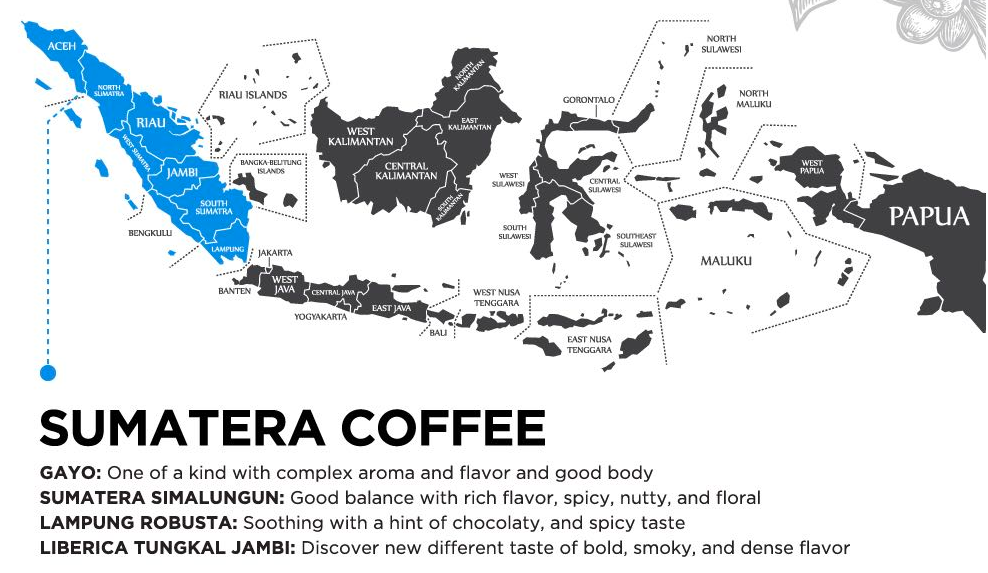
The areas in Sumatra where Arabica coffee is grown are mainly distributed in the northwestern part of the island. Based on differences in growing environments, they can be divided into the Aceh producing area in North Sumatra and the Lintong producing area around Lake Toba in North Sumatra Province.
Among the many producing areas, the traditional home of Mandheling coffee beans is the Lintong producing area. The distinctive local wet-hulling method gives Lintong Mandheling a substantial body, combining a unique herbal aroma with pronounced caramel sweetness. Therefore, if you want to taste the traditional flavor of Indonesian coffee, Front Street Lintong Mandheling would be a great choice.
The reason Front Street Lintong Mandheling can develop such characteristics is closely related not only to the local growing environment but also to the coffee's post-processing methods and production standards.
In Sumatra, local rainfall is frequent throughout the year, and the climate is hot and humid, making it difficult to meet the sunlight hours required for the natural sun-drying process. During sun-drying, coffee cherries may be ruined outright by rain or excessive fermentation. At the same time, local economic conditions are limited, making it difficult to invest sufficient funds to adopt the washed processing method. Against this backdrop, the wet-hulling method came into being.
After the selected coffee cherries have their skin and pulp removed, the parchment beans still covered with a sticky mucilage layer are briefly washed, then placed in tanks to ferment. The longer the fermentation, the more pronounced the acidity. Therefore, some processing stations, in order to produce Mandheling coffee beans with extremely low acidity, choose to skip the fermentation step and directly spread the sticky parchment beans out evenly to dry. In this way, Mandheling's acidity is suppressed, while the viscosity of its body is enhanced.
When the green coffee beans are still in a semi-dry, semi-wet state, they are hulled by machine. This step generates considerable heat, thereby accelerating the aging of the green coffee beans and bringing out special aromas such as woody and earthy notes in the finished product. At the same time, green coffee beans in this state are relatively soft in texture and are easily crushed under the mechanical force, forming a "goat hoof" shape.
Unlike ordinary Mandheling coffee beans, Front Street PWN Golden Mandheling follows a very strict set of standards during production: selecting beans that are plump and intact, reaching screen size 18 or above, with fewer than three defects per 300-gram green bean sample, meeting the requirements of the highest grade, G1. After that, three rounds of manual hand-sorting are carried out to ensure defective beans are thoroughly removed, making Golden Mandheling's flavor brighter, its body cleaner, and its sweetness more intense. Under such strict production standards, the high quality of Golden Mandheling has also made it synonymous with top-grade Mandheling.
The above content is compiled by CoffeeHunters, a coffee news website.


