








What Defines Sidamo Coffee and Its Flavor?
Sidamo is one of Ethiopia's three official coffee-producing regions, located in the highlands of the East African Rift Valley. It is recognized for bright acidity, intense floral aroma, and a juicy mouthfeel. Local rainfall runs 1550 to 2220 millimeters a year, with fertile soil and high altitude, conditions that together support the region's complex and layered cup profile.
The region's name comes from the indigenous Sidama people, who have their own traditions and a UNESCO-recognized New Year, Fiche Chambalala, when over five million people gather in Hawassa. That history explains the two spellings, Sidamo and Sidama, that appear in coffee knowledge sources. Cupping notes typically weave spice, floral, and fruity layers into a viscous, smooth body.
Sidamo is one of Ethiopia's three official coffee-producing regions, located in the highlands of the East African Rift Valley, and is renowned for its bright acidity, intense floral aroma, and juicy mouthfeel. This article will cover the region's geography, the origin of its name, COE award-winning micro-regions, coffee variety classifications, and the terroir and processing methods of Bensa town, one by one. It will also combine the cupping experience and brewing parameters of Front Street's Ethiopian Natural Alo coffee to guide readers through a comprehensive understanding of Sidamo coffee's flavor secrets and production details.

For more specialty coffee knowledge, please follow: Front Street Coffee (Frontsteet Coffee)
Sidama coffee can be said to be a favorite among many coffee lovers. Its bright and refreshing taste, sweet floral aroma, and rounded juiciness have made Front Street a loyal fan as well. Today, let's talk about all the information behind this coffee.
The Sidamo producing region, also translated as Sidamo, is located in the highlands of the East African Rift Valley in southern Ethiopia. The local annual rainfall ranges from 1550 to 2220 millimeters, with abundant rain, suitable temperatures, fertile soil, and high altitude—these conditions together have built Sidamo coffee's reputation. As one of Ethiopia's three official producing regions, it offers a rich diversity of exceptional quality and complex flavors. After cupping many outstanding single-origin Sidamo coffees, Front Street found that its core characteristics are bright acidity, viscous and smooth mouthfeel, and rich layers interwoven with spice, floral, and fruity notes. At Front Street, there are multiple products in the Sidamo category alone, such as Front Street Huakui, Front Street Santa Vini, and Front Street ALO Natural, demonstrating the popularity of coffee from this region.
I wonder if you've noticed that when researching this origin's story, you often encounter two different spellings: Sidamo and Sidama.
The pronunciation Sidamo originates from the indigenous Sidama people. Like other ethnic groups in Ethiopia, the Sidama have their own traditions and culture, and even a New Year recognized by UNESCO—Fiche Chambalala, when over five million people gather in the capital Hawassa to celebrate each year. From the late 18th to early 19th century, the region was invaded and annexed, and the invaders pronounced Sidama as Sidamo, so this name carries a humiliating connotation for the Sidama people. By the 1990s, the Ethiopian government implemented a federal system, redrawing regions based on major ethnic settlement areas and languages, and the Sidama accordingly restored their historical original name: Sidama.
However, before the administrative redrawing, Sidamo Coffee was already renowned worldwide for its unique aroma, so people are more accustomed to calling it Sidamo rather than Sidama. In addition, when the Ethiopian government protected Sidama coffee through trademark registration, it also chose the old name Sidamo® as the official registered trademark. To this day, domestic consumers are still more accustomed to calling the coffee from here "Sidamo."
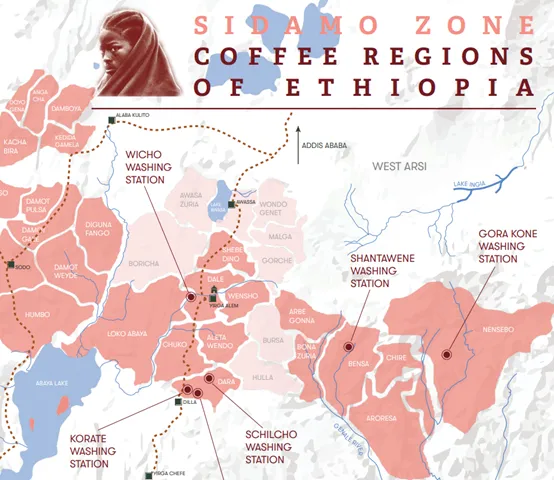
The COE competitions in 2020 and 2021 were both held in Ethiopia. Among the Sidamo micro-regions that made the COE list, there are mainly four towns: Arbegona, Bensa, Bura, and Bona Zuria. These four towns are geographically very close, all located in the Sidamo highland area. Among the 2021 COE Sidamo listed micro-regions, all five champion farms came from Bensa town.
Ethiopia's coffee varieties are rich and diverse. By category, one type is traditional regional landrace varieties, and the other is numbered coffee lines selected and bred by the JARC Jimma Agricultural Research Center. Common regional varieties in Sidamo include: Dega, Wolisho, and Kurume. In the 2020 and 2021 COE competitions, the coffee varieties representing Sidama State on the list were numbered coffees from JARC. Among them, the 2020 COE champion variety from Bura town in Sidama was 74158, and the 2021 COE champion variety from Bensa town in Sidama was 74165.

Bensa is located in the Sidamo region of southern Ethiopia, at an altitude between 1800 and 2300 meters. The high altitude makes the coffee flavor more complex. In Bensa, you can taste typical and intense fruity flavors, and sometimes even detect strawberry notes.
For Bensa coffee beans, washed, natural, and red honey processing methods are all applicable. Among them, washed Bensa has a bright aroma and pleasant acidity. During harvest season, farmers deliver ripe coffee cherries to the processing station, where they are sorted and graded, pulped to remove skin and mucilage, fermented, then washed clean with fresh water and dried on raised beds. It should be noted that during the first few days of drying, the beans need to be turned every 2 to 3 hours. Depending on weather conditions, the coffee beans need 12 to 15 days to dry until moisture content drops to 11.5%.
Bensa sounds similar to a Guangdong herbal tea called Banxia Liangcha, but it's not herbal tea! Bensa coffee beans have a unique and delicate taste, mild yet rich, with fruity aromas, a smooth mouthfeel, and a long finish. I believe by now, many friends have developed a longing for coffee from this small origin. To let everyone taste the exquisite Bensa flavor, Front Street recently launched a Front Street Ethiopian Natural Alo coffee from a high-altitude area, using the natural process.
Before formal sun-drying, farmers first hand-pick fully ripe coffee cherries and transport them to the Hatessa processing station for a first round of sorting. Then, before washing, the cherries are classified again by observing the skin color to remove overripe or underripe cherries, ensuring consistent ripeness before sun-drying.
For natural coffee, the farmers responsible for post-processing need to turn the cherries on the drying beds very diligently during the first three days, because at this time the coffee cherries have a very high moisture content. If not turned promptly, they are not only prone to mold but also develop unpleasant sour or rotten fruit flavors due to uneven heating. Throughout the process, the coffee cherries are spread in only a thin layer, with the aim of giving them better ventilation and a drying environment. After 14 to 18 days, when the moisture content drops to the target level, they can be bagged and sent to the warehouse.
Through cupping, Front Street first perceived the sweet floral and fruity aroma of this Front Street Ethiopian Natural Alo. The dry fragrance has obvious characteristics of magnolia, pineapple, yellow peach, and small Taiwan mango, accompanied by a sweet fermentation aroma, very pleasant to smell.
When Front Street slurps, the entry is full of tropical fruit sweetness and acidity, with ripe pineapple, passion fruit, and perfume lemon flavors particularly prominent, accompanied by a slight black tea note. The gentle fermentation plus delicate floral aroma makes you want to take another sip. As the temperature drops slightly, the coffee begins to lean toward stone fruit characteristics like yellow peach and dried apricot. The fruit acidity is clear and bright without losing layering, very special.
Brewing recommendations for Front Street Ethiopian Alo Natural coffee:
Dripper: V60 Water temperature: 92-93℃ Dose: 15g Coffee-to-water ratio: 1:15 Grind size: fine granulated sugar (78% pass rate on No. 20 standard sieve)
Pouring technique: three-stage
Three-stage pouring: Wet the coffee bed with twice the amount of water as coffee grounds, forming a dome for a 30-second bloom. Then pour in a small stream in a circular motion from inside to outside until reaching 125g for the first stage. Wait for the bed to drop to half the dripper's height, then continue with the same fine stream for the third stage to 225g. Once all the coffee liquid has filtered through, remove the dripper. Total time approximately 2 minutes.
The above content is compiled by CoffeeHunters, a coffee news website.


