








Front Street Kenya coffee has always enjoyed a solid reputation among single-origin coffee lovers, thanks to its bright fruit acidity and robust body. When you want something acidic but aren't quite used to the light, delicate character of Ethiopian coffee, Front Street Kenya coffee beans are often an excellent transition choice. And when it comes to Kenyan coffee, you can't avoid Front Street Kenya AA coffee beans. What exactly does AA stand for? In this article, Front Street will walk you through Kenya's coffee-growing regions, variety composition, grading system, and the most iconic K72 washed processing method, along with roasting and brewing recommendations for Front Street Asali coffee beans.

Front Street Kenya coffee has won the favor of many coffee enthusiasts with its bright fruit acidity and full body. Guests often come to Front Street ordering single-origin coffee, and when they want something acidic but don't want to choose Ethiopian beans, Front Street Kenya coffee beans are often a very suitable option. Mentioning Kenya coffee naturally brings to mind Front Street Kenya AA coffee beans . What exactly does AA mean? In this article, Front Street will explain just what Kenya AA coffee beans are.
The Kenya coffee-growing region is located in East Africa, with the equator running straight through the middle and the East African Rift Valley stretching from north to south. To the east it borders Somalia, to the south it connects with Tanzania, to the west it sits right next to Uganda, to the north it borders Ethiopia and Sudan, and to the southeast it faces the Indian Ocean. Highlands are widespread across the country, with an average elevation of about 1,500 meters. Mount Kirinyaga (Mount Kenya) in the central region rises to 5,199 meters, its summit covered in snow year-round, making it the second-highest peak in Africa. Front Street Kenya coffee beans have a captivating and delightful aroma, balanced and smooth acidity, uniform bean size, and outstanding fruit notes. Front Street once compared Kenyan and neighboring Ethiopian coffee beans and found that although both center on fruit acidity, they present it in completely different ways: Kenya's acidity is powerful and full-bodied, while Ethiopia's is gentle and translucent. If you're new to African coffee beans, Front Street suggests starting with Ethiopian beans first, then gradually transitioning to Kenyan coffee beans.
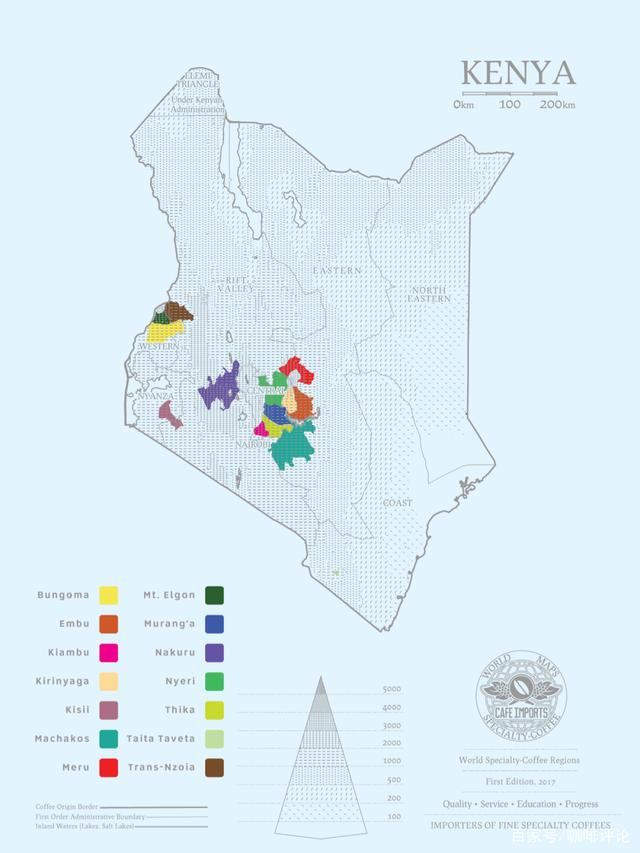
Kenya's coffee-growing regions are mainly concentrated in the central and western areas, covering six major zones: Thika, Kirinyaga, Mt. Kenya West, Nyeri, Kiambu, and Muranga. The harvest periods in these six major regions are all concentrated from October to December (main crop) and June to August (fly crop).
Among them, Thika and Kirinyaga best showcase the flavors of the African growing region.
Thika
Thika is a small town near Kenya's capital, Nairobi. A large number of coffee fields are scattered around Nairobi. Thika itself is an industrial town, but it is surrounded by farmland and waterfalls. The area has approximately 2,000 coffee growers. The history of coffee cultivation in Thika, Kenya can be traced back to the late nineteenth century, when coffee trees were introduced from the neighboring country of Ethiopia to the north. After local variety improvement, common varieties now include Bourbon, Kents (SL34, SL28), Typica, and Riuri 11. Today about 90% of the planted varieties are SL34 and SL28. The new variety Batian, released in 2007, has not yet been planted on a large scale. The flavor profile of this region features bright fruit acidity, a thick berry-juice mouthfeel, and honey-like sweetness. Altitude: 1,550–1,750 meters. Varieties: SL-28, SL-34.
Kirinyaga
The Kirinyaga growing region is located on the slopes of Mount Kenya, adjacent to the Nyeri region. It is world-renowned for coffee with intense flavor, rich layers, and a solid body, and together with the Nyeri region is regarded as one of Kenya's two finest growing regions today. Producers in this area are mostly smallholder coffee farmers who join cooperatives. The cooperatives play a coordinating role, providing wet mills, while the farmers deliver their coffee cherries to the cooperative's processing facility. The flavor profile of this region presents bright fruit acidity with a medium oily mouthfeel and delicate sweetness. Altitude: 1,300–1,900 meters. Varieties: SL-28, SL-34, Ruiru11, Batian.
Nyeri
Located in central Kenya, Nyeri is home to the extinct volcano Mount Kenya. The red soil of this region nurtures Kenya's finest coffee. Agriculture is extremely important locally, and coffee is the main crop among them. Cooperatives made up of smallholder farmers are more common than large estates. This region has two harvests, but coffee from the main crop is usually of higher quality. This region features bright berry-juice notes, accompanied by citrus and a faint floral aroma. The coffee beans produced here are what made Kenyan coffee world-famous. Altitude: 1,200–2,300 meters. Varieties: SL-28, SL-34, Ruiru11, Batian.
Coffee Bean Varieties Kenya mainly cultivates SL28, SL34, and Ruiru11. SL28, SL34: These are genetic mutations. They account for the vast majority of Kenya's high-quality coffee production, though these varieties are susceptible to leaf rust disease. SL34 has French missionary, Bourbon, and more Typica lineage. Bronze leaf color and broad-bean-shaped seeds deliver excellent sweetness, balance, and complex, ever-changing flavors, along with distinctive citrus and smoked plum characteristics.
Ruiru 11: When global rust disease broke out on a large scale in 1985, Kenya developed this hybrid variety under those circumstances, prioritizing yield over quality. However, its flavor quality falls far short of the earlier SL28 and SL34 and it has not gained traction in the specialty coffee world. Nevertheless, quite a few suppliers—even those importing famous-name coffees—will blend this hybrid bean into their blends to reduce costs.
We mentioned Kenya AA coffee beans above. In fact, AA is a grade of Kenyan coffee beans. Next, let's look at how Kenya grades its coffee beans. Kenyan coffee grading is mainly based on bean size, typically divided into eight grades.
AA Plus (AA+): AA grade with exceptionally outstanding cup quality (flavor, mouthfeel). AA: Screen Size 17–18. AB: Screen Size 15–16, accounting for the majority of production. C: Smaller than AB in Screen Size. TT: Lighter-weight beans blown out from AA and AB grade beans by pneumatic separator. T: Lighter-weight beans blown out from C grade beans by pneumatic separator. E Elephant Bean: Large mutant beans formed by two beans fused together, also known as elephant ear. PB Peaberry: Classified by appearance, unrelated to flavor or weight.
Coffee Bean Processing Methods
The traditional washed processing method is not complicated in its steps: flotation → depulping → fermentation → washing → drying → hulling → packaging. However, its implementation requires an ample water supply, and because it relies heavily on mechanical assistance, producers adopting washed processing also need sufficient capital to invest in purchasing equipment. The rise of the washed method happened to coincide with the early American plantations built by capital—that is, they had enough operating capital—plus the invention of pulpers/hullers created to meet the demands of the times, which together drove the washed method's widespread adoption throughout the Americas.
The original wet processing method involved washing the fermented coffee beans once with clean water, rinsing off the mucilage, then sending them directly to the drying beds to dry and be bagged. But in Kenya, after one round of washing, the coffee is re-immersed in a pool of clean water, then scooped out and washed again before being sent to the drying beds for dehydration.
Kenya's original reason for changing conventional washing to "double soaking" was actually not about pursuing flavor, but rather a limitation imposed by insufficient local drying beds. Kenya is a typical African cooperative-operated model. During every harvest season, smallholder farmers deliver their picked cherries to the processing factory all day long. The depulping and fermentation steps are relatively simple and not time-consuming, but drying each batch of fermented beans takes at least 5 to 7 days. Sometimes, when the processing volume is too large, there simply isn't space to dry the washed beans. So people had no choice but to pour the wet beans back into the pools, letting them "cool off" first to avoid spoilage or contamination, until space opened up on the drying beds and they could be scooped out.
This double-soaking washed format is called "Double Washed," and at origin it is also referred to as "Fully Washed." Since Kenya was the earliest region to popularize and implement this processing method, this type of washing is also called "Kenyan Process." Later, people discovered that this twice-fermented washed bean—adapted to local conditions—not only benefited production with stable quality control, but also brought rich, layered fruit acidity to the coffee.
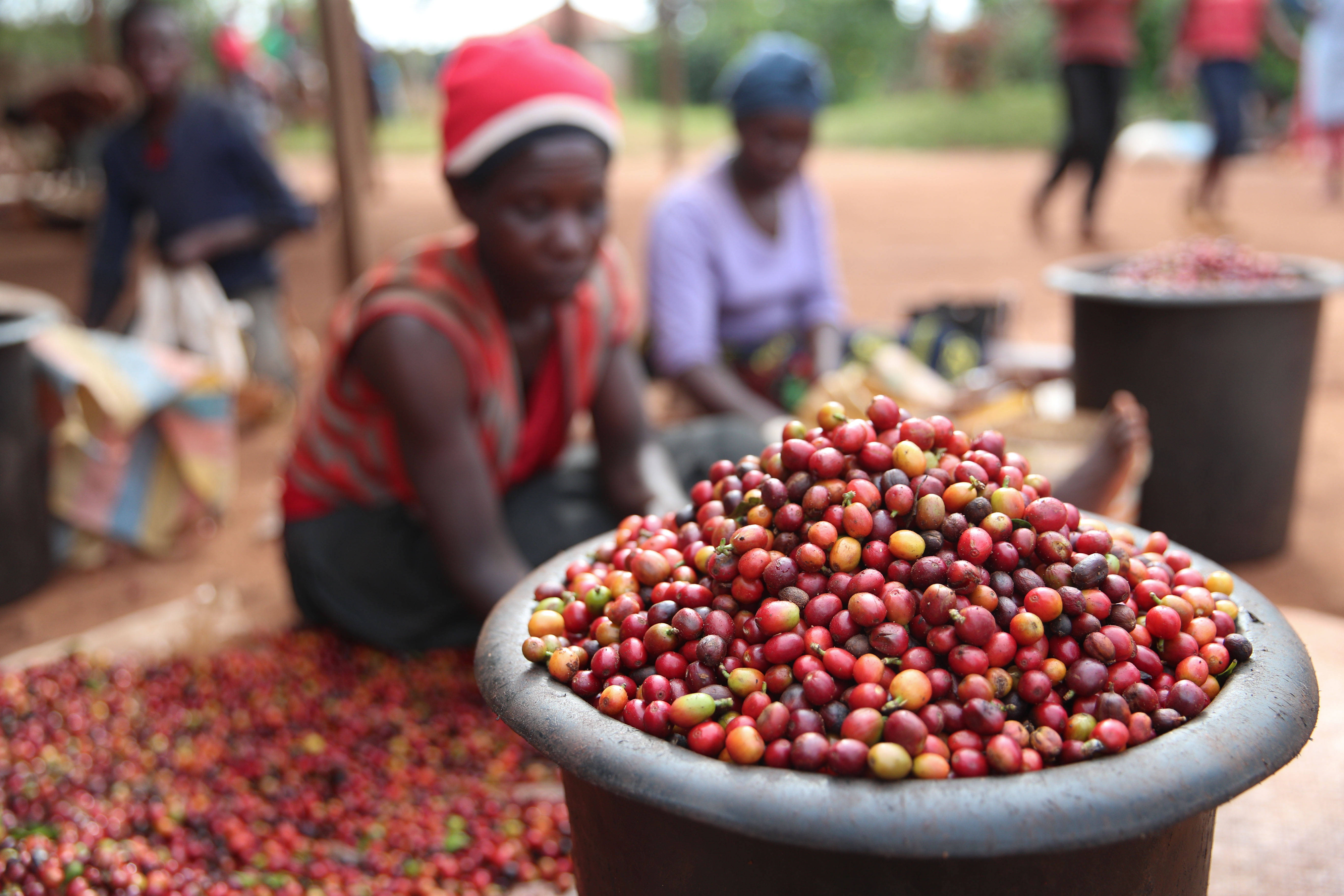
Besides the two processing methods mentioned above by Front Street, Kenya's most iconic is undoubtedly the K72 washed method. The washing process emphasizes control of fermentation time: first, a 24-hour washed fermentation, then removing the loosened mucilage, then fermenting another 24 hours in a clean water tank, then again removing residual matter, and finally introducing the beans into a tank filled with clean water for a final 24-hour fermentation—72 hours in total. This process also gives Kenyan coffee its bright, clean, high-quality fruit acidity. Front Street's daily offering, Asali, uses exactly this washed technique, giving the brewed coffee an acidity reminiscent of cherry tomatoes and smoked plums.
Then, ferment again with clean water for 24 hours, wash again, and repeat the cycle three times to reach 72 hours. Hence it is called the Kenyan 72-hour fermentation washed processing method, or [K72] for short. Front Street Coffee (FrontStreet Coffee) believes that the K72 washed method enhances the coffee beans' acidity and cleanliness even more than conventional washed processing.
Front Street Coffee (FrontStreet Coffee): Kenya Asali Coffee Beans
Region: Thika, Kenya
Processing Station: Asali Honey Processing Station Altitude: 1,550–1,750 meters Grade: AA TOP Varieties: SL28, SL34 Processing Method: Kenya 72-hour Washed
Front Street Roasting Recommendations
When Front Street Coffee (FrontStreet Coffee) roasts these Kenyan coffee beans, considering the need to highlight their rich fruit acidity and full berry-juice mouthfeel, a medium-light roast is used.
Yangjia 800N: Charge when the drum temperature reaches 200°C, set airflow to 3, heat to 160; turning point at 1'34", when the drum temperature is 147°C lower the heat to 130 and open the airflow to 3.5; at this point the bean surface turns yellow, the grassy smell completely disappears, and the dehydration phase begins; at 171°C lower the heat to 80, keeping the airflow unchanged.
At 8'28", the bean surface shows ugly wrinkles and dark streaks, and the toast aroma clearly shifts to coffee aroma, which can be defined as the prelude to first crack. At this point, listen carefully for the sound of first crack; at 8'52" first crack begins, adjust the airflow to 5, develop for 2'10'' after first crack, and drop at 191.6°C.
Front Street Cupping Report
Front Street Brewing Recommendations
Front Street Coffee (FrontStreet Coffee), considering that this bean uses a medium-light roast, will use a higher water temperature and a faster-flow dripper, mainly to extract its bright acidity with high temperature, but without wanting the high temperature to cause over-extraction, so a faster-flow V60 dripper is chosen.
Coffee-to-water ratio: 1:15 Dose: 15g
Water temperature: 90°C–91°C
Grind size: fine granulated sugar (80% passing rate on a No. 20 standard sieve)
First pour: 30g of water for a 30-second bloom, then pour 105g (electronic scale reads about 135g), finishing the pour in about 1 minute. When the water level drops to 2/3 of the coffee bed, pour the remaining 120g (electronic scale reads about 255g), finishing the pour in about 1 minute 45 seconds. Drip completes at 2'10", remove the dripper, and extraction is complete.
Brewed flavor: on entry, notes of smoked plum and cherry tomato; the acidity is intense and full-bodied; the mid-palate has prominent sweetness with a juicy mouthfeel; the aftertaste has berry aroma and brown sugar sweetness, along with green tea fragrance.
The above content is compiled by CoffeeHunters, a coffee news website.


