







How Did the History of Costa Coffee Shape Honduran Beans?
Honduras is Central America's largest coffee producer and the world's seventh-largest, yet its single-origin beans went largely unnoticed until Sherry arrived. Production topped 450,000 tons between 2017 and 2019 and reached 336,000 tons in 2020. Sherry, a barrel-fermented Honduran coffee, brought the country into the spotlight and earned it a steady following.
Coffee reached Honduras in the eighteenth century through merchants, with cultivation documented in the nineteenth century and real growth only in the twentieth. The Honduran Coffee Association, IHCAFE, was founded in the 1970s to raise quality. A 1998 hurricane destroyed many crops, including coffee, and 2011 brought a production record. Six regions, among them Copan, Montecillos, and Comayagua, now define the country's terroir.
In recent years, a Honduran coffee bean called Sherry has rapidly gained popularity in the market, bringing this Central American country into the view of more coffee lovers. Honduras is now the world's seventh-largest coffee-producing country and one of the largest coffee producers in Central America, but for a long time its single-origin coffee beans were rarely mentioned. This article will review the history of coffee development in Honduras, explain in detail the terroir characteristics of six major producing regions including Copan, Montecillos, and Comayagua, and introduce two representative Honduran coffees on the Front Street Coffee bean list—Sherry and Lychee Orchid—including their barrel fermentation process, flavor performance, and brewing suggestions, to give you a comprehensive understanding of this rising coffee-producing country.
The phrase "C in the morning, A at night" has recently become quite popular on Weibo. As the beverage market in China continues to expand and become increasingly segmented, combinations of coffee and alcohol, coffee and tea, and tea and alcohol are emerging endlessly. Tea-flavored alcoholic drinks are no longer novel, and coffee with alcoholic aromas also offers an increasingly rich variety of choices. Among them, one of the most common in recent years is Sherry from Honduras.
Before Honduran Sherry came out, the country's coffee beans were hardly heard of. Now, precisely because of the emergence of this bean, Honduran coffee has gained many loyal fans. Honduras is currently one of the largest coffee-producing countries in Central America and ranks as the world's seventh-largest coffee-producing country. From 2017 to 2019 alone, Honduras's coffee bean production exceeded 450,000 tons, with production at 336,000 tons in 2020.
Honduras's coffee-growing history can be traced back to the eighteenth century, when merchants introduced coffee to the area. It was not until the nineteenth century that documents recorded coffee cultivation in the country. Only in the twentieth century did coffee as a crop truly flourish in Honduras. In the 1970s, the Honduran Coffee Association, Hondureño del Cafe (IHCAFE), was established to improve the country's coffee quality. In 1998, a hurricane swept through Honduras, destroying a large number of crops in the country, including coffee. In 2011, Honduras's coffee bean production exceeded the combined total of Costa Rica and Guatemala.
Today, Honduran coffee has become one of the most favored producing countries in the market.
The reason FrontStreet Coffee's Honduran Sherry is so delicious and widely popular lies in Honduras's unique geographical location, bordering the Caribbean Sea to the north and the Pacific Ocean to the south, with complex terrain and coffee-growing areas at higher altitudes. In addition, Honduras's mild climate, with suitable temperatures combined with high altitude, greatly reduces the probability of coffee trees becoming diseased, allowing more nutrients to be used to produce high-quality, delicious coffee cherries.
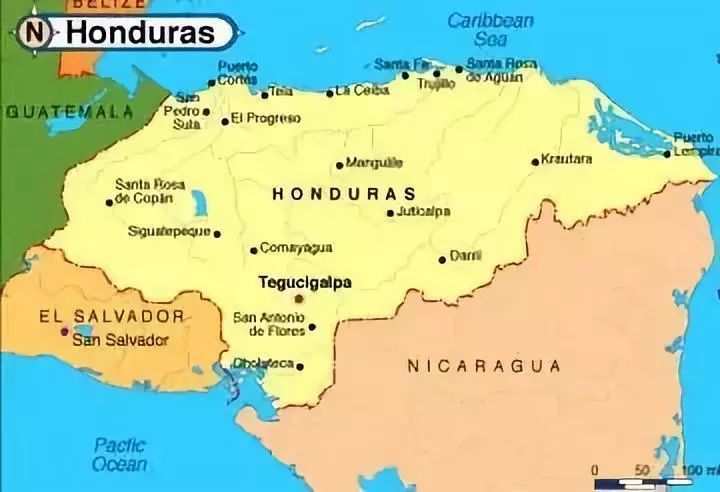
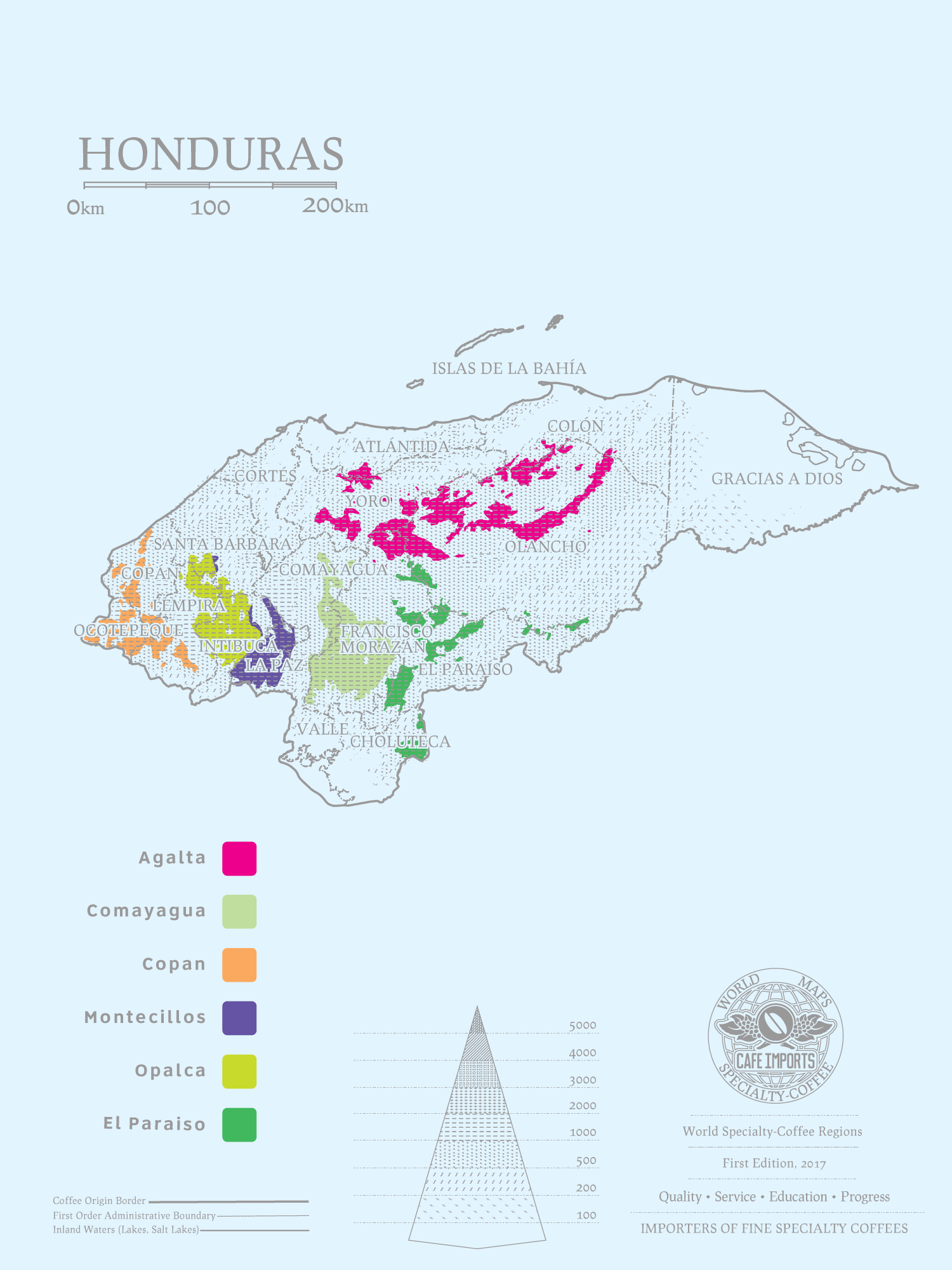
Honduras's main coffee-producing regions include Copan, Opalaca, Montecillos, Comayagua, Agalta, and El Paraiso.
[Copan]
The Copan producing region is located in the border area between Honduras and Guatemala, with a growing altitude above 1,000 meters, and is one of Honduras's most prestigious coffee-producing regions. The region's annual temperature and humidity vary greatly, and the Honduran coffee it produces is characterized by a rich aroma, prominent sweetness, and a full-bodied mouthfeel.
[Montecillos]
Montecillos is located between the border of Honduras and El Salvador. Because nighttime temperatures in this producing region are relatively low, and the highest growing altitude can reach 1,600 meters, coffee cherries have a longer maturation cycle, so the coffee from the Montecillos region has a more pronounced fruity sweet-and-sour taste.
[Comayagua]
The Comayagua producing region's output in 2016 was the highest in all of Honduras. The coffee-growing areas of this region are located in remote mountainous areas of central Honduras, and the coffee produced has both citrus and honey flavors, with balanced acidity and sweetness and a smooth mouthfeel.
[Agalta]
Most of this producing region is forest reserve with an excellent ecological environment, but the altitude is relatively low, between 1,000 and 1,400 meters, with a tropical climate. The coffee produced in this region has fruity and chocolate flavors.
[El Paraiso]
This producing region is located between the border of Honduras and Nicaragua and is Honduras's oldest and largest coffee-producing region. The growing altitude is between 1,000 and 1,400 meters. At the 2017 Honduras Cup of Excellence (COE), a coffee bean from El Paraiso won the championship that year.
[Opalaca]
The western side of this producing region is adjacent to the Copan producing region, and the growing altitude is slightly higher, giving the coffee beans from this region a strong aroma and tropical fruit flavors. Among the more well-known sub-regions under this major producing region is the Marcala region.
On FrontStreet Coffee's bean list, the Honduras country column contains two beans in total. One is Honduran Sherry, included in the everyday drinking coffee series, and the other is Lychee Orchid.
In FrontStreet Coffee's everyday drinking coffee series, each coffee bean represents the classic flavor of a certain origin or a certain processing method, such as the floral aroma of Ethiopian washed Yirgacheffe and the herbal notes of Indonesian wet-hulled Mandheling. FrontStreet uses Honduran Sherry as a typical example of a special processing method.
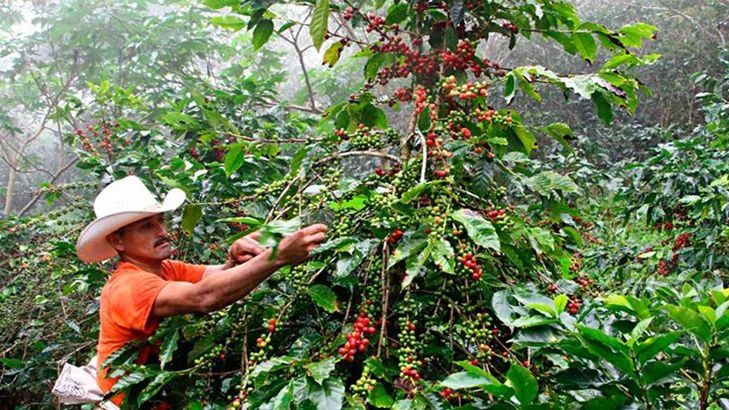
FrontStreet Coffee: Honduras · Sherry Coffee Beans
Producing region: Marcala region, Honduras
Estate: Moca Estate
Altitude: 1,500 meters—1,700 meters
Varieties: Caturra, Catuai, Pacas
Processing method: Fine washed whisky barrel fermentation
The flavor description of FrontStreet's Honduran coffee is vanilla, cream, fermented wine aroma, and honey.
Honduran Sherry comes from Moca Estate and uses a barrel fermentation processing method. After picking ripe coffee cherries, Moca Estate processes them on the same day, removing the pulp after peeling the coffee cherries and then washing them. The parchment coffee green beans are then placed into Sherry whisky barrels and fermented at low temperature for 30 to 40 days. Finally, the parchment coffee green beans are taken out and spread in a shaded place to dry.
The final drying stage must absolutely not be exposed to direct sunlight, because the heat brought by direct sunlight will cause the hard-earned wine aroma absorbed by the coffee green beans to evaporate completely, and it will also produce undesirable fermented sourness.
Friends who know whisky are aware that there are many types of whisky barrels, and many barrel types have previously been used to hold wine, including port, red wine, brandy, sherry, noble rot wine, and so on. Among them, port whisky has a slight savory umami taste, while whisky aged in sherry barrels is the sweetest and most delicious among all types of barrels.
In FrontStreet's Honduras column, there is a bean from the same estate but fermented in a different barrel—Lychee Orchid, which uses brandy barrel fermentation. Through cupping, FrontStreet found that Sherry's flavor is sweeter and more fragrant than Lychee Orchid's. No matter what is said, it is better to buy it and try it yourself.
FrontStreet Coffee: Honduras · Moca Estate Lychee Orchid Coffee Beans
Country: Honduras
Producing region: Marcala region
Estate: Moca Estate
Altitude: 1,500 meters—1,700 meters
Varieties: Caturra, Catuai
Processing method: Washed + brandy barrel fermentation
When roasting the Honduran Lychee Orchid bean, in order to show Lychee Orchid's overall balance, FrontStreet's roaster chose a medium roast; for Sherry, in order to highlight its sweet fragrance and balanced mouthfeel, a medium roast was also used.
To brew out the aroma of both coffee beans, FrontStreet recommends using a relatively high water temperature, namely 92 degrees Celsius. Because the water temperature is relatively high, to avoid over-extraction, you can choose a dripper with a relatively fast flow rate, such as the Hario V60 dripper.
Dripper: Hario V60
Water temperature: 92 degrees Celsius
Coffee dose: 15 grams
Coffee-to-water ratio: 1:15
Grind size: 80% passing through a No. 20 sieve
As for the brewing method, FrontStreet recommends a three-stage pour, which produces a richer layering in the cup. First pour 30 grams of hot water and let it bloom for 30 seconds, then pour the second stage of water slowly in circles with a small stream until 125 grams. When the water level in the dripper drops to half, continue gently pouring the third stage of water until 225 grams. After all the coffee liquid in the dripper has dripped into the server below, remove the dripper. The total extraction time is about 2 minutes.
Professional coffee knowledge sharing. For more coffee bean information, please follow the WeChat official account: FrontStreet Coffee.
The above content is compiled by CoffeeHunters, a coffee news website.


