







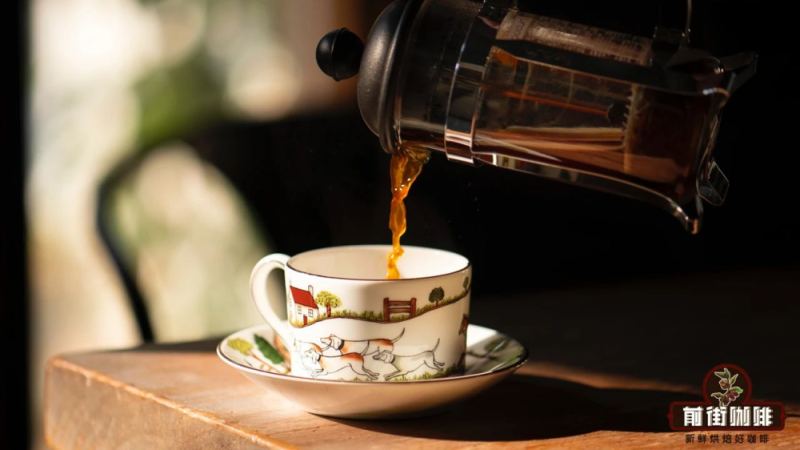
The French press has a low barrier to entry and delivers consistent results, making it extremely common in European and American households. However, many people in China only regard it as a tea-making tool. In reality, as long as you master a few variables—grind size, steep time, water temperature, and coffee-to-water ratio—a French press can present just as rich a flavor profile as pour-over, and it can easily make more than two servings at once. Drawing on Front Street's hands-on experience, this article systematically breaks down French press brewing parameters, offers specific recommendations for beans of different roast levels, and finally reminds you of an often-overlooked cleaning detail to help you consistently reproduce a delicious cup of French press coffee.
For more specialty coffee knowledge, please follow: Front Street Coffee (Frontsteet Coffee)
The French press is one of the easiest coffee brewing tools to master and is highly popular in European and American countries. However, most people in China, when mentioning it, still think of it as "something for making tea." In fact, coffee made with a French press is by no means inferior to pour-over in flavor expression, and a single brew can easily yield more than two servings. Therefore, when facing friends who want to make coffee simply at home, Front Street often recommends the French press first. So, which coffee beans are more suitable for this brewing method? Below, Front Street explains one by one.
French Press Introduction
This device originated in France. Structurally, it consists of a cylindrical container and a lid, with a metal filter mesh in the center of the lid that can be pushed up and down to separate the coffee grounds from the coffee liquid, thereby controlling the degree of extraction. The working logic of the French press is similar to brewing tea: steep the coffee grounds in hot water for a period of time, then push the plunger down, and after filtering, you get the coffee liquid. Although making coffee with a French press is indeed effortless, some friends still tell Front Street that the flavor they brew is always less than ideal.
French Press Usage Parameter Recommendations
Looking through French press tutorials on the market, most suggest using a coarse grind. Front Street's recommendation is to choose a grind size with a 70% pass rate on the China No. 20 standard sieve, roughly equivalent to the particle size of coarse granulated sugar.
A coarse grind, on the one hand, increases the margin for error during extraction, and on the other hand, reduces the amount of extremely fine powder produced by grinding. The metal filter mesh of a French press typically has pores between 80 and 300 micrometers, and the openings are visibly large to the naked eye. Fine powder easily passes through and mixes into the coffee liquid, making the whole cup cloudy. Of course, if you want a richer layering, you can also try a finer grind, but remember to shorten the steep time accordingly to avoid over-extraction.
Time is a variable that can be flexibly adjusted with a French press. Since there is no manual stirring involved, steep time becomes one of the key factors determining the extraction rate. Under otherwise identical conditions, the longer the steep, the heavier the mouthfeel usually becomes, but it is also more prone to over-extraction, bringing out bitterness, astringency, and woody notes. Paired with a coarse grind, Front Street recommends steeping light-to-medium roast beans for about 4 minutes; medium-dark roast beans release bitterness more easily, so about 3 minutes and 30 seconds is sufficient. This time range both fully releases the positive flavor compounds and avoids the bitter, off flavors produced by steeping too long.
A French press completes extraction with a single pour of water, and the water temperature gradually drops over time, so the starting water temperature should be slightly higher than for pour-over. If brewing a light-to-medium roast coffee with acidic notes, you can use 92–94°C; for medium-dark roast coffee with bitter notes, 89–90°C is recommended. In autumn and winter when room temperature is low, you can first preheat the French press with boiling water to slow heat loss during extraction.
Adjusting coffee strength is naturally inseparable from the coffee-to-water ratio. Front Street usually recommends brewing at 1:16—for example, if you weigh out 15 grams of coffee grounds, pour in 240 milliliters of water. At this ratio, the resulting coffee strength is about 1.1% to 1.2%, which is a quite comfortable range. If you prefer a richer mouthfeel, you can also switch to a 1:15 ratio.
What coffee beans are suitable for brewing with a French press?
Many customers, after choosing beans, come to ask Front Street whether this bean can be brewed with a French press. In principle, a French press is suitable for all coffee beans that can be used for pour-over. But considering that it is a static immersion extraction method, the oils can give the coffee a more pronounced heaviness, and the flavor direction tends toward rich, mellow, and balanced, it is therefore more suitable for showcasing coffee of medium or darker roasts.
If you don't like acidity, Front Street recommends medium-dark roast beans such as Golden Mandheling, Queen's Estate, Bird of Paradise, and Huilan; they naturally carry flavors of dark chocolate, nuts, and caramel. If you can accept a bit of acidity, you can try medium roast beans with prominent fruity notes such as Strawberry Candy, Mozart, and Sidra; they can also easily produce good flavor when used for French press coffee.
Finally, Front Street would like to remind you of one more thing: the metal filter mesh of a French press will, over time, absorb and accumulate the oils released by the coffee. The oils remaining on the filter mesh and plunger rod will oxidize and deteriorate, further affecting subsequent brewing performance. So after using a French press, you absolutely must remember to clean it promptly. When cleaning, disassemble all metal parts; whether it's the container or the components, wash them with detergent, wipe them completely dry, let them air dry, and then store them away.
The above content is compiled by CoffeeHunters, a coffee news website.


