







Costa Rica, as a neighbor of Panama, was also an important transit point for the Geisha variety's introduction into Panama. After Geisha shone brilliantly at Panama's BOP, Costa Rica also began to pay attention to this variety. This time Front Street Coffee is introducing a Costa Rican Geisha blend coffee bean from Mirazu Estate, located in the Tarrazu region and independently founded by Esteban Sanches, a former member of the Hacienda La Minita family. This blend contains 50% Geisha, along with ET47, SL28, and MAICO, using raisin honey processing, a medium-light roast, with a cupping flavor profile of rose, strawberry gummy, raisin, and almond, which Front Street Coffee calls "Strawberry Candy." The following will provide a detailed analysis of its variety background, processing method, roasting approach, and brewing parameters.
When Geisha is mentioned, most people first think of Panama, since the Geisha produced there indeed has a uniquely distinctive flavor. And when it comes to Geisha blend coffee beans, many people think of Panama's Butterfly, because it allows you to experience Geisha's flavor at a relatively affordable price. Costa Rica borders Panama, and Panama's Geisha was originally introduced from Costa Rica. For this reason, after Geisha achieved great success at Panama's BOP competition, Costa Rica also began to pay attention to this variety. Today, what Front Street Coffee wants to introduce to everyone is precisely a Geisha blend coffee bean produced in Costa Rica.
This Costa Rican Geisha blend from Front Street Coffee comes from Mirazu Estate, a small estate in the Tarrazu region. The estate owner, Esteban Sanches, was originally a family member of the neighboring Hacienda La Minita, and out of his dedication to coffee, he established his own estate, naming it "Mirazu," meaning "gazing at Tarrazu from afar." As its name suggests, not only is the scenery here magnificent, but the microclimate is also very suitable for coffee cultivation, laying a good foundation for green bean quality.
This Mirazu Geisha blend, as the name suggests, is mainly based on the Geisha variety, accounting for about 50%. In addition to Geisha, it also blends ET47, SL28, and MAICO. The Geisha variety is one of the most highly regarded coffee varieties, first discovered in the Geisha forest of Ethiopia, and later sent to the Kenya Coffee Research Institute; in 1936 it was introduced to Uganda and Tanzania, in 1953 Costa Rica introduced it, and in the 1970s it spread to Panama, after which it became famous overnight. ET47 originates from Ethiopian native species and belongs to native Geisha; the wild Geisha in Costa Rica is usually used for hybrid variety research, with laboratory number 47 (because many varieties were introduced during the same period, they are mostly distinguished and identified by numbers). SL28 is a high-quality variety selected by Kenya's Scott Laboratories, carrying Bourbon genes.
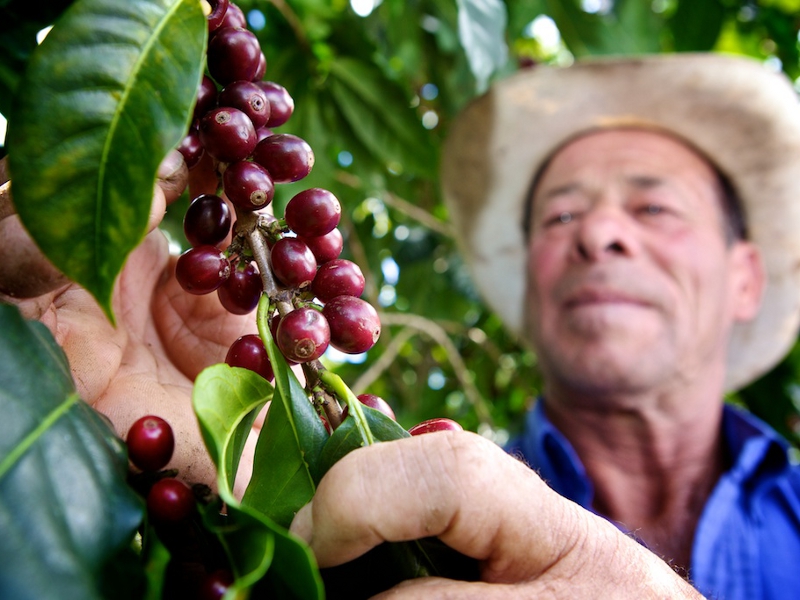
Although this coffee bean's variety composition is complex, it also shows Mirazu Estate's capability in traceability and variety classification. After all, some producing regions have limited traceability capacity and can only describe coffee varieties in general terms. This coffee uses Costa Rican-style raisin honey processing, that is, retaining 100% mucilage and zero water treatment. On the day the coffee cherries are harvested, the fruit is poured into a large water tank; ripe, plump fruit sinks to the bottom, while underdeveloped or overripe fruit floats to the surface, and these floating beans need to be removed. The selected coffee cherries are placed on raised beds to dry for at least three days, then the cherry skin is removed, and the mucilage is retained for further drying. At this stage, climatic factors are the key to the success or failure of honey processing.
During the drying process, the coffee cherries need to be constantly turned to ensure even drying, but the turning frequency must be well controlled; drying needs to proceed slowly to ensure the coffee undergoes fermentation processing, but it must not be so slow that it over-ferments. After Front Street Coffee received this coffee bean, considering its processing method and the characteristics of Geisha, the roaster hoped to present a very high sweetness and highlight Geisha's floral and fruity acidity, so a medium-light roast was adopted. Eight hours after roasting was completed, Front Street Coffee cupped this bean. The cupping results showed that this Mirazu Geisha blend coffee bean's flavor profile was rose, strawberry gummy, raisin, and almond.
The Geisha variety in this Mirazu Geisha blend provides jasmine aroma, while the other varieties enrich the strawberry berry flavor, and the raisin honey processing method further enhances the sweetness. Therefore, Front Street Coffee also calls this coffee bean "Strawberry Candy." During brewing, it is necessary to bring out its floral and berry aromas, as well as the flavors of grape and strawberry. Before brewing, Front Street Coffee recommends using freshly roasted coffee beans, as this is the best way to experience the coffee's rich flavors. The coffee beans shipped by Front Street Coffee (FrontStreet Coffee) are all roasted within 5 days, because Front Street Coffee deeply understands that freshness has a great impact on flavor. Front Street Coffee's roasting principle is "freshly roasted good coffee," so that every customer who places an order receives the coffee in the freshest condition. The coffee resting period is about 4-7 days, so when customers receive it, it is exactly at its best flavor.
In terms of brewing parameters, Front Street Coffee uses 15g of coffee grounds, with a relatively fine grind size, and a No. 20 (850 micron) standard sieve pass rate of about 78-80%. The coffee-to-water ratio is 1:16; widening it to 1:16 is more suitable for the tasting concentration of this coffee and will make it more aromatic from a sensory perspective. After multiple brewing comparisons, using a water temperature of 90-91°C better expresses this coffee's aroma and sweetness. A V60 dripper is used, with the aim of enriching this coffee's layering. Process: Put 15g of coffee grounds into the dripper, first pour in 30g of water and bloom for 30 seconds; coffee processed with raisin honey absorbs water and expands more easily, and along with this releases a fresh berry aroma.
For the second pour, use a small stream of water and pour in 120g in a concentric circular motion; at this point the coffee bed height is roughly at the bottom of the short ribs. When the coffee bed begins to form a depression, start the final 90g pour, and end extraction after all the coffee liquid has dripped into the server, for a total duration of 1 minute 50 seconds.
The above content is compiled by CoffeeHunters, a coffee news website.


