







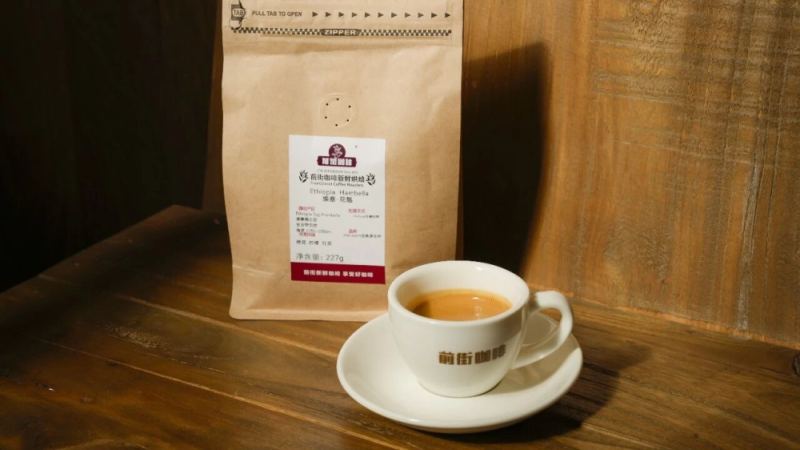
The Hualei coffee from the Sidamo region, with its rich floral and fruity aromas and honeyed sweetness, has become a star among Ethiopian natural-process beans. This article begins with Ethiopia's coffee grading standards, outlining the two systems of cupping scores and green bean defect rates, and explaining the differences between G1 and G3 grades as well as the impact of ECX reform on the grading of natural-process beans. It then focuses on Hambela in the Guji region, introducing Hualei's terroir, farm background, traditional natural processing method, and the origin of its name after winning TOH. Finally, it includes Front Street Hualei coffee's light-roast approach and V60 three-pour brewing parameters, helping readers fully understand the flavor source and extraction key points of this bean.
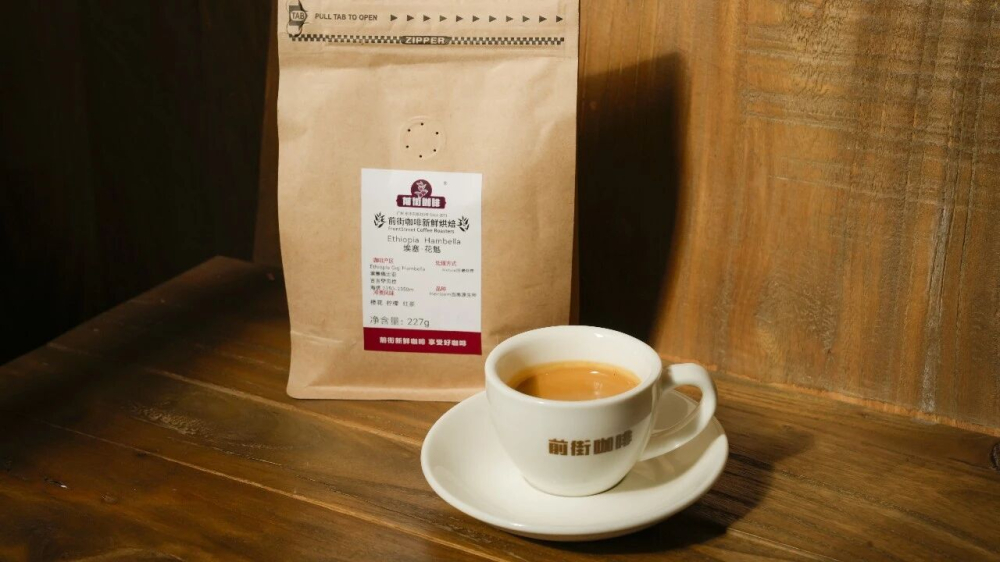
Front Street Ethiopia Hambela G1 Hualei Coffee Bean Flavor, Taste, and Aroma Description
Each coffee-producing country has its own grading system. When determining coffee bean grades, Ethiopia mainly relies on two indicators: cupping performance and green bean defect rate.
In terms of cupping, the evaluation dimensions include green bean cleanliness, regional characteristics, cup flavor, and the inherent traits of the beans themselves. According to SCAA standards, G1 and G2 scoring above 85 points are classified as Q1; G1, G2, and G3 scoring between 80 and 85 points are listed as Q2; and all G1, G2, and G3 below 80 points are uniformly placed in G3.
Green bean defect rate standard: To judge green bean quality, in addition to cupping taste, comprehensive grading must also combine the defects found in sampled green beans.
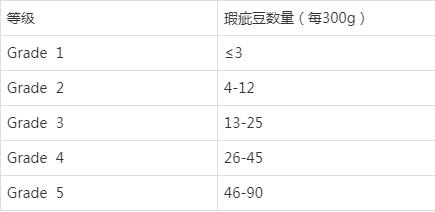
The defect rate sampling method for washed beans is: randomly sample 300 grams of green beans for inspection. If the number of defects is between 0 and 3, the batch is designated Grade 1; if the number of defects in 300 grams is 4 to 12, it is designated Grade 2. Based on the number of defects extracted, a total of 9 grades are divided. Specialty grades are G1 to G2, while the remaining G3 to G9 are classified as non-specialty, and grades after G6 circulate only in the domestic market. Before the establishment of ECX, natural-process beans could only be rated G3, G4, and G5, meaning the highest grade for natural-process beans stopped at G3. After ECX appeared, the grading rules were redefined. The evaluation method for washed beans remained the same, but G1 also appeared for natural-process beans. Therefore, Ethiopian natural-process beans on the market can be seen in G1 and G2 grades, while G3 gradually decreased.
Scoring composition of the natural processing method:
1. Physical characteristics account for 40%, of which defects account for 30% and odor accounts for 10%.
2. Cupping quality accounts for 60%, of which cleanliness accounts for 15%, acidity accounts for 15%, mouthfeel accounts for 15%, and flavor characteristics account for 15%.
Different coffee batches each have their own corresponding number. Hambella 7063 refers to the coffee batch. The grades of the natural processing method are divided into three levels: G1, G2, and G3. Among them, G1 coffee beans are the best, with the lowest defect rate. Natural Hualei coffee is exactly G1 level.
In fact, the difference between G1 and G2 lies only in the number of defects, and the flavor level is basically the same. Therefore, one cannot simply assume that G1 is the best grade or the best coffee bean. However, from the perspective of green bean defect rate, G1 is necessarily better than G2, because fewer defects mean higher bean quality.
All coffee can be classified into three types according to natural or washed processing methods:
A Speciality : Few defects, high cupping flavor quality;
B Commercial : Does not reach specialty grade, but is higher than the domestic consumption grade;
C Local /Domestic : Many defects (including immature beans), relatively poor flavor due to being out of season or improperly stored.
Among them, Speciality and Commercial are for export to the international market; Local is for sales in the domestic market.
Front Street New Season Hualei Coffee Beans
Hambela Region
Hualei coffee comes from the Hambela region within the Guji area of Sidamo. "Hambela" is located in Guji (GUJI), Ethiopia's largest coffee-producing region, and administratively belongs to Oromia State. To the west, Hambela faces Yirgacheffe Kochore across the mountains. Between the two producing regions lies a highland with an altitude of 3,200 meters and a width of about 30 kilometers. Its southeast, north, and east sides are adjacent to Guji's Shakiso, Uraga, and Kercha sub-regions respectively. It is Ethiopia's highest-altitude coffee sub-region (Harrar is Ethiopia's highest-altitude main producing region).
The Hambella farm covers an area of 200 hectares and employs 28 full-time workers year-round. During the peak harvest season, the total number of workers expands to more than 700. Of these workers, 70% are women. At the same time, there is a plan to have local farmers work closely with agronomists and processing experts to improve coffee quality. In addition, some beans are also purchased by the farm and then resold.
Front Street Hualei Coffee 's natural processing method:
Front Street Hualei coffee beans use the traditional natural processing method. To prevent coffee fruits from becoming moldy or absorbing unpleasant odors such as soil during drying, the coffee beans are placed on raised beds to sun-dry for 21 days. During the drying process, they are constantly turned to ensure even drying and allow the beans to lose moisture uniformly; every three to five days, the coffee farmers manually pick out defective and moldy beans. After the fruit skin dries and hardens, a hulling machine is used to remove the dry hard skin. After obtaining the green coffee beans, in pursuit of the ideal taste, the coffee farmers also carry out one final sorting.
The farm was co-founded by Aman Adinew and his brother Michael. Before that, Aman had served as Quality Control Director of ECX (Ethiopia Commodity Exchange) and was responsible for Ethiopia's first specialty coffee laboratory.
Front Street Hualei Coffee 's naming:
What is the origin of this Hualei coffee? In 2017, the African Coffee Association held the TOH (the Taste Of Harvest) competition. Ethiopia's DW Green Bean Company sent this coffee to compete, and this batch of natural green beans became famous overnight, defeating multiple Geisha variety coffees and taking the championship. Subsequently, a green bean trader in Beijing named "Hongshun International" introduced this batch of natural green beans and named it based on its championship status. Since then, the name "Hualei" was established.
Coffee is an agricultural crop, and its flavor is affected by climate and environment every year, but the main profile is still retained. To distinguish each year's Hualei coffee beans, Hongshun Company separately identifies coffee beans from the "Buku Abel" processing station in the Hambela region. Only coffee beans from the Hambela "Buku Abel" processing station are called Hualei coffee. Thus came Hualei 2.0 all the way to today's Front Street Hualei 11.
Front Street Brewing Parameters for Hualei Coffee:
In order to highlight the rich floral and fruity flavors of Front Street Hualei coffee, such as floral aroma, mango, jackfruit, citrus, and honey, Front Street uses a light roast. Light-roasted coffee beans are not as porous as dark-roasted ones, so when brewing, Front Street uses a V60 dripper with higher-temperature water for extraction. The V60 dripper body has guide ribs connecting the top and bottom as well as a large central hole, which can speed up the water flow rate; the spiral-shaped vent groove design extends the water flow path, increasing the contact time between coffee grounds and hot water. Each stream of water converges along the groove toward the center point of the dripper, concentrating the pressure on the coffee grounds and producing a coffee with richer layers.
Dripper: Hario V60, water temperature: 91°C, dose: 15g, coffee-to-water ratio: 1:15, grind size: 80% passing through a Chinese standard No. 20 sieve.
FrontStreet Coffee three-pour extraction method: First use 30g of water to fully wet the coffee bed into a "hamburger" shape and bloom for 30s; for the second pour, at 1'00" on the timer, pour water until it reaches 125g, then stop and wait until the water level drops to 2/3 of the coffee bed before pouring the third stage; for the third pour, at 1'40" on the timer, pour water until it reaches 225g, and after the coffee liquid has completely dripped through, the total extraction time is 1'59". The total brewing time is 2'00". After extraction is complete, gently swirl, and wait until the coffee liquid is fully uniform before tasting.
Flavor Description
Front Street Natural Sidamo Hualei Coffee Flavor : Light fermented wine aroma, floral aroma, citrus, mango. The taste is rich and much more complex, with honeyed sweetness, cocoa notes, and a hint of spice. The body is thick and the aftertaste is long-lasting.
For coffee brewing, Front Street always recommends using freshly roasted coffee beans to better showcase coffee flavor. Therefore, the coffee beans sold by Front Street are all products within 5 days of roasting. Front Street's roasting philosophy is "freshly roasted good coffee," so that every customer who places an order receives the freshest possible state when the coffee arrives. The coffee resting period is about 4 to 7 days, and by the time customers receive it, it is exactly at its best flavor stage.
The above content is compiled by CoffeeHunters, a coffee news website.


