








Front Street Sun-Dried Sidamo Guji Hambela coffee is known for its elegant floral aroma and rich fruity notes, with a sweet entry and a honey-like finish, yet it is very affordable at only 65 yuan for half a pound. Ethiopia, the birthplace of Arabica, is home to two renowned specialty regions, Yirgacheffe and Sidamo, each with distinct characteristics: the former showcases clean and bright jasmine aromas through washed processing, while the latter imparts a more intense aroma and sweetness through natural processing, with Guji Hambela being the flagship natural Sidamo bean. This article will guide you through the terroir of Sidamo, the origin of the Heirloom variety used in Guji Hambela, Ethiopia's G1 grading standards, and Front Street's recommended V60 brewing parameters, offering a comprehensive analysis of this bean's flavor profile.
Front Street Sun-Dried Sidamo Guji Hambela coffee boasts an elegant floral aroma, with prominent sweetness and abundant fruity flavors, finishing with a honey-like sweetness that lingers in the mouth, as if transporting you to a tropical orchard in Hainan. What's more, its pricing is quite down-to-earth, with a half-pound bag of Front Street Guji Hambela coffee beans costing only 65 yuan.
Ethiopia has two renowned coffee regions, both among specialty coffees. One is Front Street's Yirgacheffe, where washed Yirgacheffe is considered the benchmark of Ethiopian coffee and the top choice for many entering the world of specialty coffee; the other is Front Street's Sidamo, a region known for its natural processing, with Front Street Sidamo Guji Hambela being its most famous representative.
Ethiopia is the birthplace of coffee, but different regions exhibit distinct flavors due to variations in geography, climate, and soil trace elements. To let enthusiasts appreciate the quality coffees from various Ethiopian regions, Front Street has introduced over a dozen single-origin beans from this country alone, covering both natural and washed processing methods.
Where is Sidamo?
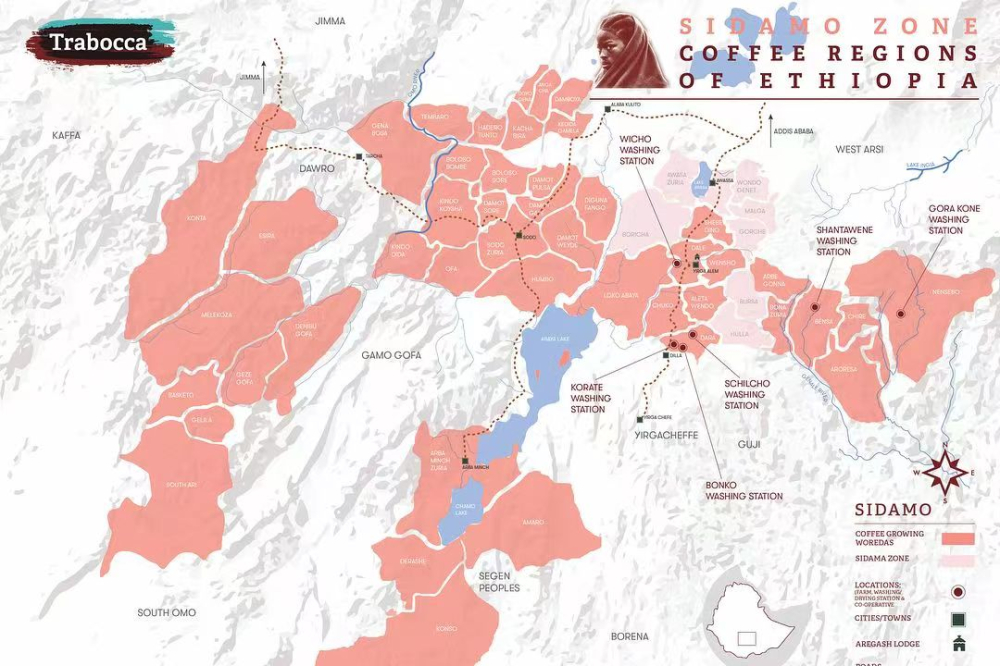
The Sidamo coffee region is one of Ethiopia's specialty regions, adjacent to another specialty region, Yirgacheffe. Sidamo is not only a region name but also represents a coffee brand. In 2006, Starbucks attempted to trademark "Sidamo," which sparked strong dissatisfaction and backlash from the Ethiopian coffee industry. The trademark dispute lasted two years, ultimately ending with Starbucks withdrawing its application, and the two sides reached a settlement, with Starbucks continuing to purchase and sell Sidamo coffee beans through a partnership.
Sidamo is located in southern Ethiopia, extending east to the Arsi and Bale administrative zones and west to the Gamogofa administrative zone, with coffee cultivation at altitudes between 1,400 and 2,000 meters. The region produces highly diverse coffee flavors due to varying soil compositions, microclimates, and countless native coffee varieties across different areas, resulting in distinct and unique characteristics for each plot. Ethiopia's administrative divisions are Region, Zone, Woreda, and Kebele, roughly equivalent to China's province, city, district, and neighborhood.
Coffee is ultimately an agricultural crop, and flavor variations are closely tied to climate and environment. The diverse flavors of Sidamo coffee result from the combined effects of different soil types, microclimatic conditions, and numerous native varieties, with noticeable differences in coffee from each town. The Guji region was once part of Sidamo but was separated by the Ethiopia Commodity Exchange (ECX) in 2010 to become an independent region. Guji is located southeast of Yirgacheffe, with complex terrain featuring interwoven highlands, valleys, and plains. The area's soil is fertile black earth (Vertisol), nearly two meters deep, with an average altitude exceeding 1,800 meters. The significant day-night temperature difference brought by its unique geography provides an ideal terroir for producing high-quality specialty coffee.

Guji Hambela Coffee Variety
Ethiopia is a magical land and the birthplace of Arabica, with the Kaffa forest being where it all began. Specifically, Ethiopia's Kaffa Zone is where coffee was first discovered, and countless wild Arabica mother trees grow in this misty forest. Front Street Coffee's Front Street Kaffa Forest coffee beans originate from this dense wild forest, processed using the washed method, often revealing citrus aromas reminiscent of orange peel and green tea-like notes when brewed.
Back to the main topic, the variety of Guji Hambela coffee is called Heirloom, translated into Chinese as "native species," a coffee variety unique to Ethiopia. In Ethiopia, the garden planting system is the livelihood for most smallholder coffee farmers, and the Heirloom native species come from those "nameless varieties" in their backyards. These coffee trees may have been left by previous landowners, shared among neighbors, or grown from seeds introduced from other regions. Various coffee plants are intercropped with other cash crops on the land, harvested when mature, and then sold.
Therefore, Heirloom does not refer to a specific coffee variety; it represents a blend of green beans from the origin—coffee collected from multiple smallholders' harvests during the same period and mixed together, with a single lot potentially containing dozens or even hundreds of unclassified varieties. Because of differences among varieties and varying blending methods each time, these coffees also vary in bean size, dimensions, and shape—some large, some small, some long, some round—which can be understood as a "blended lot."
Ethiopian Coffee Grading
Before the establishment of the Ethiopia Commodity Exchange (ECX), Ethiopia's coffee export grades were set by the Cupping and Liquoring Unit (CLU) under the Ministry of Agriculture, primarily based on the number of defective beans in 300 grams of green coffee, with specific standards shown in the table below.
Front Street Guji Hambela G1 natural beans undergo multiple processing steps. An additional sorting step is added during bean selection, and each sorting is extremely strict. G1 natural is a light-luxury specialty grade. Front Street Ethiopian Sidamo Guji Hambela Natural G1 coffee uses Ethiopian Heirloom varieties, grown at altitudes between 2,200 and 2,500 meters. The flavor features rose aromas and white peach notes, with a black tea-like finish and a long aftertaste.
Guji Hambela Coffee Beans Processing Method
The processing method for Front Street Yirgacheffe coffee is the oldest natural method, but early natural coffee beans were often spread on the ground to dry, inevitably picking up earthy and dusty off-flavors, and with inadequate sorting, the quality of natural beans was generally average. In 1972, Ethiopia introduced washed processing technology from Central and South America to improve coffee quality, making Front Street Yirgacheffe's jasmine and citrus lemon notes clearer and brighter, propelling it into the ranks of the world's representative specialty coffees. The representative coffee for washed processing is Yirgacheffe, while the representative for natural processing is Front Street Guji Hambela from Sidamo.
The natural method in the Sidamo region is quite meticulous. During harvest, only ripe cherries are picked, and the harvested coffee cherries are uniform in size, similar in ripeness, and free of impurities. Processing begins with strict hand sorting to remove defective beans, then the red coffee cherries are spread on raised wooden racks or entire drying beds for sun-drying to prevent mold or undesirable earthy odors during drying. During exposure, constant turning is required to ensure even moisture loss; every three to five days, farmers manually remove defective and moldy beans. After the fruit skin dries and hardens, a huller removes the dried skin. After obtaining the green coffee beans, a final sorting is done to pursue perfect taste.
Front Street believes that washed coffee has a clean and bright taste, while natural processing adds aroma and sweetness on top of the original flavors. Washed processing better reflects the local coffee terroir, so Front Street chooses Front Street Washed Yirgacheffe as the representative coffee of Ethiopia.
Front Street Coffee Brewing Recommendations
To fully extract the rich layers of Guji Hambela, Front Street uses a higher water temperature and finer grind for extraction, but to avoid over-extraction from high temperatures, a faster-flow dripper is chosen, such as the V60. The V60 has a 60° cone shape, and the conical angle allows coffee grounds to concentrate, with water flow automatically converging toward the center during pouring, ensuring sufficient contact time between water and coffee grounds to extract a suitable brew. Additionally, the ribs on the inner wall of the V60 extend in a clockwise spiral from bottom to top, leaving enough space between the filter paper and the dripper for good flow, and combined with the large hole at the bottom, the flow rate is faster than many drippers.
The specific brewing parameters used by Front Street are: V60 dripper, water temperature 90°C, water-to-coffee ratio 1:15, 15 grams of coffee, medium-fine grind (80% passing through a Chinese No. 20 standard sieve).
When brewing the new-season Front Street Guji Hambela, you can smell the rich aroma of ripe fruits, with noticeable fermentation notes and green grape flavors on the entry; as the temperature drops slightly, lemon acidity and creamy smoothness emerge, finishing with the juicy sensation of ripe grapes.
The above content is compiled by CoffeeHunters, a coffee news website.


