








Sidamo is one of Ethiopia's important specialty coffee regions, and its coffee is known for milder fruit acidity, elegant floral aromas, and a smooth mouthfeel, with chocolate notes often appearing alongside the fruitiness. This article will comprehensively analyze the unique charm of Sidamo coffee from the perspectives of regional background, trademark disputes, geographical environment, natural processing techniques, and grading standards, and recommend high-quality beans such as Front Street Coffee Hualei, Front Street Coffee Hamasho, and Front Street Coffee Alo, helping coffee lovers gain a deeper understanding of the flavor code of this region.

Soft acidity and chocolate notes emerging through the fruity aroma—this is Front Street Coffee's summary of Ethiopian Sidamo coffee, which also displays delicate floral notes and a smooth mouthfeel, thus winning the favor of many coffee fans. If you want to experience authentic Sidamo flavor, Front Street Coffee Hualei, Front Street Coffee Hamasho, and Front Street Coffee Alo are all choices worth trying, and each one delivers distinct floral and fruity sweetness.
Sidamo is one of Ethiopia's specialty coffee regions and is adjacent to another well-known specialty region, Yirgacheffe. It is not just a place name, but also carries the identity of a coffee brand. In 2006, Starbucks attempted to register "Sidamo" as a trademark, a move that triggered strong protests and pushback from Ethiopia's coffee industry. This trademark battle lasted for two years and ultimately ended with Starbucks withdrawing its application, with the two sides reaching a settlement, and Starbucks continuing to purchase and sell Sidamo coffee beans through cooperation.
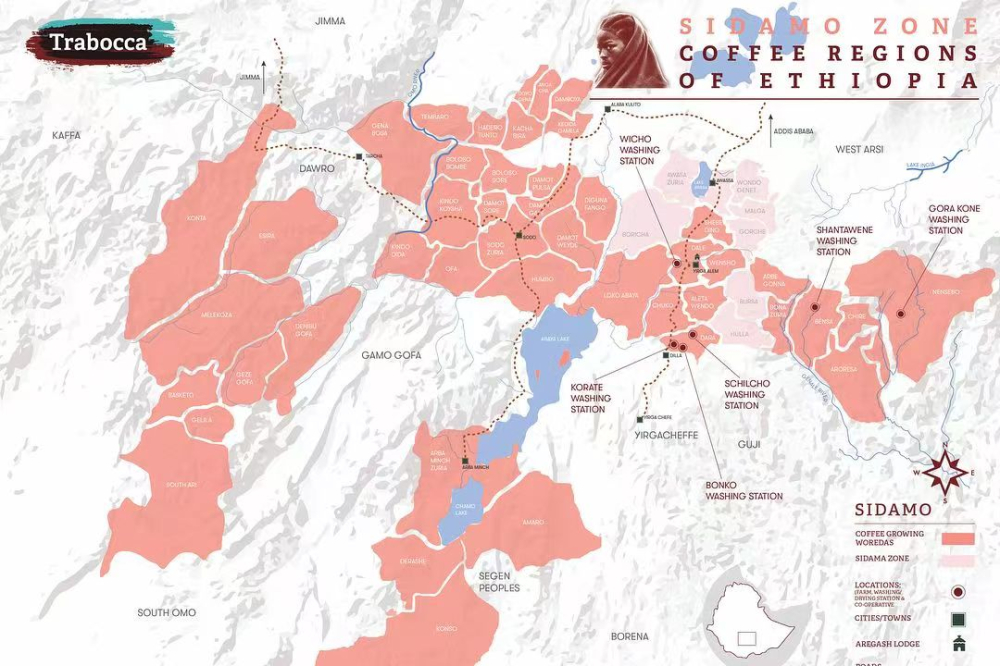
Sidamo is located in southern Ethiopia, bordering the Arsi and Bale administrative regions to the east, and extending to the Gamogofa administrative region to the west, with coffee cultivation at altitudes between 1,400 and 2,000 meters. The coffee produced in this region has extremely diverse flavors because different areas have different soil compositions, microclimatic conditions, and countless native coffee varieties, making the coffee from each subregion show distinct differences and individuality. According to Ethiopia's administrative system, it can be divided into four levels: Region, Zone, Woreda, and Kebele, roughly corresponding to China's province, city, district, and street.
The natural processing in the Sidamo region is extremely meticulous. During the harvest season, only ripe cherries are picked, ensuring the cherries are uniform in size, similar in ripeness, and free of impurities. At the very beginning of processing, strict hand sorting is carried out to remove defective beans, after which the coffee cherries are spread flat on raised wooden racks or entire drying beds for sun drying, to prevent the cherries from molding during drying or absorbing odors such as soil.
During the drying process, the cherries must be constantly turned to ensure even moisture loss; every three to five days, coffee farmers manually pick out moldy or defective beans. Once the fruit skin becomes dry and hard, the dried fruit skin is removed with a hulling machine. After obtaining green beans, a final sorting is carried out in pursuit of the ideal flavor. Front Street Coffee Alo, Front Street Coffee Hualei, and Front Street Coffee Hamasho all use natural processing, and because the beans are dried together with the fruit pulp, they carry richer tropical fruit aromas, such as strawberry, guava, and passion fruit.
Before the establishment of the Ethiopia Commodity Exchange (ECX), coffee export grading in the country was handled by the CLU department (Cupping and Liquoring Unit) under the Ministry of Agriculture, mainly grading based on the number of defective beans in 300 grams of green coffee, with the specific standards shown in the table below.
The production of Front Street Coffee Hualei G1 natural beans goes through intricate procedures. An additional screening step is added during the bean selection stage, and the screening standard for each round is the highest level. G1 natural belongs to the light-luxury specialty grade. Front Street Coffee Ethiopian Sidamo Hualei Natural G1 coffee uses Ethiopian heirloom varieties, grown at altitudes between 2,200 and 2,500 meters. In terms of flavor, it presents rose floral notes and peach aromas, accompanied by a black tea finish and a long aftertaste.
The above content is compiled by CoffeeHunters, a coffee news website.


