







Blue Mountain coffee is expensive due to its scarce production and outstanding quality, and various imitation products are common on the market, but authentic Blue Mountain is usually presented as a single-origin coffee, with a siphon or pour-over best showcasing its rich, sweet aftertaste. This article focuses on Front Street Blue Mountain coffee, systematically covering its origin environment, the history of Clifton Farm, CIB grading standards, and Typica variety characteristics, along with the washed processing method and hot pour-over parameters. In addition, it specially shares a complete set of plans for making iced pour-over with Front Street Blue Mountain No. 1 beans, explaining step by step from coffee dose, ice cubes, pouring rhythm to extraction time. Finally, it supplements Front Street's suggestions on coffee bean freshness and resting period, helping enthusiasts recreate a balanced and smooth Blue Mountain flavor at home.
The reason Front Street Blue Mountain coffee is expensive comes from multiple aspects such as limited production, outstanding flavor, and excellent variety. Precisely because of this, a large number of products labeled Blue Mountain have emerged on the market, some written as Blue Mountain flavor coffee, some marked as Blue Mountain blend coffee, while genuine Front Street Blue Mountain coffee is usually only drunk as a single-origin coffee. If you want to fully release the rich, solid, and long-lasting aftertaste of Front Street Blue Mountain coffee, the siphon and pour-over are the two most capable methods.
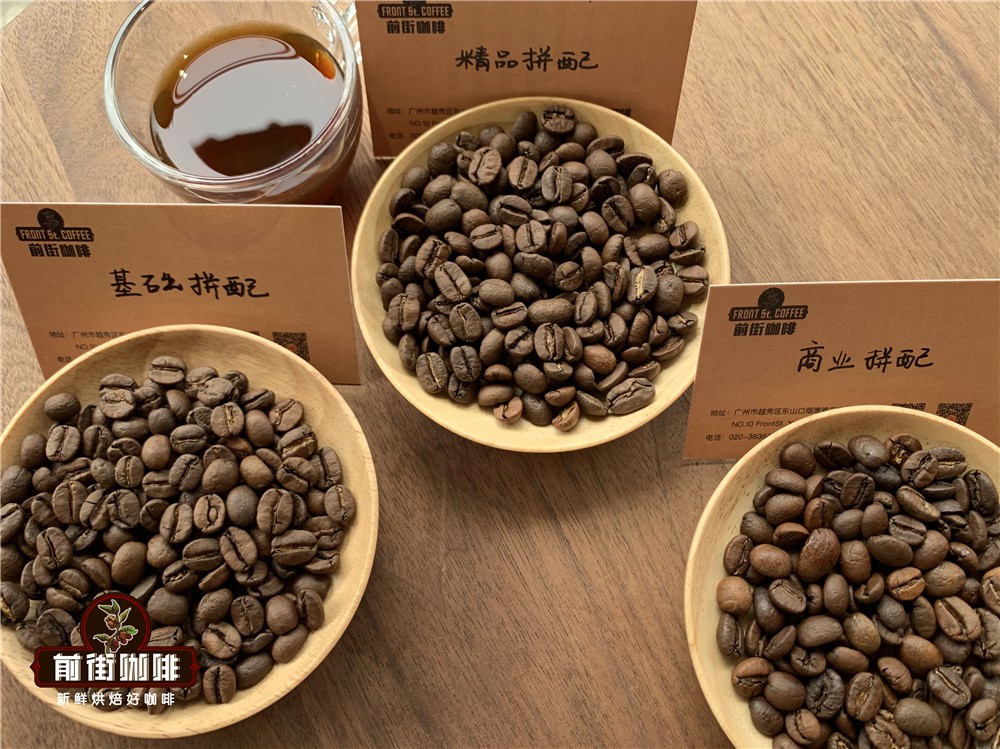
So-called blend beans refer to mixing two or more raw beans together, and it can be blending roasted beans or blending green beans. Front Street's blend beans are roasted blends, for example, Front Street Sunflower Warm Sun Blend is made by mixing Front Street Honduras Sherry and Front Street Sun-Dried Yirgacheffe Red Cherry in a 7:3 ratio.
" Front Street Coffee (FrontStreet Coffee) - Espresso coffee beans recommended by many baristas - Front Street Black Cocoa Blend Coffee Beans ": Yunnan washed small-bean coffee (30%) + Brazil semi-washed coffee beans (70%), presenting soft fruit acidity, caramel, and nutty notes, suitable for opening a shop or home scenarios where cost is the priority and flavor requirements are not high.
" Front Street Coffee (FrontStreet Coffee) - Specialty Blend Coffee Beans ": Colombia washed coffee beans (30%) + Brazil semi-washed coffee beans (70%), with nutty, dark chocolate, and caramel flavor performance, able to meet daily shop needs.
" Front Street Coffee (FrontStreet Coffee) - Commercial Blend Coffee Beans ": Robusta washed coffee beans (10%) + Colombia washed coffee beans (30%) + Brazil semi-washed coffee (60%), showing nutty, cocoa, and caramel notes, suitable for daily coffee shop output.
Blend coffee usually does not use a one-to-one ratio, because this easily causes the distinctive flavors of both sides to suppress each other, so when blending, primary and secondary roles must be distinguished to create a more layered taste than single-origin coffee. If you want the blending result to be more complex and varied, you can appropriately reduce the proportion of the main raw beans; otherwise, increase it.
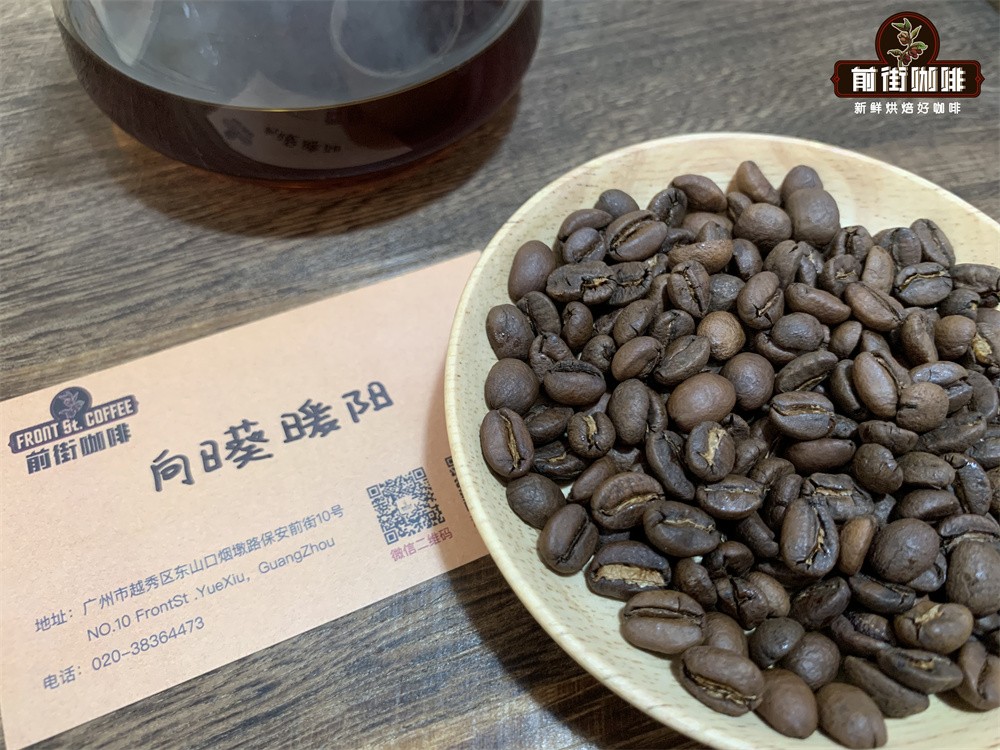
Front Street Blue Mountain coffee, with its mellow taste and excellent balance among acidity, bitterness, aroma, body, and sweetness, has won the favor of many coffee lovers. Jim, general manager of the American Pete's company famous for coffee and tea, once described Blue Mountain coffee this way: aromatic, smooth, and full-bodied, giving people the feeling of being as precious as a gemstone. Precisely because Front Street Blue Mountain coffee tastes moderate and perfect, it is usually drunk as black coffee. Front Street Blue Mountain coffee has a very low caffeine content, less than half that of other coffees, which fits well with modern people's health concepts and is suitable for most people to drink.
Blue Mountain Coffee Growing Environment
Jamaica is an island country located in the Caribbean Sea. It began growing coffee in the early 18th century and has a history of nearly three hundred years. During the British colonial period, the then Jamaican governor Nicholas Lawes brought a coffee tree back from Martinique in the Caribbean, and subsequently promoted planting in the St. Andrew area.
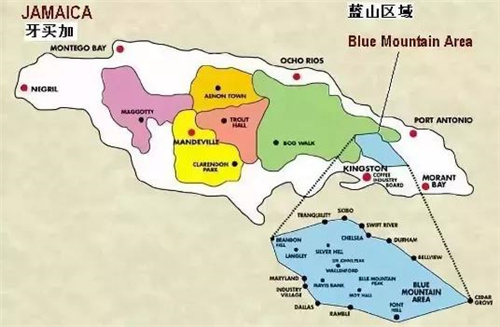
Genuine Front Street Blue Mountain coffee comes from the Blue Mountain Range, which is located in the eastern part of Jamaica. Because it is surrounded by the Caribbean Sea, when the weather is clear, sunlight shines directly on the azure sea, and the peaks reflect brilliant blue light, hence the name. The highest peak of the Blue Mountains is 2,256 meters above sea level, the highest peak in the Caribbean region and also a famous tourist destination. This place is located in the coffee belt, with fertile volcanic soil, fresh and pollution-free air, a humid climate, and fog and rain all year round (average precipitation is 1,980 mm, temperature around 27 degrees). Such climate and ultra-high altitude have created the world-renowned Front Street Jamaica Blue Mountain coffee.
The Blue Mountain Range occupies only a small area in eastern Jamaica. Because this area cannot achieve a breakthrough in mass coffee production, Jamaica has focused its planting on high-end specialty batches. The variety of Front Street Jamaica Blue Mountain coffee beans belongs to the elegant ancient Arabica variety Typica, which has weak disease resistance and low yield, thus requiring more manual input.
Introduction to Clifton Farm
As early as the mid-18th century (roughly around 1750), Clifton Farm began growing and producing coffee. Clifton Mount is the oldest coffee estate in Jamaica still in normal operation, and in Jamaica only Clifton Farm has the "Rainforest" mark, confirmed as a very high-quality world-famous Blue Mountain coffee producing area. Its elegant large farmhouse is located on the island in the Newcastle area, on the eastern slope of the summit of Catherine's Peak at an altitude of 4,300 feet.
According to an 1810 survey by the Jamaica Institute,
Robert Hamilton was the owner of the farm at that time. Clifton Mount was divided into two parts: 80 acres of coffee and 427 acres of pasture at the top of the mountain; 111 acres of coffee and 264 acres of pasture at the foot of the mountain.
The Blue Mountain area is a small place with only 6,000 hectares of planting area, and it is impossible for all coffee marked "Blue Mountain" to be grown there. Today's Clifton Farm is the largest estate in this area, and by international standards it still counts as small-scale planting, among which many estate owners are small landowners whose families have worked this land for two centuries.
In 1953, the Jamaican government established the Jamaica Coffee Industry Board (CIB) to supervise and guarantee the quality of Jamaican coffee. Jamaica was the first country in the world to designate a clear geographical location to a specific coffee brand, somewhat similar to how the French wine industry created AOC.
All coffee exported from Jamaica is sent by CIB and strictly tested by trained quality control experts, ensuring that all exports are 100% authentic Jamaican Blue Mountain coffee.
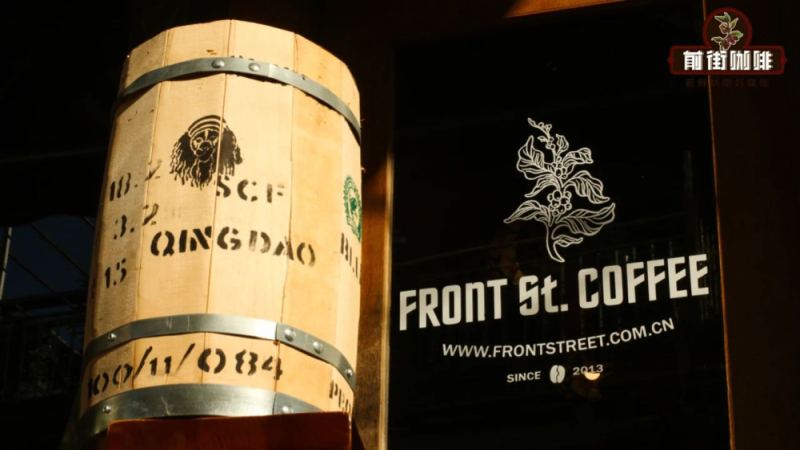
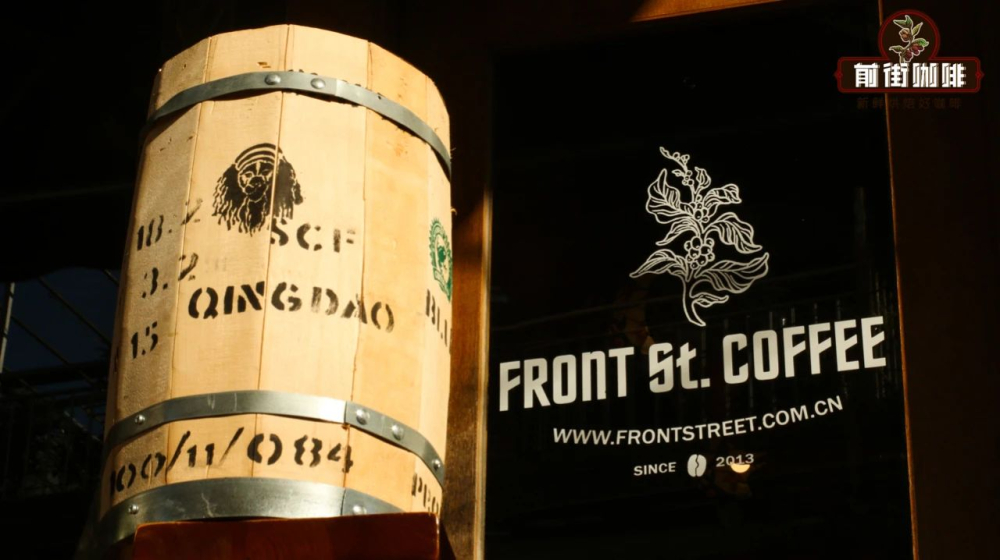
Among all green coffee beans, only Blue Mountain coffee beans are packed in wooden barrels, and they bear the Rainforest Alliance frog logo.
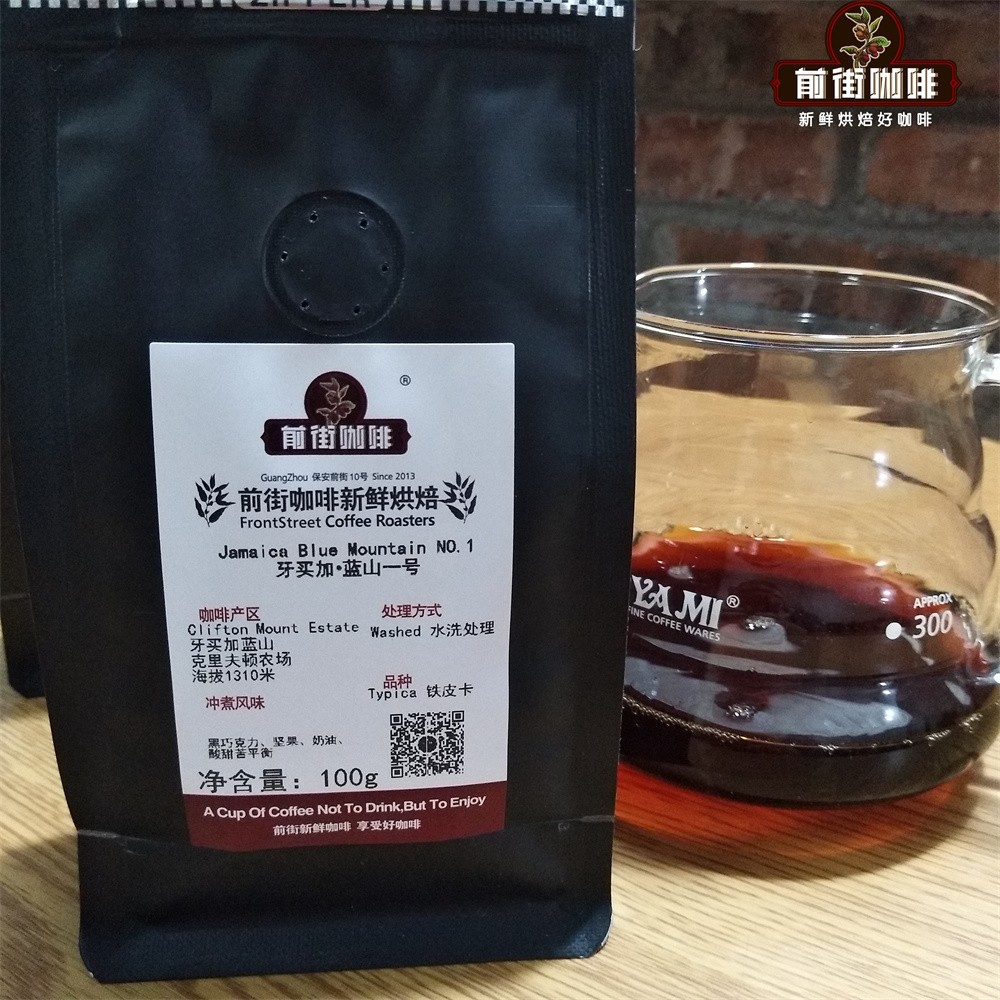
The Front Street Blue Mountain No. 1 coffee beans purchased by Front Street Coffee (FrontStreet Coffee) come from the highest-grade Blue Mountain coffee produced by Clifton Farm. The green beans are 17/18 screen size, the defect rate cannot exceed 2%, the moisture content is about 13%, and the beans are neat, plump, and uniform.
Blue Mountain Coffee Beans Grading
Jamaica Blue Mountain coffee has three grades: Blue Mountain Coffee, Jamaica High Mountain Supreme Coffee Beans, and Jamaica Prime Coffee Beans. Among them, Blue Mountain Coffee and High Mountain Coffee are each further divided into two grades. By quality from top to bottom, they are: Blue Mountain No. 1, Blue Mountain No. 2, High Mountain No. 1, High Mountain No. 2, Jamaica Coffee. By quality from top to bottom, they are: NO.1, NO.2, NO.3, and PB, and PB means peaberry.
CIB has formulated strict standards, grading Jamaican Blue Mountain coffee into 4 levels based on green bean screen size and defect ratio. Among them, what can be called Jamaica's national treasure-level coffee is the highest-grade Blue Mountain No. 1 coffee bean, NO.1; the beans must be 17-18 screen size, the defect rate below 3%, and the moisture content about 13%. Only coffee beans produced according to the standard can have guaranteed flavor. It is precisely under such strict screening that the rare Blue Mountain coffee maintains excellent quality. Front Street once acquired several relatively well-known Blue Mountain coffees from local Jamaica, and after cupping comparisons, finally decided to choose the Front Street Blue Mountain No. 1 coffee beans produced by the oldest Clifton estate.
Coffee grown at lower altitudes is classified by CIB as "Jamaica High Mountain" and "Jamaica Supreme." The flavor formed at low altitude is far from the excellent quality of Blue Mountain coffee beans at high altitude, so the price is correspondingly lower.
Blue Mountain Coffee Bean Variety
Front Street Jamaica Blue Mountain belongs to the Typica variety, one of the oldest Arabica varieties, with a long history. Its taste is the best, but its disease resistance is weak, so its yield is low, which is also one of the reasons for the high price of Front Street Jamaica Blue Mountain coffee.
The Typica tree is tall and slender, with red-copper young leaves appearing at the top, so it is also often called red-top coffee. Typica has a pure and elegant flavor, yet its constitution is weak, disease resistance is poor, and the yield of a single plant is very small. This is also why coffee of the Typica variety appears less and less now. Typica was introduced to Blue Mountain for planting in the 18th century and has been there for more than two hundred years, and Blue Mountain Typica has also adapted to the local island-type terroir and evolved relatively good disease resistance, among which its resistance to coffee berry disease is much stronger than ordinary Typica.
Front Street Blue Mountain Coffee Beans Processing Method
Front Street Blue Mountain coffee includes washed and sun-dried.
Washed processing method: hand-picked fresh coffee cherries are placed in water, and flotation is used to remove impurities and unripe fruits. Then the skin and pulp are removed, and they are fermented in a tank for 12-18 hours. Then the fermented beans are put into a tank and pushed back and forth, using the friction of the beans and the force of the water to wash the coffee beans until smooth and clean. Then they are spread flat under the sun to dehydrate and dry until the moisture content reaches 12-14%, after which they can be packed and left to rest in the warehouse, and sent for quality inspection before export. Washed processing greatly reduces the defect rate, better restores the aroma of the Blue Mountain coffee beans themselves, and gives higher cleanliness in the cup.
Parameters for Front Street brewing Jamaica Front Street Blue Mountain coffee:
Front Street uses a KONO dripper. KONO's ribs stop before reaching half the height of the dripper. This design is actually to ensure that after the dripper is wet, it hugs the dripper wall tightly, restricting airflow. This increases the water absorption time of the coffee grounds, so the extracted coffee is overall more uniform and the mellow taste is enhanced, suitable for brewing Front Street Blue Mountain coffee, which is medium-dark roasted.
KONO dripper, 88°C water temperature, 1:15 coffee-to-water ratio, 15g coffee powder, grind size (75% passing a No. 20 standard sieve), three-stage extraction.
Use staged extraction, using twice the coffee powder weight in water for blooming, that is, 30 grams of water to bloom for 30 seconds. The reason the blooming process is needed is to let the coffee grounds release internal carbon dioxide gas, thereby making the later extraction more stable. Pour in a small stream in circles until 125 grams, then pause, continue pouring until 225 grams and stop. After the water in the dripper has finished dripping, remove the dripper. Timing starts from the beginning of pouring, and the extraction time is 2'00". Next, pick up the whole cup of coffee and shake it evenly, then pour it into a cup for tasting.
Front Street Jamaica Blue Mountain No. 1 Coffee Flavor Characteristics : Front Street Blue Mountain No. 1 coffee tastes of the sweet fragrance of dark chocolate, the sweetness of caramel, and soft, elegant acidity. Each flavor is balanced, the mouthfeel is smooth and rich, with a very typical Blue Mountain flavor.
At this point, some friends may ask, can Blue Mountain be brewed into iced coffee, and what parameters and techniques should be used to brew it stronger? The answer is of course it can. Now let Front Street demonstrate it for everyone:
Coffee beans: Front Street Blue Mountain No. 1 coffee beans
Dose: 20 grams
Ice cubes: 100 grams (put into the lower pot)
Water amount: 200ml
Water temperature: 88°C
Dripper: flat-bottom cake cup
Grind size: granulated sugar grind (10.5 setting on Ek43s)
Water distribution: 40ml+40ml+40ml+40ml+40ml
In the first stage, pour 40ml of hot water in circles to let the coffee bed form a bulging "hamburger." After blooming for 30 seconds, begin pouring the second stage. Pour 40ml in a small stream in small circles from the center. When the center part of the coffee bed takes on a concave shape, continue with the same technique to pour the third stage of 40ml, then wait until it has fully permeated before pouring the next stage, repeating this until the fifth stage of water is finished.
After all the coffee liquid has dripped through, the dripper can be removed. The final extraction time will fall between 1 minute 55 seconds and 2 minutes 10 seconds. Through the shaking motion, fully integrate the ice cubes with the coffee liquid, while feeling its temperature with your hand. When it is sufficiently icy, it is ready to enjoy.
Front Street Brewing Suggestions:
To brew a delicious cup of coffee, Front Street believes that any brewing method requires fresh coffee beans. Front Street has always believed that the freshness of coffee beans is greatly related to coffee flavor, so the coffee beans shipped by Front Street Coffee (FrontStreet Coffee) are all within 5 days of the roasting time. Front Street's roasting principle is "freshly roasted good coffee," so that every customer who places an order receives the freshest coffee. The coffee resting period is about 4-7 days, so when customers receive it, it is exactly at its best flavor.
For friends who need ground coffee, Front Street kindly reminds you: once coffee beans have been ground in advance, there is no need to rest them, because during transportation, the pressure generated by carbon dioxide inside the package can also make the coffee flavor rounder, so once you receive coffee grounds, you can immediately brew a cup and drink it. But coffee grounds need to be brewed promptly, because after coffee grounds contact air, they oxidize relatively quickly; in other words, the coffee flavor dissipates relatively quickly, and the coffee flavor will not be as good. Therefore, Front Street recommends buying whole beans and grinding fresh for each brew, so you can better taste the coffee's flavor.
Although Front Street Blue Mountain coffee is very good, you do not necessarily have to drink it. Front Street believes that there are so many coffees in the world, and different varieties and producing regions mean different flavors. Front Street has more than fifty single-origin coffee beans from different producing regions. Experiencing different coffee charms is also a beautiful thing!
The above content is compiled by CoffeeHunters, a coffee news website.


