







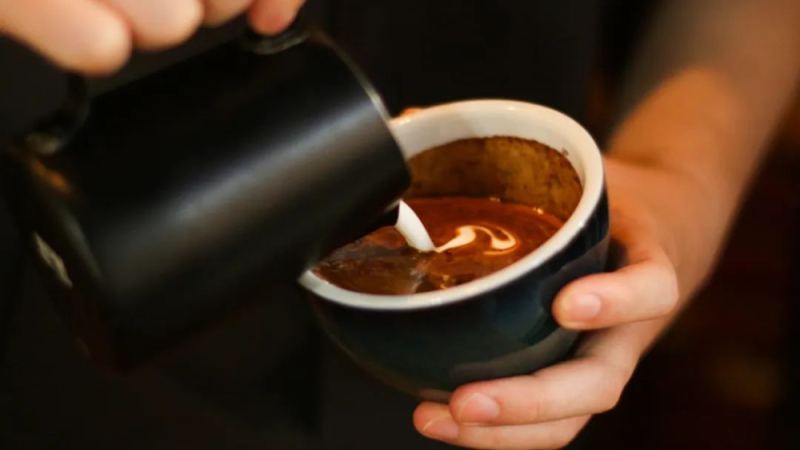
Mocha coffee was once a classic drink on Italian menus, standing alongside lattes and cappuccinos, but it is now gradually disappearing from specialty coffee shops. This article traces the origin of the name mocha—from the port of Mocha in Yemen as a hub of the coffee trade, to the Italian mocha created by Italians in the 18th century to imitate the chocolate notes of Mocha beans, and then to how it became a dessert-like drink in the second wave of coffee that masked the bitterness of dark roasts. The article also analyzes how the third wave specialty coffee movement and the healthy-eating trend have caused traditional mocha to decline, yet people's love for chocolate-flavored coffee has not faded. Finally, it includes an iced mocha recipe shared by Front Street Coffee for enthusiasts to recreate at home.
For more specialty coffee knowledge, please follow: Front Street Coffee (Frontsteet Coffee)
"Boss, I'd like a mocha."
"Sorry, we don't have mocha~"
Once, mocha was a regular option on espresso menus alongside lattes and cappuccinos, and was the first choice for many customers after entering a shop. But now, many specialty coffee shops no longer treat mocha as a featured flavored coffee, and some even remove it directly from the menu, replacing it with more sought-after categories such as dirty and oat milk latte. Mocha seems to be fading out of coffee shops step by step.
When exactly did mocha coffee enter Italian menus?
The name "mocha" comes from the port of Mocha in Yemen. For several hundred years starting in the 15th century, all coffee beans had to be gathered at the port of Mocha before being shipped across the Red Sea to places around the world. The port of Mocha thus became a hub of the coffee trade.
Because the burlap sacks holding coffee beans were generally printed with the word "MOCHA" to indicate that the goods had been sent from the port of Mocha, Europeans collectively called coffee beans shipped through the port of Mocha "mocha coffee." This also explains why, in earlier times, the word Mocha almost became synonymous with coffee. Mocha coffee beans are known for being small in size and rich in aroma; after dark roasting, they have a prominent acidity and body, moderate sweetness in the finish, and a strong chocolate note.
What people today call espresso mocha coffee, however, dates back to 18th-century Italy. At that time, the Dutch had already introduced coffee to Southeast Asia, and the French had also brought coffee to South America, so the port of Mocha lost its monopoly on the coffee trade; in addition, with Ottoman rule in the middle and later periods, Mocha beans actually became a scarce commodity in Europe.
In order to reproduce that chocolate note in Mocha coffee beans, some people tried adding cocoa powder to coffee to blend it. Later, with the invention of the espresso machine and the global popularity of espresso-based flavored coffees, this chocolate-added milk coffee also naturally became an indispensable member of Italian menus.
Espresso mocha coffee took shape during the second wave of coffee
As espresso coffee sparked a popular trend, chain coffee shops emerged one after another and swept the globe. At that time, coffee quality varied greatly, while market demand for coffee was rising sharply, so this kind of coffee shop chose beans blended from multiple origins. Through heavy (dark) roasting, they brought out golden crema and roasting aromas, which could both lower costs and provide stable, consistent output. At that stage, bitterness and caffeine were most people's impression of coffee.
To mask the strong bitterness in coffee, sweet elements were naturally indispensable. Syrups, chocolate sauce, caramel sauce, cream, and other additives therefore became important materials in beverage development.
Traditional espresso mocha coffee uses espresso and hot milk as its base, with chocolate-containing flavoring ingredients added—which can be cocoa powder, chocolate syrup, dark chocolate, or milk chocolate. The surface is usually also topped with whipped cream, then drizzled with chocolate sauce, or sprinkled with cinnamon powder or marshmallows for decoration. The addition of chocolate and cream both enriches the drink's layers and neutralizes the coffee's bitterness, making it highly popular among consumers.
Now, why is mocha becoming less and less common?
Let us drag the progress bar to the third wave of coffee. The rise of the specialty coffee concept emphasizes the flavor characteristics of origin and single-origin coffee, while also paying more attention to the different experiences brought by cultivation and processing methods. Comprehensive improvements at every stage have allowed coffee bean quality to improve. In order to showcase the uniqueness of the coffee itself, beans are no longer mainly dark-roasted, and brewing methods have also become more diverse, such as pour-over.
In addition, in recent years, the concept of healthy eating with less sugar and no sugar has continued to spread, and high-sugar, high-calorie diets have gradually been replaced. As a result, mocha coffee, whose flavor is obscured by additives and whose sugar content is relatively high, has naturally been "eliminated" by the market.

Although classic espresso mocha is indeed weakening, people's affection for rich chocolate flavor still exists. It is not hard to see that, in addition to espresso drinks whose beans themselves carry dark chocolate flavor, there are also more coffee specialty drinks made directly with chocolate.
In summer, you should drink iced mocha~
Considering that the ingredients are not easy to preserve, mocha coffee has currently been removed from Front Street's permanent menu. Whenever they want a sweet milk coffee, Front Street will make an iced mocha for itself. The materials needed to make an iced mocha are not complicated: double espresso + chocolate sauce + 200 grams fresh milk + ice cubes.
First prepare a transparent glass, coat the walls of the glass with chocolate sauce, add ice cubes and half of the milk, then mix 10 grams of chocolate sauce into the extracted espresso and pour it in as well. Next, use a French press to froth the other half of the iced milk, scrape off the large bubbles on the surface, and pour it in until the glass is almost full. Finally, use chocolate sauce to draw a pattern, and a cup of rich, fragrant, sweet iced mocha is complete.
The above content is compiled by CoffeeHunters, a coffee news website.


