







Yunnan is an important coffee-producing region that cannot be overlooked on China's coffee map, with the three major producing areas of Pu'er, Baoshan, and Lincang each having their own distinctive characteristics. The excellent quality of coffee depends on a suitable growing environment—low latitude, high altitude, abundant rainfall, and moderate sunlight. These conditions together determine the flavor profile of coffee beans. Pu'er's high-altitude beans carry plum-like acidity and a fermented tea sweet aftertaste; Baoshan, with its unique three-dimensional climate, cultivates a nutty caramel-like sweetness; Lincang, with its significant temperature difference between day and night and long sunshine hours, injects a clean and elegant character into coffee. Front Street Coffee has established its own Typica estate in Lincang, exploring more possibilities for Yunnan coffee from the root of the variety. This article will analyze the terroir characteristics and cupping performance of the three major producing areas one by one, and share Front Street's recommended brewing method.
The flavor performance of coffee is closely related to the natural environment, climatic conditions, and field management methods of the growing area. Ideally, coffee trees prefer regions with low latitude, high altitude, abundant rainfall, and moderate sunlight, which is why the area between the Tropic of Cancer and the Tropic of Capricorn (from 28 degrees north latitude to 38 degrees south latitude) is recognized as the coffee golden growing belt.
In China, parts of Yunnan, Guangxi, Guangdong, Taiwan, and Hainan all have conditions suitable for coffee cultivation, but only Yunnan and Taiwan truly meet the high-altitude requirements. Yunnan specialty coffee is usually grown in dry-hot river valley areas at altitudes of 1,200 to 1,600 meters. The temperature difference between day and night brought by high altitude can slow down the ripening pace of coffee cherries, allowing flavor compounds to accumulate more fully.
FrontStreet Coffee has found through cupping comparisons that Yunnan coffee beans from high-altitude producing areas often present soft acidity, nutty and caramel-like aromas, with a mellow and full-bodied mouthfeel.
Currently, the cultivation areas for Yunnan arabica coffee cover multiple prefectures and cities including Pu'er, Lincang, Baoshan, Dehong, Nujiang, Xishuangbanna, Dali, and Diqing. Among them, the arabica coffee beans produced in Baoshan, Pu'er, and Lincang are the most well-known.
"Pu'er City"
Coffee cultivation in Pu'er City is distributed across 9 counties and districts including Simao, Ning'er, Mojiang, Jinggu, Jingdong, Zhenyuan, Jiangcheng, Lancang, Menglian, and Ximeng. The local average annual temperature ranges from 17 to 20 degrees Celsius, and the planting altitude extends from 700 meters to 1,600 meters. FrontStreet Coffee's cupping results show that arabica coffee beans from Pu'er's high-altitude producing areas carry fruit acidity such as plum, along with the sweet aroma of nuts and caramel, and a distinct fermented tea sweet aftertaste can also be detected in the finish.
Geographically, Pu'er is located in the southwestern part of Yunnan Province, bordering Vietnam and Laos to the southeast and adjacent to Myanmar to the southwest. It is the starting point of the historical "Tea Horse Road." Not only is it known as the "World's Tea Source," but with the continuous development of the coffee industry, it has also gained the reputation of "China's Coffee Capital" in recent years.
"Baoshan City"
Coffee cultivation in Baoshan City is concentrated in five counties and districts: Longyang, Longling, Shidian, Changning, and Tengchong. The coffee beans produced in these areas have obtained the Baoshan arabica coffee geographical indication product certification. Baoshan has a low-latitude mountain subtropical monsoon climate. The low-latitude plateau and complex terrain together create a three-dimensional climate pattern of "one mountain, four seasons; ten miles, different weather."
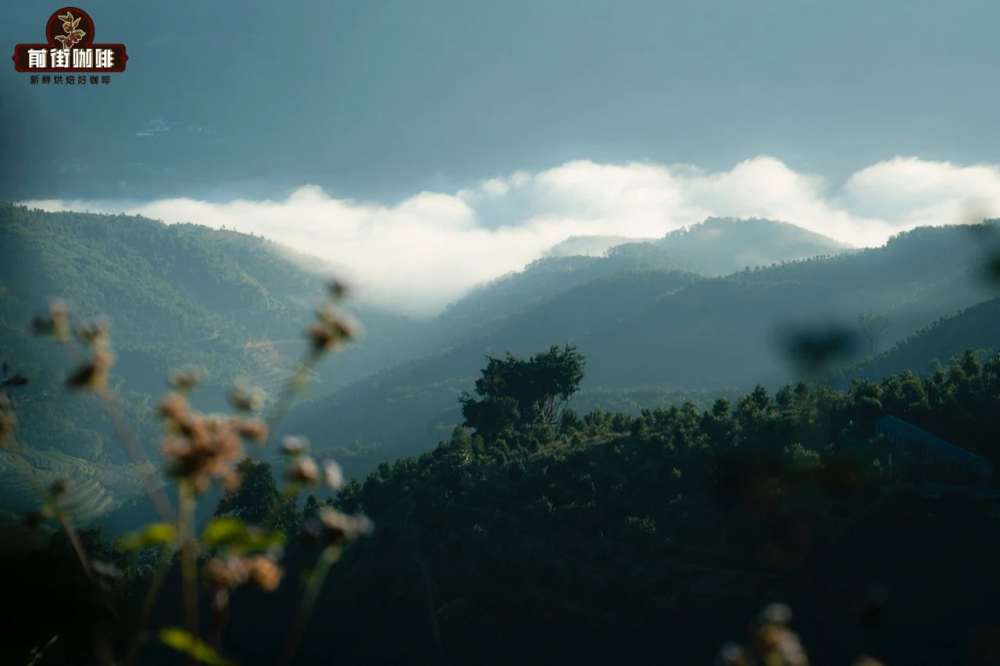
The local annual temperature difference is small while the daily temperature difference is large, with an average annual temperature between 14 and 17 degrees Celsius; rainfall is abundant but the dry and wet seasons are distinct, with uneven distribution, and annual precipitation of about 700 to 2,100 millimeters. Coffee plantations are mostly distributed within the range of 1,000 to 1,500 meters above sea level.
【Lincang City】
Lincang's geographical location is quite special, with its western part connected to Myanmar. The climatic conditions here are very ideal, with significant temperature differences between day and night, abundant rainfall, and a mild average annual temperature. Coffee cultivation altitude is concentrated at 1,000 to 1,600 meters.
Lincang has a subtropical low-latitude plateau mountain monsoon climate, with complex and diverse terrain and topography, covering multiple climate types. The region is mainly affected by the warm and humid airflow from the Indian Ocean and the southwest monsoon. The boundaries between the four seasons are not distinct, but the dry season and rainy season are clearly differentiated. There is relatively more precipitation and abundant sunshine, with an average annual sunshine duration of over 2,000 hours. The frost period is short, and some areas even have no frost throughout the year; the three-dimensional climate characteristics are prominent, with an average annual temperature in mountainous areas of about 13 to 15 degrees Celsius.
FrontStreet Coffee recognized Lincang's planting potential and established its own coffee estate on a mountain at an altitude of 1,300 meters in this producing area, planting the oldest arabica variety—Typica.
The reason for choosing Typica is that, as one of the oldest coffee varieties, it retains pure arabica genes, has an elegant and clean flavor, and has long been regarded by the industry as a representative variety of specialty coffee.
Front Street hopes to start from the source of the variety and give everyone the opportunity to taste Yunnan arabica coffee beans with better flavor and superior quality. Currently, these Yunnan Typica coffee beans grown on our own estate are already available for sale at the Front Street flagship store and FrontStreet Coffee physical stores.
The Yunnan coffees currently sold by Front Street mainly come from two producing areas, Lincang and Baoshan, specifically including: "Front Street 2013 Sun-Dried Typica Coffee Beans" grown on our own estate, a "Selected Producing Area Daily Beans - Yunnan Baoshan Washed Catimor Coffee Beans," and a "Full Red Cherry Sun-Dried - Catimor Coffee Beans from Baoshan Lujiangba Producing Area."
All three coffee beans can reflect the typical flavor of Yunnan coffee—nutty, caramel, and plum-like notes. If you want to fully appreciate the best flavor of Yunnan coffee beans, Front Street recommends choosing freshly roasted beans for brewing, as this allows you to experience the coffee's rich layers to the greatest extent. Coffee beans shipped by FrontStreet Coffee are all dispatched within 5 days after roasting~
When brewing Yunnan coffee, it is recommended to use a V60 dripper, with a coffee-to-water ratio of 1:15, medium grind (about the size of coarse granulated sugar / 75% passing rate through a Chinese No. 20 standard sieve), and a water temperature controlled at 88 to 89 degrees Celsius.
Using a three-stage pouring technique can enhance the coffee's layering: in the first stage, pour 30 grams of water and let it bloom for 30 seconds; in the second stage, pour in a small stream in a circular motion up to 125 grams, and after the water level in the coffee bed drops by half, continue pouring, still in a small stream in a circular motion, up to 225 grams. After all dripping is complete, the total extraction time is about 2 minutes and 10 seconds.
The above content is compiled by CoffeeHunters, a coffee news website.


