







Coffee blending is not simply mixing a few beans together, but is built on a full understanding of the flavor differences among various origins. This article starts from the actual blending formulas of Front Street Coffee, and sorts out the differences between single-origin beans and blended beans, the respective applicable scenarios of pre-roast blending and post-roast blending, and the core purpose of blended coffee in pursuing flavor consistency and taste balance. The article breaks down in detail three espresso blend formulas—Specialty Blend, Commercial Blend, and Dark Cocoa Blend—using Colombia, Brazil, Robusta, and Yunnan AA as ingredients, analyzing their proportion settings, processing methods, and final taste performance, to help coffee lovers understand the blending ideas behind the formulas.
For more specialty coffee knowledge, please follow the WeChat public account: Front Street Coffee (FrontStreet Coffee) Today Front Street Coffee (FrontStreet Coffee) would like to talk with everyone about the two major categories of coffee beans: single-origin beans and blended beans. So-called blended coffee, also called combined coffee, refers to mixing several single-origin coffee beans in a certain proportion so that the strengths of each bean can be brought into play. Blended beans are usually composed of coffee beans from different producing regions, with the goal of a more balanced flavor performance. Front Street currently offers four espresso blend beans with different styles. For example, if a certain bean is smooth in taste but lacks aroma, it can be paired with a bean with a prominent aroma, allowing their respective advantages to complement each other. In terms of taste, the relationship may be complementary or reinforcing, ultimately forming a new taste with richer layers. There are two choices for the timing of mixing: mixing beans first and then roasting, called pre-roast blending; roasting separately first and then mixing, called post-roast blending.
Whether pre-mixing green beans or blending after roasting separately, the blending method of single-origin coffee beans depends on the characteristics of each coffee in the formula, and both approaches are reasonable. The advantage of mixing after roasting is that different roasting curves can be applied to each bean, so that each component presents its best state. Before actually blending, Front Street Coffee (FrontStreet Coffee) first understands the flavor characteristics of coffee varieties around the world, because beans have different features depending on their origin. Due to differences in variety and origin, different coffee beans have subtle differences in acidity, bitterness, sweetness, aroma, body, and so on. Single-origin coffee beans tend to focus more on showing the unique personality of a certain type of coffee. Blended coffee beans are mostly used for espresso drinks, such as Espresso, Americano, Latte, or Cappuccino, with a more balanced and smoother taste and stronger stability, which can be said to be more popular in flavor. Mixing different coffee beans into blended beans is mainly for the following considerations:
1. Consistency of flavor Coffee beans are an agricultural product, and even the same variety may fluctuate in flavor from year to year. Mixing several coffee beans into blended beans can effectively address this problem, keeping the taste basically stable every year. 2. Balance of taste Espresso machines have a notable characteristic: they amplify the most prominent flavor characteristics of coffee beans. Therefore, we almost never use a single variety of coffee to make Espresso, otherwise if that bean is bitter, the Espresso made will be especially bitter; if it is sour, it will be very sour. So blending is needed to balance the various tastes.
Front Street Coffee (FrontStreet Coffee) has always believed that blended coffee is absolutely not simple addition, but rather hopes that the blender, with a unique understanding of coffee flavor, can let different coffee beans learn from each other's strengths to offset their weaknesses, and harmonize them into blended coffee beans with excellent flavor. 3. Stability of flavor Coffee beans are an agricultural product, and even for the same producing region and same variety, the flavor may differ from year to year. Mixing several coffee beans together can solve this problem well, keeping the flavor basically consistent every year. The formation of the single-origin SOE trend: Recently SOE has become quite popular. SOE refers to single-origin espresso. It is not necessarily equivalent to specialty coffee, but if single-origin coffee beans with easily recognizable flavors are chosen to make SOE, espresso with a unique and typical flavor can be made. For example, the signature citrus flavor of Yirgacheffe, the fruity notes of Kenya, and so on, plus espresso will amplify the taste of coffee, so specific flavors will be more prominent than in pour-over. However, Front Street Coffee (FrontStreet Coffee) also believes that although SOE performs brilliantly, because it comes from a single origin, the exposure of its shortcomings is also relatively easier to amplify. Factors such as roast level and grind size will affect the flavor, so SOE is not necessarily tastier than blended coffee. So how do the baristas of Front Street Coffee (FrontStreet Coffee) blend a blended bean with a unique flavor? (1) Front Street Coffee (FrontStreet Coffee) Specialty Blend: Colombia:Brazil, ratio 3:7
Colombia Huila producing region Huila is located in southwestern Colombia and is one of the main coffee cultivation areas. Colombian coffee is generally grown at an altitude of 1,500-1,800 meters, mostly Bourbon and Caturra varieties, using the washed processing method, with relatively high bean density, uniform screen size, and plump bean shape (thicker from the center to the surface). Because many famous coffee cultivation areas are distributed within the Huila region, the names of various small areas circulate as brand names. Although the cultivation conditions in the region are quite good, the infrastructure of coffee farms and surrounding areas is still not developed enough, and green bean drying equipment and washed processing facilities are not yet complete, which is rather regrettable. Front Street Coffee (FrontStreet Coffee) has cupped many coffee beans from the Huila producing region and believes that the Huila region has a strong taste and relatively heavy texture. In particular, the nutty, chocolate, and caramel aromas and suitable acidity of coffee from the Huila region can be called premium specialty coffee.
Flavor characteristics: rich and solid taste, with pleasant acidity, mellow aroma, moderate acidity, and rich sweetness that is very intriguing. Because it is cheap and the beans are small, it is suitable for blending coffee. The coffee has a strong taste and relatively heavy texture. Its nutty, chocolate, and caramel aromas and suitable acidity can be called premium specialty coffee, suitable for single-origin use or as an espresso blend base. Brazil Cerrado producing region Brazilian coffee generally grows at an altitude of 1,000-1,300 meters, so its density is relatively low. Most varieties are Bourbon, using semi-dry processing. The moisture content is moderate, the bean texture is relatively soft, and the thickness from the bean surface to the center is relatively thin, so it is not suitable to roast at too high a temperature; the temperature of the boiler inner wall will scorch the bean surface, producing a burnt bitter taste;
At the same time, if one wants to express nutty, milk chocolate, and better body characteristics and use it as a blend base, Front Street Coffee (FrontStreet Coffee) will adopt the method of dropping beans at medium heat, maintaining the heat until the dehydration stage, and after first crack begins, making fine adjustments as the temperature rises to promote a fuller caramelization reaction, and when the temperature rises close to second crack, the beans can be discharged. Flavor characteristics: comfortable sweet bitterness, extremely smooth on entry; with a faint grassy aroma, light and slightly bitter; sweet and smooth, with a pleasant aftertaste; Flavor after blending: a sweet and fragrant taste. Using medium-dark roasting, when making espresso, the taste will have soft slight acidity, light sweetness, and a nutty sweet aftertaste. The overall feeling is not too stimulating, peaceful, and the crema is medium. (2) Front Street Commercial Blend Espresso Coffee Beans:
Colombia:Brazil:Robusta; ratio 3:6:1, pre-roast blend; [Robusta] beans have strong resistance to pests and diseases and high yield. They are usually not as acidic as Arabica beans and often carry a slight woody aroma. The caffeine content is 2.2%, higher than Arabica beans' 1.2%, and the chlorogenic acid content is also higher, and they are quite bitter. They are usually used in commercial beans, and cost less than Arabica beans.
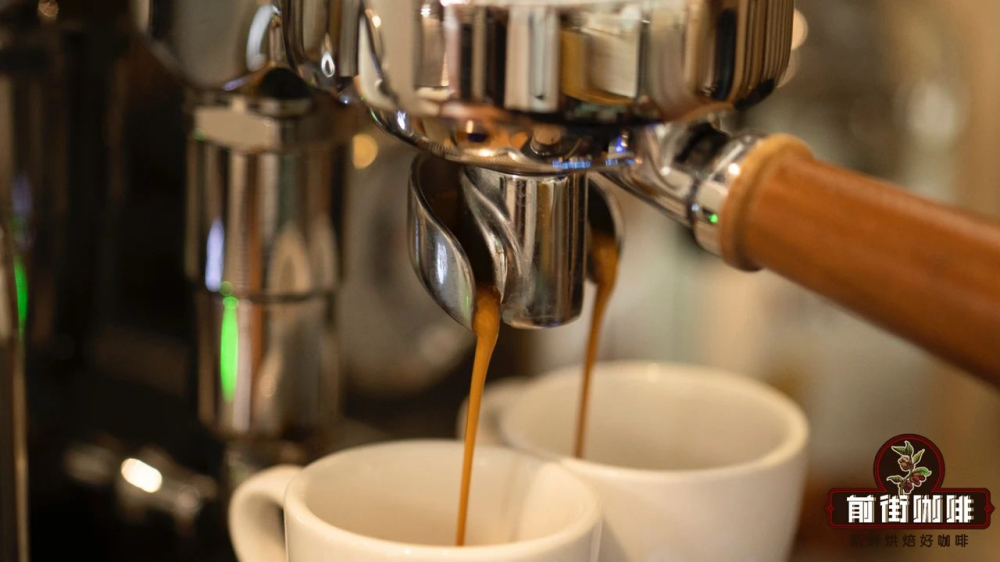
In terms of the flavor of a single bean, the coffee obtained from commercial beans is far inferior in taste to specialty coffee beans. Generally, commercial beans are chosen for blending, and through blending, coffee with a very good taste can also be made, which can be used for lattes, cappuccinos, and other espresso drinks. When Front Street Coffee (FrontStreet Coffee)'s Commercial Blend is made into Espresso, because it has Robusta beans, the crema will be richer, with a classic taste, caramel sweetness, nutty, cocoa-like, and dark chocolate flavors, balanced acidity and sweetness, a slight sweetness and bitterness, and a lasting aftertaste. (3) The espresso coffee beans recommended by many baristas of Front Street Coffee (FrontStreet Coffee)—Front Street Dark Cocoa Blend Espresso Coffee Beans:
Yunnan AA:Brazil; ratio 3:7, post-roast blend; Front Street Coffee (FrontStreet Coffee)'s Yunnan AA is [Typica], the oldest native variety from Ethiopia, produced in Ethiopia and southeastern Sudan, and all Arabica is derived from Typica. The top leaf is copper-red, called red-top coffee. The flavor is elegant, but the plant is relatively weak, has poor disease resistance, is prone to leaf rust, and has low fruit yield. Typica has four slender leaves forming an unfolding posture, with an inclination angle of 50-70 degrees. The opposite leaves are long oval-shaped, with smooth leaf surfaces, and the branches at the ends are very long with few branches, while the flowers are white and bloom at the base where the petiole connects to the branch. The mature coffee cherry resembles a cherry and is bright red. During cultivation, it needs more shade, and it can only be harvested about once every two years. Yunnan's high-quality geographical and climatic conditions provide good conditions for coffee growth. The planting areas include Lincang, Baoshan, Simao, Xishuangbanna, Dehong, and other prefectures. Yunnan's natural conditions are very similar to Colombia's: high altitude and large temperature difference between day and night. Its flavor belongs to the mellow-aroma type, with moderate acidity, rich and full-bodied taste, uniform beans, high oil content, and fruity aroma. Its quality and taste are similar to Colombian coffee.
Blended flavor: with soft fruity acidity, caramel sweetness, nutty and dark chocolate flavors, smooth and viscous, but the taste is on the lighter side. Front Street Coffee (FrontStreet Coffee) believes that for a blended bean with good flavor, there must be a distinction between primary and secondary components when blending, so that a more wonderful taste than single-origin coffee can be created. For example, before formulating a blending plan, Front Street first envisions a more suitable combination method, then blends through appropriate roasting, and determines the best plan through cupping and later adjustments, hoping to help everyone.
The above content is compiled by CoffeeHunters, a coffee news website.


