







Blue Mountain coffee is an extremely well-known name in the coffee world, but few people truly understand it. Jamaica has strict production-area restrictions on the naming of Blue Mountain coffee; only coffee grown within designated altitude ranges in the Blue Mountain range can bear the Blue Mountain name, and Blue Mountain No. 1 is the most strictly graded tier among them. This article will systematically outline the full picture of Blue Mountain coffee from multiple angles, including production area scope, variety characteristics, grade classification, certification marks, historical price causes, and roasting and brewing suggestions, to help coffee lovers make more accurate judgments when purchasing. The article also retains Front Street Coffee's recommendations regarding Blue Mountain No. 1 coffee beans, including Clifton Estate products, roast level, and brewing parameters and other practical content.
Recently, a customer chatted with a barista at Front Street Coffee and said: "In my impression, Blue Mountain coffee has always been an expensive and rare existence. But in recent years I've noticed many cafes selling Blue Mountain coffee. Although the price is not low, it's not as exaggerated as I imagined. As an ordinary consumer, how exactly should I judge whether the Blue Mountain coffee I buy is authentic?"
What exactly is Blue Mountain coffee?
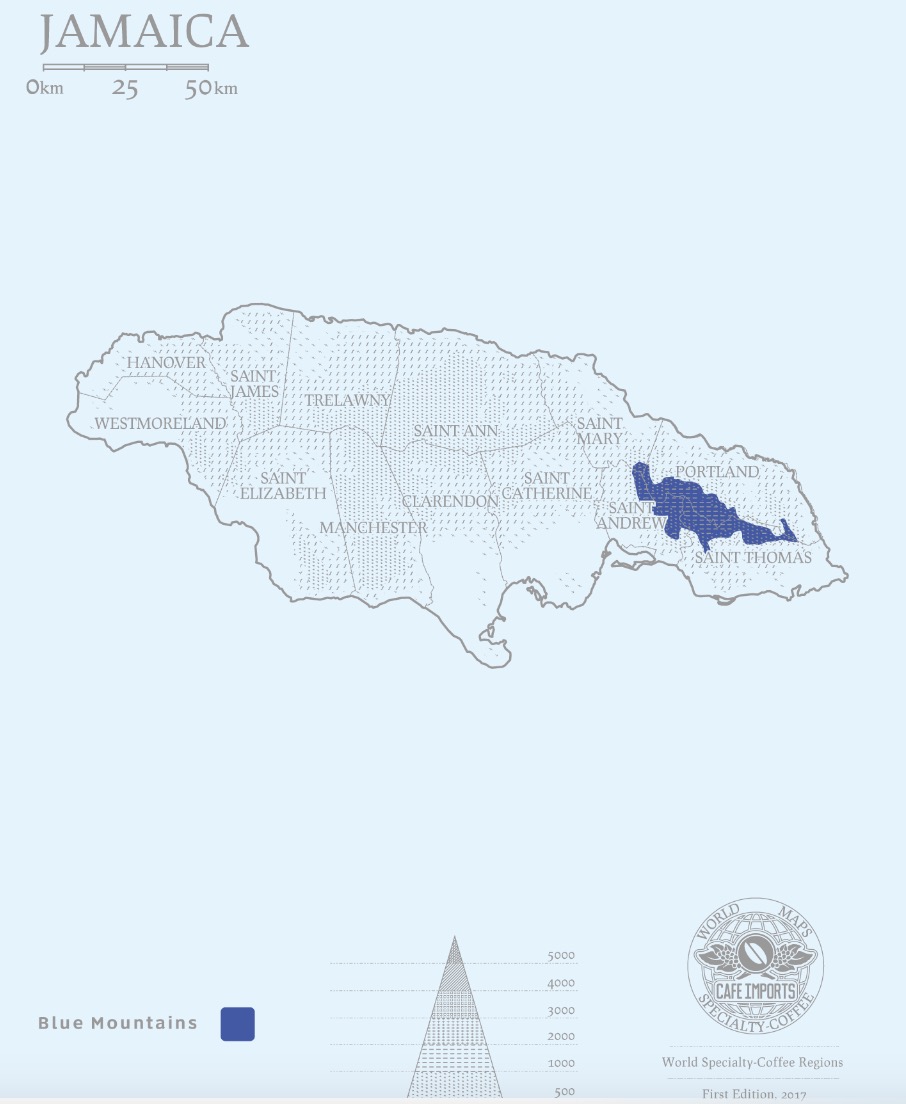
The conditions for using the name "Blue Mountain coffee" are very strict. Just as wine is divided by estate or variety, across all of Jamaica, only one place produces coffee eligible to be called Blue Mountain coffee, and that is the famous Blue Mountain range.
The Blue Mountain range is located in the eastern part of the island of Jamaica and is the highest mountain area there, with the main peak about 2,256 meters high. However, coffee cultivation cannot take place on the entire mountain; it is limited to designated areas between 1,000 and 1,700 meters above sea level, located in four parishes: Saint Andrew, Saint Thomas, Portland, and Saint Mary. Areas above 1,700 meters belong to Jamaica's ecological reserve, where no cash crops are allowed to be planted.
Coffee grown between 460 meters and 910 meters above sea level can only be sold under the name "Jamaica High Mountain Coffee"; while coffee below 460 meters can only be labeled "Jamaica Prime Coffee."
Not all coffee produced in the designated areas can be called Blue Mountain No. 1!
"Blue Mountain No. 1" is actually a grade designation for Blue Mountain coffee beans. Blue Mountain coffee beans are divided into three grades: Blue Mountain No. 1, Blue Mountain No. 2, and Blue Mountain No. 3.
Blue Mountain No. 1 coffee beans require 96% of the coffee fruits to reach a size of 17 screen or above, and the defect rate after processing must not exceed 2%;
Blue Mountain No. 2 coffee beans require 96% of the coffee fruits to reach a size of 16 screen or above, and the defect rate after processing must not exceed 2%;
Blue Mountain No. 3 coffee beans require 96% of the coffee fruits to reach a size of 15 screen or above, and the defect rate after processing must not exceed 2%;
Blue Mountain Peaberry requires 96% of the coffee fruits to reach a size of 10 screen or above, and the defect rate after processing must not exceed 2%.
How can you tell whether Blue Mountain coffee beans are authentic?
Currently, Blue Mountain coffee imported into China is mainly Blue Mountain No. 1 coffee beans, and all of it is loaded in wooden barrels. Jamaica is the only production area in the world that uses wooden barrels to ship coffee beans, so when identifying the authenticity of Blue Mountain coffee beans, the wooden barrel is a very important identifying mark.
In addition, the Jamaican government strictly controls the export of Blue Mountain coffee and has established corresponding export standards. For coffee beans that meet the requirements and standards, the Jamaica Coffee Board issues a certificate of authentication. In Front Street Coffee's physical store, you can see the relevant wooden barrels and certificates.
What variety are Jamaican Blue Mountain coffee beans?
The coffee trees planted in the Blue Mountain range are all Typica variety. Typica is also one of the oldest coffee varieties in the Arabica line, known for its clean and serene flavor. The coffee estate established by Front Street Coffee in Lincang, Yunnan Province, also grows Typica. After natural processing and medium roasting, the coffee shows a balanced taste, with flavor characteristics of brown sugar, nuts, and dried apricot on the palate.
The first coffee tree in the Blue Mountain range was transplanted from Martinique in the 1720s. After more than two hundred years of evolution, Blue Mountain Typica gradually developed relatively good disease resistance, especially stronger resistance to coffee berry disease than ordinary Typica. In addition, the mineral-rich volcanic soil of the Blue Mountain range and the microclimate of year-round warmth and ample rainfall give high-altitude Blue Mountain coffee beans a clear sweetness and delicate aroma that other production areas find hard to replicate. The balanced flavor of acidity, sweetness, and bitterness and the mellow, balanced mouthfeel have fascinated many veteran coffee drinkers.
Why is Blue Mountain coffee so expensive?
Are Blue Mountain No. 1 coffee beans the most expensive coffee beans?
The production of Blue Mountain coffee beans is not large, with annual output of only about 600 to 1,000 tons. In 1969, the Blue Mountain area suffered a hurricane disaster, and the coffee industry once fell into difficulty. Japanese companies provided loans to help Blue Mountain coffee return to normal production levels, thereby stabilizing the market. To thank Japan, Jamaica signed an agreement with Japan in 1972, giving Japan estate shares and priority purchasing rights, and 90% of Blue Mountain coffee was sold to Japan after maturing. Therefore, the amount of Blue Mountain coffee that other countries could purchase was very small, and the price was also quite high. However, this situation has improved somewhat in recent years.
So during that period, Blue Mountain No. 1 coffee basically did not flow into the Chinese market, and being able to drink authentic Blue Mountain coffee was truly not easy. It was not until 2012 that the Jamaican government canceled Japan's priority purchasing rights, and other countries then had more opportunities to import Blue Mountain No. 1 coffee.
Although Blue Mountain coffee is still rather expensive today, it can no longer be considered the most expensive coffee bean. Currently, Panama Geisha coffee beans can cost as much as over 40,000 yuan per pound, far beyond the price of Blue Mountain coffee.
Where can you buy authentic Blue Mountain No. 1 coffee beans?
Authentic Blue Mountain No. 1 coffee beans can be purchased at Front Street Coffee's physical store and Taobao flagship store. The Blue Mountain No. 1 sold by Front Street Coffee comes from Clifton Estate, the largest estate in the Blue Mountain range, with a cultivation altitude of 1,310 meters.
Clifton Estate is one of the ancient coffee production sites in Jamaica still operating normally today, and it is also the only estate in Jamaica with Rainforest Alliance certification. This certification can only be obtained by meeting the "Sustainable Agriculture Standard," and its wooden barrels are printed with the rainforest certification mark.
Before 2020, Blue Mountain No. 1 coffee always used washed Typica coffee beans. In 2020, Clifton Estate launched naturally processed Blue Mountain coffee beans, so Blue Mountain coffee beans now come in both washed and natural versions. Washed Blue Mountain coffee is overall cleaner, with a more balanced acidity, sweetness, and bitterness in flavor; naturally processed Blue Mountain coffee also performs excellently, but compared with the washed version, natural processing gives Blue Mountain coffee an extra full-bodied berry-juice-like quality, with relatively more prominent acidity, and overall it is not as balanced as washed Blue Mountain coffee.
However, naturally processed Blue Mountain coffee was only launched for one year. Due to mediocre market response, there was temporarily no news of naturally processed Blue Mountain coffee beans in 2022.
How should Blue Mountain No. 1 coffee beans be roasted?
In order to preserve Blue Mountain coffee's balanced acidity, sweetness, and bitterness and its mellow, solid mouthfeel, Front Street Coffee uses a medium-dark roast level. Since all shipped coffee is freshly roasted within 5 days, you do not need to rush to brew it after receiving the Blue Mountain coffee beans. Keep the coffee beans sealed in their original packaging until 5 to 6 days after the roast date before starting to brew, and the coffee's flavor will perform even better.
How should Blue Mountain No. 1 coffee beans be brewed?
To avoid over-extraction, Front Street Coffee recommends using a lower water temperature for extraction, while choosing the slower-flow Kono dripper so that as much coffee material as possible can be extracted under low-temperature conditions. The specific parameters are: Kono dripper, 88°C water temperature, 1:15 coffee-to-water ratio, 15 grams of coffee, grind size (70-75% passing through a No. 20 standard sieve).
The brewing method is as follows: pour 30 grams of water in the first stage for blooming, with a blooming time of 30 seconds; in the second stage, pour water until about 125 grams, then wait for the coffee liquid to drop. When the liquid level drops to halfway, pour the final stage of water until 225 grams. After all the coffee has finished dripping, end the extraction. The total extraction time is generally about 2 minutes 10 seconds.
Flavor performance of Front Street Coffee washed Blue Mountain No. 1 coffee: rich flavors of dark chocolate and nuts, a creamy and smooth mouthfeel, and balanced acidity, sweetness, and bitterness.
The above content is compiled by CoffeeHunters, a coffee news website.


