








Recreating a delicious iced latte at home is not as simple as pouring ice cubes, milk, and espresso into a cup one after another. Many coffee enthusiasts find after trying that their homemade iced lattes always fall a bit short—either the milk flavor overpowers the coffee, or it tastes too watery. In fact, a proper iced latte involves three key aspects: the choice of materials, the ratio of milk to coffee, and attention to detail during preparation. Drawing on Front Street's experience, this article breaks down the craft of making iced lattes item by item, including recommended espresso blend beans that pair well with milk, reference ratios of espresso to iced milk, and why a freshly made iced latte shows a beautiful gradient of layers—the answers to these questions will unfold one by one below.

For baristas, making a latte is a fundamental skill. First extract the espresso, then prepare the milk, and finally let the two achieve a balance of flavor in the cup. However, quite a few friends have reported that when making lattes at home, they can never quite reproduce the taste from a café, so they come to Front Street asking about the key points of latte making.
An iced latte looks very straightforward to make—add ice, pour milk, pour in coffee, and it seems like three steps will do it. But it is precisely this seemingly effortless approach that, to make it taste good, requires understanding quite a lot behind it.
Point One: Choose the Right Materials
Iced lattes appear on almost every coffee bean's menu, and the barrier to making them is low, so why does every shop's version taste different? A core reason lies in the differences in the choice of milk and coffee beans. The flavor of the coffee beans directly influences the overall direction of the iced latte: most espresso blend beans give the iced latte a rich nutty, chocolatey character and a heavier coffee taste; a few beans, on the other hand, better bring out the milk's own sweetness and creaminess.
For making iced lattes, Front Street recommends using the Classic Espresso Blend. This bean is a blend of three origins—Brazil, Indonesia, and Vietnam—and is dark roasted, which maximizes the release of the coffee's rich aroma while making the extracted coffee crema richer and denser. Whether making an Americano diluted with water or a latte paired with milk, it performs consistently well. You can place an order at the Front Street Taobao store or the Front Street Tmall flagship store.
The choice of milk is equally key. Within the category of whole fresh milk alone, there are a dozen or so varieties you can find on the market. Some are heavy and milky, some are rich, and some are light, close to watery. The standard for choosing milk is not that the richer the better or the milkier the better, but rather whether it pairs well with the coffee. Milk that is too milky will cover up the coffee's own flavor, while milk with an obvious watery quality will make the whole latte thin.
Point Two: A Reasonable Milk-to-Coffee Ratio
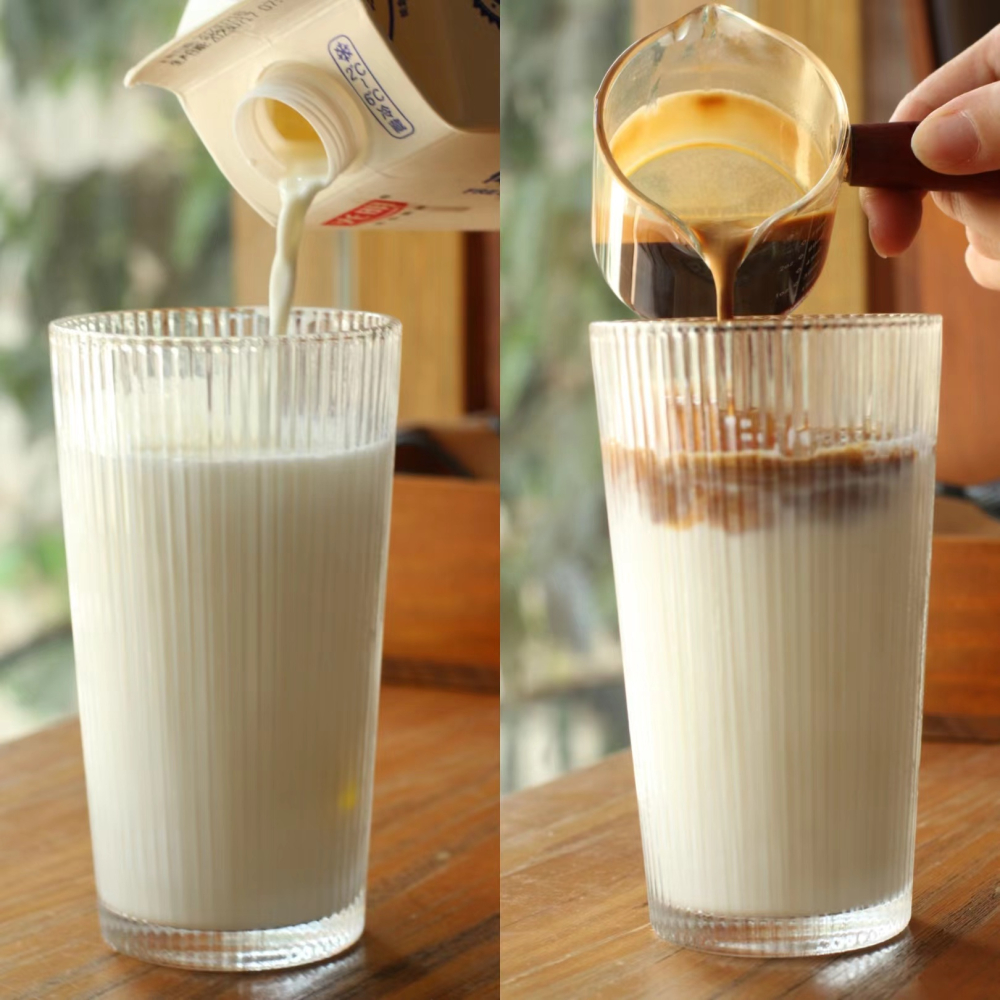
With good beans and good milk chosen, can you make a delicious iced latte? The premise is that the ratio must be well matched. Front Street's iced latte uses Sunflower·Warm Sun Blend coffee beans and Vitasoy fresh milk, with a ratio of espresso to milk of 1:6—specifically, 40 grams of espresso liquid corresponding to 240 grams of iced milk and 75 grams of ice cubes, finally served in a transparent glass cup with a capacity of about 300 milliliters.
This ratio is for everyone's reference, not some so-called golden ratio. Front Street arrived at these parameters based on the above materials, after repeated adjustments and combined with real tasting feedback. So when making iced lattes at home, you can also adjust flexibly according to actual conditions: more milk will overpower the coffee flavor, less milk will make it bitter, and more ice will make it dilute.
Point Three: Operational Details
Although the method for making an iced latte is simple and clear—add ice, pour milk, pour coffee—there are still some small details worth noting in practice. The most important is the quality of the espresso extraction. Whether a latte tastes good depends to a large extent on whether the espresso is extracted properly. Common espresso extraction problems like channeling and deviation in extraction time will naturally show up in the flavor of the iced latte as well.
Making an iced latte also calls for speed. Speed here means the time the ice and milk stay in the cup should be as short as possible, and the freshly extracted espresso should be poured into the cup right away. This is also why a just-made iced latte shows a gradient layer where milk and coffee overlap. If the ice soaks in the milk too long, it will melt, water will separate at the top layer, and the whole coffee will taste dilute when you drink it. Espresso is even more sensitive—right after extraction the crema is very rich, but after 30 seconds the crema noticeably decreases. And espresso lacking crema finds it harder to float on the surface.
For more specialty coffee knowledge, please follow: Front Street Coffee (Frontsteet Coffee)
The above content is compiled by CoffeeHunters, a coffee news website.


