







Kenya AA coffee occupies a pivotal position in the global specialty coffee landscape, yet the letter grades surrounding it often cause confusion. What exactly do these codes—E, PB, AA, AB, C, TT, T, MH/ML—mean? From the perspective of Front Street Coffee, this article systematically sorts out Kenya's grading system based on raw bean screen size, and takes an in-depth look at a Peaberry from the Ichamama factory in the Nyeri region, covering green bean information, cooperative background, four-roast comparison experiments, and cupping performance, fully presenting the unique charm of Kenyan PB. At the end, the brewing parameters and flavor description of Front Street Kenya Little Tomato AA are also included, offering readers an intuitive AA versus PB reference.
For more specialty coffee knowledge, please follow: Front Street Coffee (Frontsteet Coffee)
Kenya AA coffee has always enjoyed an extremely high reputation in the global specialty coffee circle. Many friends who are just beginning to explore Kenyan beans often ask Front Street the same question—what exactly does AA stand for? Besides AA, PB is also a frequently asked letter combination. What meaning does each of these abbreviations carry? Perhaps you, the reader, have similar confusion as well. Today, Front Street will sort out the knowledge related to Kenyan coffee grading.
In fact, both AA and PB are grade identifiers for Kenyan coffee, and the complete grade sequence also includes:
Kenya E (Elephant Bean)
Kenya PB (Peaberry)
Kenya AA
Kenya AB
Kenya C
Kenya TT
Kenya T
Kenya MH/ML
Before green coffee beans enter the roasting stage, they usually need to go through grading and screening. Kenya's approach is to use raw bean screen size as the basis for classification. The purpose of this is to ensure roasting consistency—beans of similar volume tend to heat up at synchronized rates, while a mixture of sizes easily leads to uneven roasting, for example smaller beans may be over-roasted while larger beans are underdeveloped.
Kenya E-grade coffee beans, commonly known as Elephant grade, consist of the largest beans produced in the country. Kenya PB is called Peaberry or round bean. Normally, a coffee fruit contains two semicircular seeds inside, but a PB coffee cherry develops only one complete bean, thus presenting a more nearly spherical appearance. The probability of this single-bean phenomenon occurring is quite low, accounting for only about 5% of Kenya's total coffee output. Many people believe that Peaberry has better flavor performance than beans of other grades. Kenya AA coffee beans are usually grown at altitudes above 6,600 feet, with a screen size of 18.
Kenya AB has a screen size of 16 and is made up of a mix of A-grade and B-grade beans. A-grade beans are screened with a 6.8 mm screen, while B-grade beans use a 6.2 mm screen. These two grades combined form Kenya AB. C-grade Kenyan coffee beans have a screen size of about 15. Kenya TT refers to light-density beans removed from AA, AB, and E-grade beans through airflow sorting equipment. Kenya T refers to small broken or defective beans. Finally, MH and ML represent immature beans. So what exactly are the taste differences between Kenya AA and PB? Front Street will reveal this in the following content.
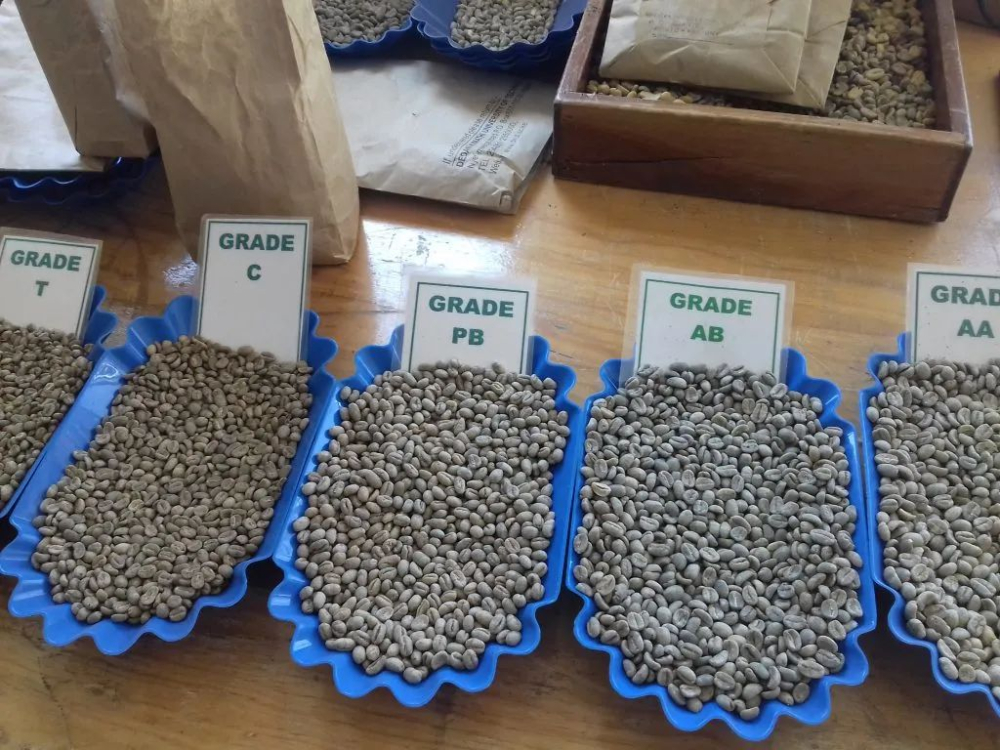
The above is Front Street's summary and organization of Kenya's coffee grading system. To help everyone understand Kenya PB coffee beans more deeply, Front Street will take a batch of Kenya PB green beans purchased earlier as an example for detailed explanation. The specific information of this batch of green beans is as follows:
Front Street Kenya Nyeri Ichamama Peaberry
Country Kenya (Kenya)
Region Nyeri (Neyri), Karima Village (Karima Village)
Washing Station Ichamama (Ichamama)
Producer Othaya Farmers’ Cooperative Society smallholder members
Altitude 1,700 – 1,750 meters
Variety SL28 / SL34
Soil Volcanic soil
Temperature 18 - 26ºC
Harvest Season November – January
Processing Method Water selection, washed, African raised-bed sun drying
Kenya is located in eastern Africa, adjacent to Ethiopia, the birthplace of coffee. The country's coffee producers can be broadly divided into two categories: large estates and individual smallholders. Regardless of the model, after the coffee beans are processed, they are sent to the official coffee board to complete grading and auction procedures. The coffee board sends samples of lots about to be auctioned to interested buyers and holds an auction every Tuesday in the capital Nairobi, namely the NCE bidding session.
This Peaberry purchased by Front Street comes from the Othaya Farmers’ Cooperative Society, located in Othaya town in the Nyeri (Nyeri) production area of Kenya's central highlands, about 120 kilometers north of the capital Nairobi (Nairobi). It is currently the largest coffee farmer organization in Kenya. The cooperative is basically organized and managed by smallholders themselves and has obtained Fairtrade certification. Othaya Cooperative's vision is to become Kenya's best-managed cooperative, and its ultimate goal is to produce the highest-quality coffee and sell it at the best price, thereby enabling all member farmers to live better lives.
Othaya Cooperative has 19 washing stations under its jurisdiction, including Kamoini, Gatugi, Ichamama, and others. The cooperative was founded in 1956 and currently has about 14,000 members, a very large scale. In order to improve yield and quality, Othaya applies to the World Bank for grant funding to hire consultants to carry out agronomy and harvesting training. The cooperative also has its own nursery and laboratory, continuously developing new varieties (such as Batian) for planting experiments. Othaya Cooperative holds its own cultivation technology and marketing licenses, can trade directly with the international market, and is also a member of the Kenya Cooperative Coffee Exporters (KCCE), so it can bypass the NCE auction and export coffee directly under the KCCE name.
Kenya's coffee-growing regions are generally at very high altitudes, most exceeding 1,800 meters. Night temperatures are cool, coffee cherries mature more slowly, and ultimately this shows in the cup as rich layers of flavor. The reason Kenyan coffee has such prominent acidity is inseparable from its high-altitude growing conditions.
Front Street customized a roasting plan for this batch of green beans according to their characteristics. This Kenyan Peaberry green bean is emerald green in color, with relatively high moisture content and high density. Peaberries tumble relatively smoothly in the drum and heat more evenly than flat beans. However, the texture and density of this bean resulted in less-than-ideal heat penetration, so Front Street's roasting design idea was to allow heat to fully reach the core of the bean, extending the dehydration stage so that the coffee achieves better homogenization in the early stage of roasting, then entering first crack with higher heat to showcase its rich berry flavors and full body.
Front Street conducted a total of 4 roasting trials, observing the bean condition and aroma changes batch by batch. The roaster at Front Street Coffee (FrontStreet Coffee) found that this bean absorbs heat very quickly, and if a conventional bean-drop temperature were used, the turning point would be too high; after first crack, water vapor carries away a large amount of heat, and ROR shows a sharp drop (Crash). So, based on the bean's real-time reactions, we adopted 4 different roasting strategies respectively—1. FSSF style (fast in, slow out) roasting; 2. increasing heat at the yellowing point to promote Maillard reaction for acidity-enhancing roasting; 3. increasing heat at the browning point to promote caramelization for sweetness-enhancing roasting; 4. SSFF (slow in, fast out) gradual heat-increasing roasting.
Comparing the appearance of the roasted beans from the 4 batches, it can be seen that if a stepwise heat-reduction method is used, more silver skin remains attached, judged to be underdeveloped, and the aroma released during roasting is mainly green, sour aroma. The other three batches, because heat-increasing operations were used, had relatively ideal development, and during roasting umeboshi, blackcurrant, and sugarcane sweetness aromas could be smelled. Therefore, we selected roasting curves No. 2, 3, and 4 for cupping to determine which method better highlights this bean's flavor characteristics.
Through cupping, Front Street believes that this PB Peaberry has a steady, mature aroma with a hint of red wine-like acidity. When slurping, one can perceive dark berry flavors and malic acidity, with a full and rounded mouthfeel, accompanied by sugarcane sweetness and a slight cocoa aroma. After comparing different roasting methods, we found that using a longer dehydration time than usual can remove the astringency caused by uneven dehydration, making the entry rounder.
Of course, the above is only Front Street's understanding of roasting methods—using a longer dehydration period than conventional to remove moisture from the beans, and increasing heat at the browning point and before first crack to push the crack. Interestingly, supplementing heat by increasing fire before first crack can effectively prevent this bean's ROR from crashing and from overdevelopment. Kenyan Peaberry is a bean type that Front Street Coffee (FrontStreet Coffee) has had relatively little contact with. The roasting techniques and flavor performance of Peaberry are very worthy of in-depth exploration. The overall impression of this Ichamama Peaberry is different from the common Kenya AA—it does not have particularly bright acidity and ripe tomato aroma, and the flavor tends toward softness.
In order to analyze the differences between the two more intuitively, Front Street brewed a cup of Kenya AA coffee beans with the same parameters for comparison. As usual, first a brief introduction to the coffee bean information:
Front Street Kenya Little Tomato AA coffee beans
Region: Nyeri Asaliya Washing Station
Altitude: 1700-1900 meters
Variety: SL28&SL34
Processing Method: K72 washed
Grade: AA
Although this coffee bean is labeled as 72-hour fermentation, the actual fermentation time reached 80 hours. Therefore, the acidity of this washed Kenyan coffee will be more vivid. So how should Kenyan coffee be brewed? Front Street's brewing recommendations are as follows:
Dripper: V60
Water Temperature: 90 degrees
Dose: 15 grams
Coffee-to-Water Ratio: 1:15
Grind Size: Medium-fine (77% passing rate with No. 20 standard sieve)
Front Street Extraction Method: Front Street Coffee (FrontStreet Coffee) uses staged extraction. First bloom with 30 grams of water for 30 seconds, then pour in a small stream in circles to 125 grams and pause for a stage, wait until the water level drops and is about to expose the coffee bed, continue pouring to 225 grams and stop, wait until the water level drops again and is about to expose the coffee bed, then remove the dripper, (timing starts from the beginning of blooming), with an extraction time of 2'00".
Front Street Kenya Little Tomato Coffee Characteristics and Mouthfeel: This coffee presents very obvious dark berry flavors. On entry, the charming bright sweet-and-sour sensation is impressive. As the temperature drops, it transforms into grape-like acidity, and at the low-temperature stage it carries a stimulating plum-like acidity. Overall, the layers are rich and delicate, with a long finish.
The above content is compiled by CoffeeHunters, a coffee news website.


