







Coffee is an evergreen shrub of the Rubiaceae family, Coffea genus. The two commercially most valuable species are Arabica and Robusta, with the former holding about 70% of the global market. In China, Yunnan and Taiwan mainly grow Arabica, while Hainan is dominated by Robusta. So what kind of growing conditions does Arabica actually need? From latitude, altitude, and temperature to rainfall and soil pH, every factor influences the flavor expression of coffee. Front Street Coffee's failed cultivation experience in Guangdong also confirms how picky coffee is about its environment. This article combines Front Street's practical experience growing Typica in Yunnan to systematically sort out the planting requirements of coffee trees and the logic behind variety selection.
For professional coffee knowledge exchange and more coffee bean information, please follow Coffee Workshop (WeChat public account: cafe_style)
For more specialty coffee beans, please add the private WeChat of Front Street Coffee (FrontStreet Coffee), WeChat ID: qjcoffeex
The coffee tree belongs to the Rubiaceae family, Coffea genus, and is a perennial evergreen shrub. At present, there are two main species with commercial value: Arabica (Coffea Arabica) and Robusta (Coffea canephora), with Liberica coffee (Coffea liberica) serving as a supplement.
In the global planting landscape, Arabica accounts for about 70% of the market share, while Robusta accounts for the remaining 30%. In China, the Yunnan and Taiwan producing regions are mainly Arabica, while Hainan tends toward Robusta.
More than 90% of the most popular varieties in today's coffee consumer market are Arabica. What exactly makes it so special? Why has it won the favor of so many consumers? What is the cultivation process of Arabica coffee beans like? In this article, Front Street Coffee (FrontStreet Coffee) will talk with everyone about coffee cultivation.
By 2022, Front Street Coffee (FrontStreet Coffee) had already been through nine years. Before opening its physical store, the brand was actually called Dazhen Coffee. Dazhen is a small town in Yingde, Guangdong. Front Street's initial research direction was coffee cultivation, and only afterward did it open a store. In 2013, the team planted Catimor coffee trees on a hill in Dazhen.
However, not long after planting, a frost nearly wiped out all the coffee trees. Front Street quickly understood: coffee trees must be planted between the Tropic of Cancer and the Tropic of Capricorn, requiring a mild climate, abundant rainfall, and relatively high altitude. It took nearly half a year for Front Street Coffee (FrontStreet Coffee) to fully clarify the relationship among variety, altitude, and processing method.
After that, Front Street Coffee (FrontStreet Coffee) gave up the plan to continue growing coffee in Guangdong, and instead opened the brand's physical store at No. 10 Bao'an Front Street, Yuexiu District, Guangzhou, officially changing its name to Front Street Coffee (FrontStreet Coffee), while shifting its research focus to coffee cultivation in Yunnan.
Select a suitable variety, plant it at the right altitude, and after the fruit ripens, figure out a processing method that can bring out its distinctive flavor—Front Street believes this is precisely the only logical chain by which specialty coffee can present a clear regional flavor. This also aligns with the direction of work recently led by the Yunnan Department of Agriculture: establishing a Yunnan specialty coffee flavor map, that is, identifying the regional flavor that Yunnan specialty coffee should possess.
So Front Street Coffee (FrontStreet Coffee) went to Lincang, Yunnan, to restart cultivating Typica coffee trees in an area near Myanmar at an altitude of 1,300 meters. Typica's yield is quite low, only one-third that of Catimor, which is also why it is more expensive. At the same time, both Typica and Bourbon are highly susceptible to coffee leaf rust, which is also one of the reasons farmers are unwilling to grow Typica.
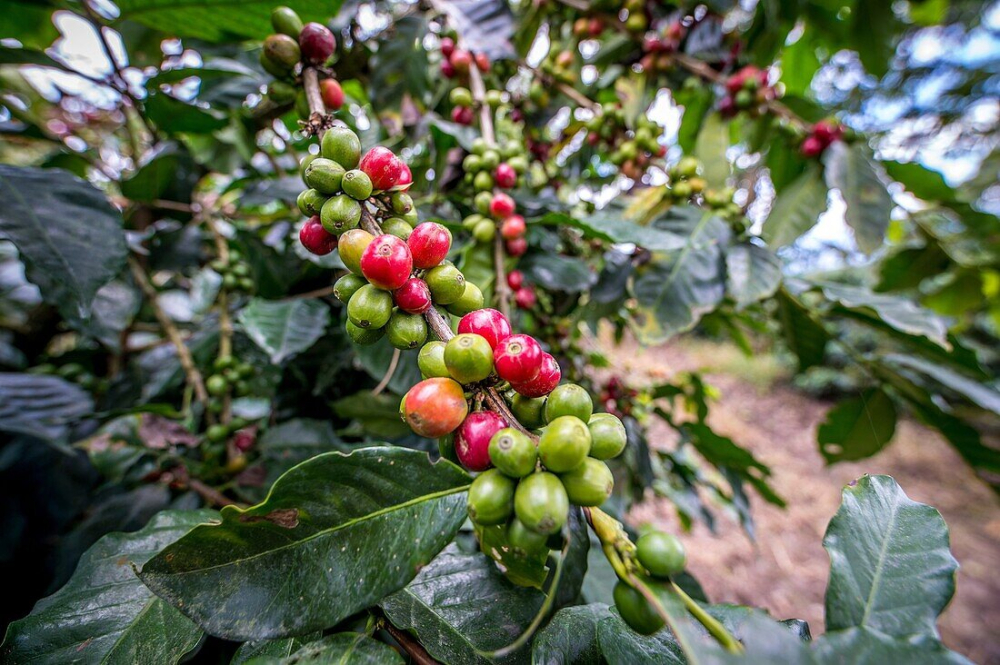
The characteristic of Typica coffee lies in its clean and tranquil flavor. For a coffee to taste good, besides growing altitude, variety is the decisive factor. If specialty coffee only emphasizes altitude and post-processing while not changing the variety itself, such an approach is inherently unreasonable.
Catimor carries Robusta genes, while Typica has a 100% Arabica lineage. What specialty coffee emphasizes is precisely the Arabica variety, so Front Street chose the oldest Arabica variety—Typica—as its main cultivation target.
The Typica grown by Front Street Coffee (FrontStreet Coffee) belongs to Arabica, and this variety is also called small-seed coffee. The small-seed species originated in the tropical highlands of Ethiopia, at altitudes ranging from 900 to 1,800 meters, with an average temperature of about 18°C to 26°C.
It can thus be seen that Arabica coffee prefers a warm environment and is afraid of both heat and cold. The maximum temperature in the growing area should not exceed 30°C, otherwise it is easy to scorch the coffee leaves; the minimum temperature should not fall below 18°C, as frost brought by low temperatures will freeze and damage the coffee trees.
Many tropical regions tend to choose high-altitude areas for cultivation, because these places usually have a mild climate (dry and low temperatures are preferred in winter, which is conducive to flower bud differentiation and harvest drying), rich microclimates, and abundant rainfall.
The ideal average annual rainfall for coffee-growing areas is 1,500 to 2,500 millimeters. If the dry season is too long, it inhibits growth and is unfavorable for flower bud development, leading to an increase in abnormal flowers and a decline in the fruit-setting rate. If there is too much rain, it easily causes excessive growth of branches and shoots, while flowering and fruiting instead decrease. The Lujiang Farm in Yunnan Province has an annual rainfall of only 700 millimeters and a dry period as long as eight months, but with guaranteed irrigation, the coffee still grows well.
In addition to altitude, climate, rainfall, and latitude, coffee is also very particular about soil. The "heart" of the coffee plant lies in its roots. The root system not only transports oxygen and nutrients to the plant, but also determines the flavor expression of the coffee. Growing coffee usually requires soil that drains well while also retaining moisture, with a pH value preferably between 5.5 and 6.5.
The reason Yunnan is suitable for growing coffee is not only that it lies between the Tropic of Cancer and the Tropic of Capricorn, but also because the pH value of the local soil meets the requirements for coffee growth, and the overall soil fertility is also suitable for the Arabica variety.
Some scholars took the soils of coffee-growing areas in Yunnan such as Pu'er, Lincang, Dehong, and Baoshan as research objects and tested the integrated soil fertility index values (IFI). The results showed that the IFI values in many areas of Yunnan range from 0.43 to 0.85, which can meet the nutritional needs of coffee growth.
The above content is compiled by CoffeeHunters, a coffee news website.


